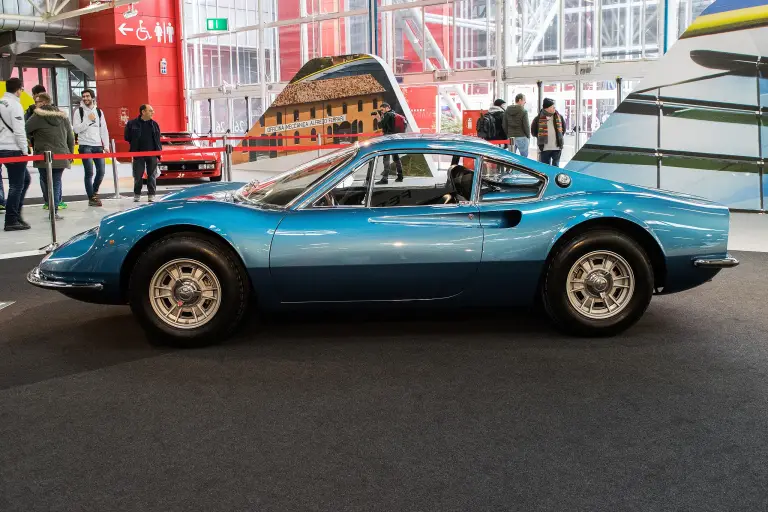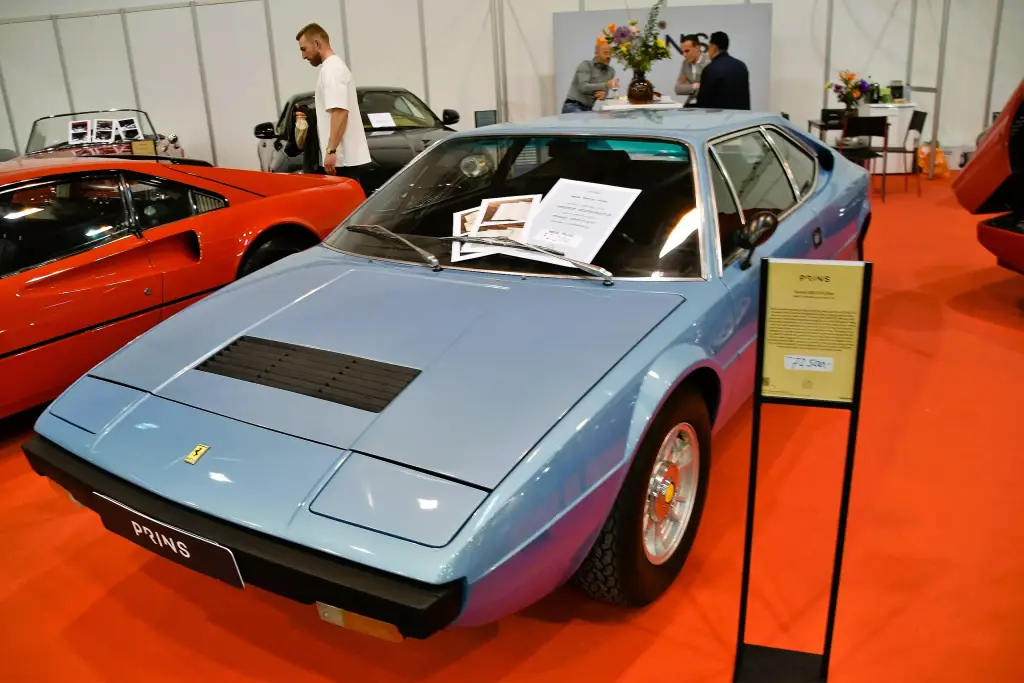
The Dino 308 GT4 was a mid-engined V8 2+2 built by Ferrari and sold under the Dino marque from 1973 until May 1976, when it received Ferrari badging. It was the first production Ferrari with the rear mid-engined V8 layout that would later form the bulk of the company’s business, and the only production Ferrari with bodywork by Bertone.
Dino 308 GT4 at a glance
| Maker | Ferrari, sold as Dino until May 1976 |
|---|---|
| Production | 1973–1980 |
| Design | Bertone, Marcello Gandini |
| Body | 2+2 coupé |
| Engine | 2.9 L V8 (308 GT4); 2.0 L V8 (208 GT4) |
| Power | 255 hp in Europe, 240 hp in the United States |
| Gearbox | five-speed transaxle |
| Wheelbase | 2,550 mm |
| Tyres | 205/70 VR14 Michelin XWX |
| Built | 2,826 (308 GT4); 840 (208 GT4) |
The English Wikipedia article also covers the later 208 GT4 and the Ferrari-badged cars; this page is based on that single source and describes the 308 GT4.
History of the Dino 308 GT4
Design by Bertone
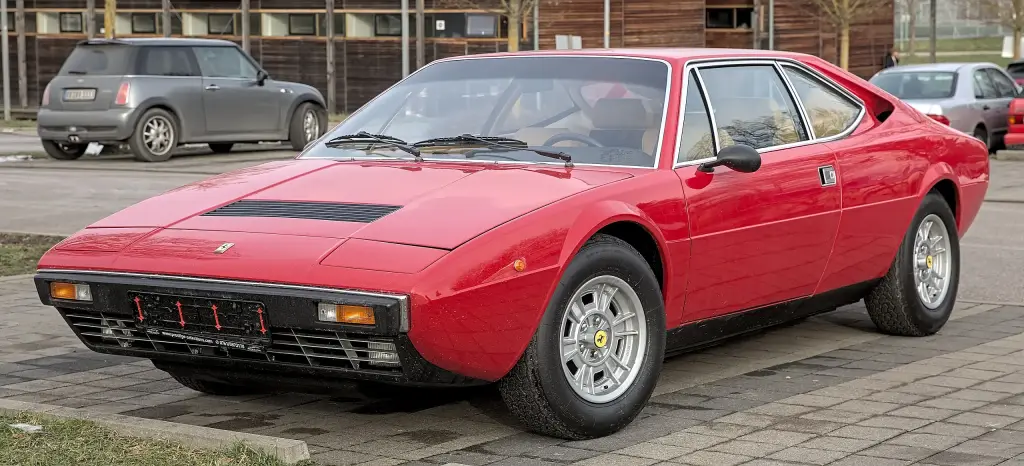
The GT4 is the only production Ferrari to feature bodywork designed by Bertone, though the Turin studio had created one-off designs for Ferrari in the past. Pininfarina was upset at the decision to give the design to its cross-town rival. The shape, with sharp angular surfaces, contrasted with the curvaceous two-seater Dino 246 GT and GTS and was controversial at the time: journalists compared it to the Bertone-designed Lancia Stratos and especially the Lamborghini Urraco, which shared both its designer, Marcello Gandini, and its mid-engined layout. Gandini was never again hired to design a Ferrari. Enzo Ferrari himself took a major role in the design, even having a mock-up made in which he could sit to test steering, pedal and seating positions.
Chassis and engine
The chassis was a tubular spaceframe based on the Dino 246, stretched to a 2,550 mm wheelbase to make room for the second row of seats. The suspension was fully independent on both axles, with double wishbones, anti-roll bars, coaxial telescopic shock absorbers and coil springs. The 2.9-litre (2,927 cc) V8 was mounted transversely and joined to a five-speed transaxle gearbox; an aluminium alloy block and heads, 16 valves, belt-driven dual overhead camshafts and four Weber 40 DCNF carburettors gave 255 hp in the European version and 240 hp in the American one. Cars rode on 205/70 VR14 Michelin XWX tyres, and the 208 GT4 used 195/70 R14 rubber.
308 GT4 (1973–1980)
The Dino 308 GT4 was introduced at the Paris Motor Show in October 1973 in Azzurro Metallizzato light blue metallic; chassis 07202 was the only example produced that year. The car went on sale as a 1974 model and gained the Prancing Horse badge in May 1976 on the bonnet, wheels, rear panel and steering wheel, while the Dino 308 GT4 logo remained on the boot lid. The change caused confusion for years, and during the energy crisis many prospective owners hesitated to buy such an expensive car without Ferrari badges. To improve sales before the 1976 rebadging, Ferrari issued factory update 265/1 on 1 July 1975 with technical and cosmetic revisions, which dealers applied in part or in full — so 1975 cars vary widely.
Two series were built. Earlier cars had a twin-distributor engine and fog lamps mounted in the front valance; Series 2 cars had a wider, shallower grille with the fog lamps behind it, and European versions changed to a single distributor while American and Australian cars kept twin distributors with two sets of points. European cars received Magneti Marelli electronic ignition from July 1978. Series 2 cars also had Cavallino Rampante badges on the nose, steering wheel and wheel centres. The GT4 was the only 2+2 Ferrari ever raced with factory support, and it was replaced by the Mondial 8 in 1980 after a production run of 2,826 308s and 840 208s.
208 GT4
Presented at the Geneva Motor Show in 1975, the 208 GT4 used a lower-displacement version of the V8 for the Italian market, where cars with engines larger than two litres were taxed far more heavily.
Design and features
- Bertone body: the only production Ferrari with bodywork from Bertone, drawn by Marcello Gandini with sharp, angular surfaces.
- Mid-mounted V8: a transverse 2.9-litre V8 with four twin-choke Weber carburettors, the first production Ferrari with the rear mid-engined V8 layout.
- Stretched spaceframe: a tubular chassis derived from the Dino 246 and lengthened to a 2,550 mm wheelbase for two extra seats.
- Four-wheel independent suspension: double wishbones, anti-roll bars, coil springs and coaxial telescopic dampers on both axles.
Dino 308 GT4 versions
- Dino 308 GT4 (1973–1976): sold with Dino badges on the bonnet, wheels, rear panel and steering wheel.
- Ferrari 308 GT4 (1976–1980): Prancing Horse badges from May 1976, with the Dino logo left on the boot lid.
- Series 2: wider grille with fog lamps behind it, Cavallino Rampante badges and, in Europe, a single distributor.
- US-specification cars: 240 hp and twin distributors retained after the European change.
- Dino 208 GT4 (1975–1980): 2.0-litre V8 for Italy, 840 built.
The GT4 succeeded the curvy Dino 206 GT and 246 GT and was replaced by the Mondial 8 in 1980. More cars are in the Dino collection.
Video: Vintage Behind the Wheel: 1975 Ferrari Dino 308 GT4
Video on YouTube.
Sources
- Ferrari GT4, English Wikipedia: design, chassis, engines, series, production