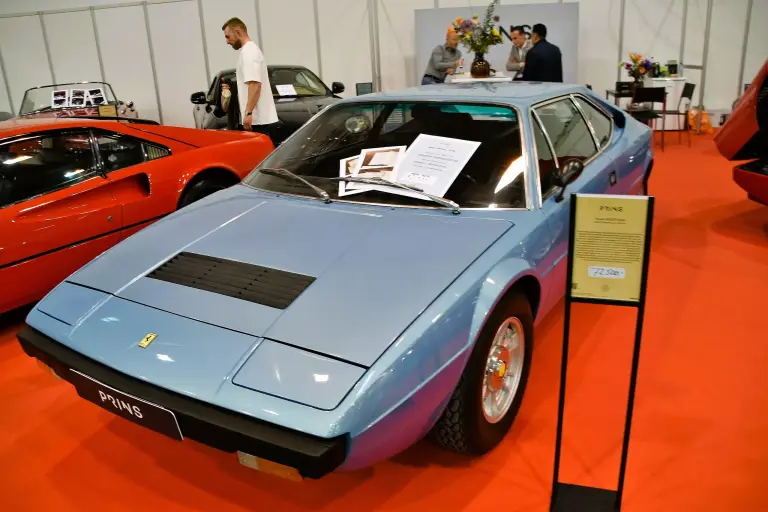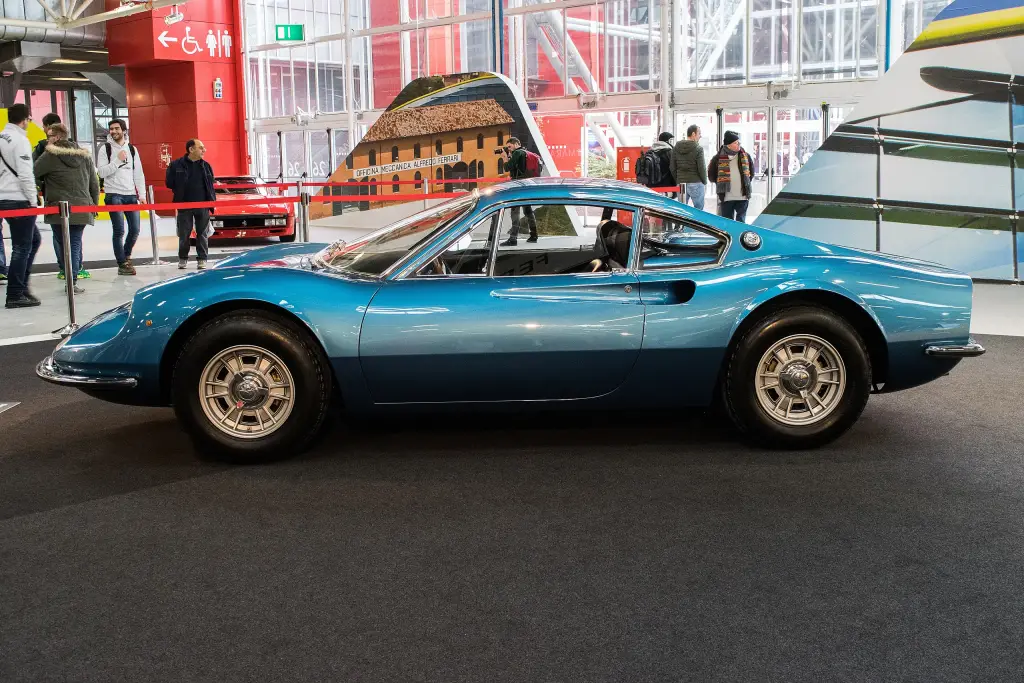
The Dino 206 GT, 246 GT and 246 GTS were V6 mid-engined sports cars produced by Ferrari and sold under the Dino marque between 1967 and 1974. The 206 GT of 1967 was the first of the line, with an all-aluminium 2.0-litre V6; the larger-engined 246 GT followed and, with the open GTS, became the first automobile Ferrari manufactured in high numbers.
Dino 206 GT / 246 GT at a glance
| Maker | Ferrari, sold under the Dino marque |
|---|---|
| Production | 206 GT 1967–1969; 246 GT and GTS 1969–1974 |
| Design | Pininfarina (Aldo Brovarone, Leonardo Fioravanti); built by Scaglietti |
| Engine | 2.0 L 65° V6 (206 GT); 2.4 L V6 (246 GT and GTS) |
| Power | 180 PS at 8,000 rpm (206 GT); 195 PS at 7,600 rpm (246 GT) |
| Layout | mid-engined, rear-wheel drive |
| Wheelbase | 2,290 mm (206 GT); 2,340 mm (246 GT) |
| Top speed | 235 km/h |
| Weight | 1,080 kg (246 GT); 1,100 kg (246 GTS) |
| Built | 152 (206 GT); 3,569 (246 GT and GTS) |
The 206 GT, 246 GT and 246 GTS share a single English Wikipedia article; this page is based on that one source.
History of the Dino 206 GT / 246 GT
Dino 206 GT (1967–1969)
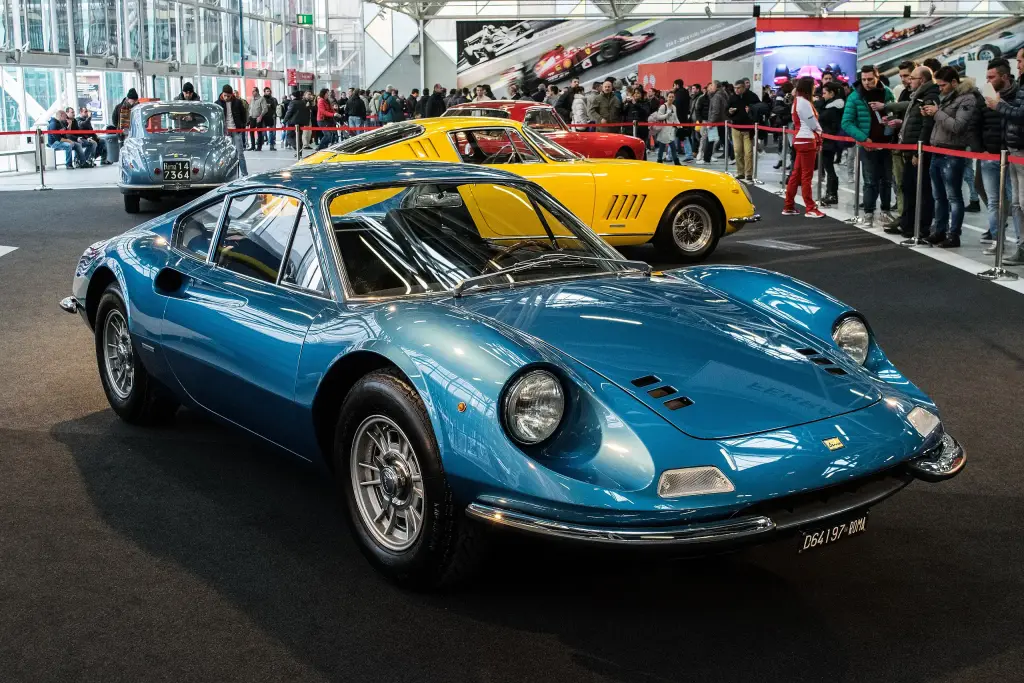
The production 206 GT was designed by Aldo Brovarone and Leonardo Fioravanti at Pininfarina and built by Scaglietti. It had the soft edges and curving lines typical of earlier Italian cars, unlike its angular successor, the 308 GT4. Its transverse-mounted 2.0-litre all-aluminium 65-degree V6 had dual overhead camshafts, a 9:1 compression ratio, four main bearings and three Weber 40 DCN/4 two-barrel carburettors, and made 180 PS at the 8,000 rpm redline with 187 N·m of torque at 6,500 rpm. The 206 GT was the first car sold by Ferrari with electronic ignition — the Dinoplex C capacitive discharge system developed by Magneti Marelli for the high-revving Dino V6 — and its first product with direct rack-and-pinion steering. The frame carried a light aluminium body, full independent suspension and all-round disc brakes on a 2,290 mm wheelbase, and the car was credited with 235 km/h. Only 152 were built between 1967 and 1969, all left-hand drive.
The 2.0-litre engine was the same unit used in the Fiat Dino Coupé and Spider of the period. Fiat took over production in Turin, and 150 engines were taken from the first production batch at the beginning of 1968 to power the 206 GTs; Fiat quoted 160 hp for its own cars while Ferrari claimed 180 hp for the 206 GT, although the engines were built on the same line.
Dino 246 GT and GTS (1969–1974)
Calls for more power were answered with the 2.4-litre (2,419 cc) version of the 65-degree V6, now with an iron block and alloy heads, 9.0:1 compression and 195 PS at 7,600 rpm with 226 N·m at 5,500 rpm. A detuned American version with an exhaust air pump and revised timing made 175 hp. The 246 was available as a fixed-roof GT coupé and, from 1971, as the open Spyder GTS. The body was now mostly steel to save cost, the wheelbase grew by 53 mm to 2,340 mm, and the interior was revised; the engine lid carried two rows of seven vents instead of six, and a fuel cap flap replaced the exposed filler of the 206.
Three series were built, differing in wheels, windscreen wiper coverage and engine ventilation. Series I cars, also known as the L series, used centre-bolt wheels and “clapping hands” wipers like the 206; 357 were built until the summer of 1970. Series II, the M series, brought five-bolt Cromodora alloy wheels and parallel-moving wipers, with 507 cars until July 1971. Series III, the E series, had minor changes to gearing and fuel supply and was built at a much higher rate as sales in the United States began: 1,431 GT coupés and 1,274 GTS cars, for a total of 2,295 coupés and 1,274 spyders.
On the road
The 246 was credited with the same 235 km/h as the 206, but a July 1971 road test by Britain’s Motor magazine recorded 238 km/h, against 219 km/h for the recently tested Porsche 911S. It reached 80 km/h in 5.5 seconds, narrowly beating the Porsche, though the Porsche was slightly more economical. At £5,485 in Britain the Dino was dearer than the £5,211 Porsche and well above the £4,700 Citroën SM. A Dino 246 GTS won the Cannonball Baker Sea-to-Shining-Sea Memorial Trophy Dash in 1975, and the 2.4-litre V6 also powered the Fiat Dino 2400 and the Lancia Stratos rally car. Sports Car International placed the car sixth among the top sports cars of the 1970s in 2004, and Motor Trend Classic put the 206/246 seventh in its list of the ten greatest Ferraris.
Design and features
- High-revving V6: a 65-degree V6 with dual overhead camshafts and three twin-choke Weber carburettors, mounted transversely behind the seats.
- Electronic ignition: the 206 GT was the first Ferrari with a Dinoplex C capacitive discharge system, and the 246 used a more compact Magneti Marelli AEC103A version.
- Rack-and-pinion steering: the 206 GT was the first Ferrari product with direct rack-and-pinion steering.
- Light construction: an aluminium body on the 206 GT, replaced by steel on the 246 to reduce cost, with fully independent suspension and disc brakes on both.
Dino 206 GT / 246 GT versions
- 206 GT (1967–1969): 2.0-litre all-aluminium V6, aluminium body, 152 cars, left-hand drive only.
- 246 GT (1969–1974): 2.4-litre V6 with an iron block, steel body and a 53 mm longer wheelbase.
- 246 GTS (1972–1974): the open Spyder, built in 1,274 examples.
- US-specification 246: detuned to 175 hp with an exhaust air pump and revised timing.
- Series I, II and III: L, M and E series differing in wheels, wipers and engine ventilation.
The Dino’s angular successor was the Dino 308 GT4, the first Ferrari with a mid-mounted V8. More cars are in the Dino collection.
Video: Dino 246 GT on the road
Video on YouTube.
Sources
- Dino 206 GT and 246 GT, English Wikipedia: design, engines, production, road tests