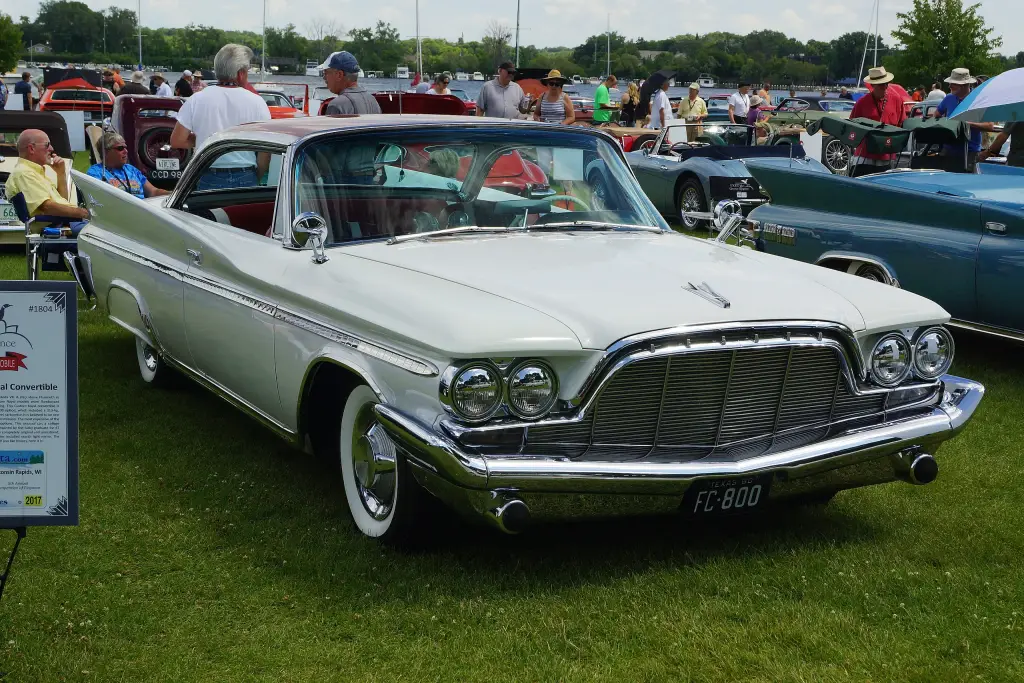
The DeSoto Adventurer was DeSoto’s special high-performance model, produced from 1956 through the 1960 model year. Introduced as a four-seat sports coupe concept, it ended up as DeSoto’s limited-production flagship, playing the same role in the division as the Chrysler 300 did further up the range.
DeSoto Adventurer at a glance
| Maker | DeSoto division, Chrysler Corporation |
|---|---|
| Production | 1956–1960 |
| 1956 engine | 341 cu in Hemi V8, dual exhaust |
| 1956 body | two-door hardtop only, white/black/gold |
| 1956 output | 996 cars |
| 1957 engine | 345 bhp, dual four-barrel carburettors |
| 1957 output | 1,950, including 300 convertibles |
| 1958 output | 432, a 78% fall |
| 1959 engine | 383 cu in wedge, 350 bhp at 5,000 rpm |
| 1959 output | 687 |
| 1960 output | 11,597, its best year |
| Wheelbase, 1956 | 126 in (3,200 mm) |
| Transmission | PowerFlite automatic |
History of the DeSoto Adventurer
1956: a special hardtop
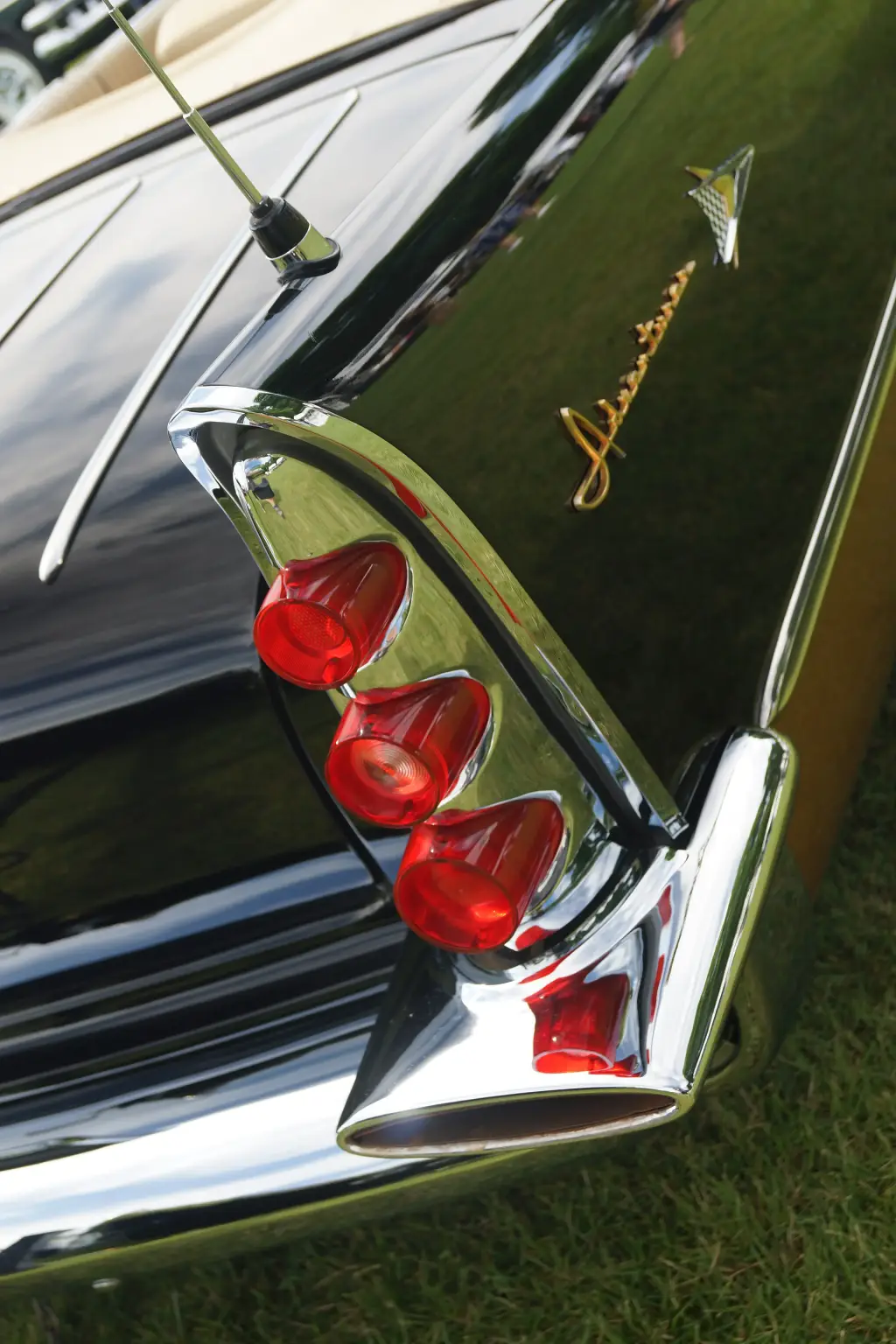
The Adventurer arrived in 1956 as a sub-series of the top-level Fireflite: a limited-production two-door hardtop sold only in a white, black and gold colour scheme. It used a high-output 341 cubic inch Hemi V8 with dual exhausts, a PowerFlite automatic, and a long list of standard equipment including dual outside mirrors, gold wheel covers, radio, electric clock, padded instrument panel, windscreen washers, full instrumentation, safety door locks and heavy-duty suspension. The 1956 car had a 126 in wheelbase and measured 220.9 in long, 78.9 in wide and 60.3 in tall. A total of 996 were sold in that first year.
1957: the Forward Look and a convertible
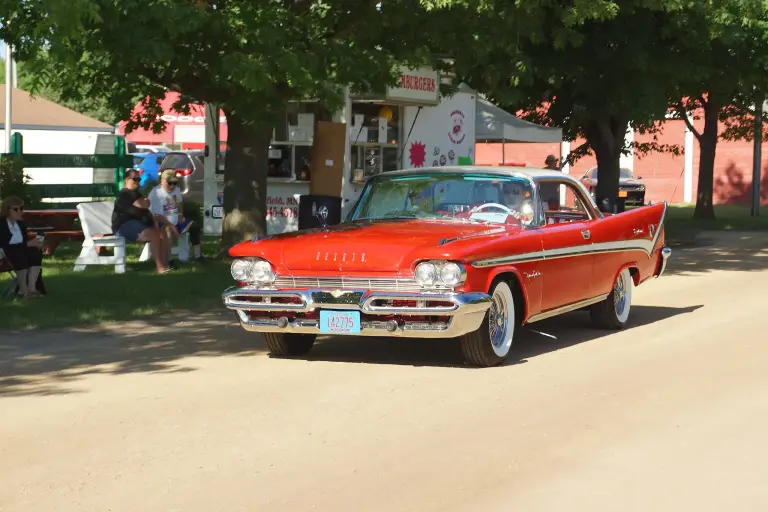
For 1957 the Adventurer took on Chrysler’s Forward Look styling, and a convertible joined the hardtop; colours were again limited to the black-and-white and gold theme. The hardtop was shown in December 1956 to strong reviews, among them Mechanix Illustrated editor Tom McCahill’s verdict that the DeSoto was the best-styled of all the 1957 Chrysler makes; the convertible followed in February 1957. Power came from a high-output V8 of 345 bhp with dual four-barrel carburettors, giving one horsepower per cubic inch, and most cars had dual headlamps. Production reached 1,950, including 300 convertibles.
1958: fuel injection and a short year
The 1958 car updated the styling with a mesh-insert grille and slightly revised dual headlamp openings, and was shown at the Chicago auto show in January 1958. The Hemi was gone, replaced by a 361 cubic inch wedge-head V8. DeSoto offered Bendix fuel injection, but it was troublesome and expensive and very few Adventurers were sold with it; cars without it had dual-quad carburettors. The shortened model year and the 1958 recession cut production to 432 — 350 hardtops and 82 convertibles, a 78 per cent drop that mirrored the fall across the whole DeSoto range.
1959–1960: top of the range
Restyled for 1959 and introduced in October 1958, the Adventurer took on more traits of the upmarket Chrysler, kept its limited colour schemes and came with the most standard features of any DeSoto, although the radio was now an option. A 383 wedge V8 gave 350 bhp at 5,000 rpm, swivel-out seats were new, and 687 were built — 590 hardtops and 97 convertibles. For its final year the Adventurer lost the convertible but gained a four-door hardtop and a sedan, and became the top trim of the two-series 1960 line rather than a limited edition. Ram induction returned on cars with the four-barrel carburettor, colours were no longer restricted, and standard equipment included dual-speed rear window defoggers, a driver’s seat back five inches taller, the Hiway Hifi unit that played RCA Victor 45 rpm records, and unit-body construction. Output reached 11,597, the line’s best year, just as Chrysler announced the end of DeSoto in November 1960.
Design and features
- Limited colour schemes: white, black and gold only in the early years.
- High-output V8s: from the 341 Hemi to the 350 bhp 383 wedge.
- Flagship equipment: full instrumentation, padded dash and heavy-duty suspension as standard in 1956.
- Low production: hand-built numbers until the 1960 range year.
- Film fame: a 1960 Adventurer hardtop is the regular car of the title characters in the Sam & Max games.
DeSoto Adventurer versions
- 1956 hardtop: the original limited edition, 996 built.
- 1957 convertible: added in February 1957, 300 built.
- 1958 fuel-injection cars: a handful with Bendix injection instead of dual quads.
- 1959 hardtop and convertible: restyled cars with swivel-out seats.
- 1960 four-door hardtop and sedan: the top trim of the two-series line, 11,597 built.
The Adventurer replaced the Custom as DeSoto’s flagship and topped the Fireflite range. More DeSotos are in the DeSoto collection.
Video: 134362 / 1957 DeSoto Adventurer
Video on YouTube.
Sources
- DeSoto Adventurer, English Wikipedia: year-by-year history, engines, production, equipment