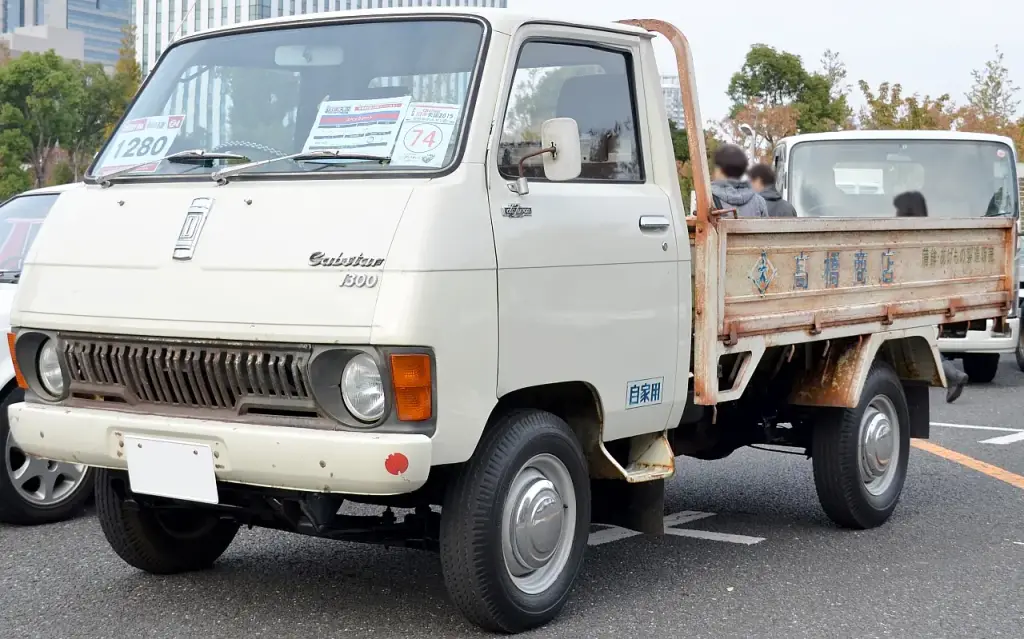
The Datsun Cabstar appeared in Japan in March 1968 as the replacement for the Datsun Cablight and the Nissan C80. It was a cab-over light truck, sold as a pickup, a glazed van or a small bus, and it shared its range with the Prince-designed Homer. The name survived into the 1980s on export versions of later Nissan trucks.
Datsun Cabstar at a glance
| Maker | Nissan (Datsun), Japan |
|---|---|
| First generation | March 1968 – 1976 (A320, A321, PA321) |
| Layout | cab-over engine, rear-wheel drive |
| Bodies | truck, glazed light van, route van (bus) |
| First engine | 1,189 cc D12, 56 PS (41 kW) |
| From August 1970 | 1.3 L J13, 67 PS (49 kW), code A321 |
| From May 1973 | new front clip; 1.5 L J15, 77 PS (57 kW) |
| Second generation | F20 from January 1976, sold as the Datsun Cabstar |
| Second-generation engines | 1.5 L J15, 2.0 L H20, 2.2 L SD22 diesel |
| Replaced by | Nissan Atlas F22, February 1982 |
History of the Datsun Cabstar
The first Cabstar, the A320, went on sale in Japan in March 1968 to replace the Datsun Cablight and the Nissan C80. It was a cab-over-engine design, with the cab sitting above the front axle, and it was sold either as a truck, as a glazed light van or as a route van — a small bus for fixed routes. In Japan it was exclusive to the dealerships known as Nissan Bluebird Store.
Under the cab sat the 1,189 cc Nissan D12 engine with 56 PS (41 kW). After modifications and the arrival of the 1.3-litre J13 of 67 PS in August 1970, the code changed to A321. A further facelift in May 1973 brought an entirely new front clip and made the 1,483 cc J15 with 77 PS (57 kW) standard, under the code PA321.
The Cabstar shared its range with the Homer, a truck developed by Prince and sold through a different Japanese dealer network. In January 1976 the Homer was replaced by the F20, which was also sold as the Nissan Datsun Cabstar in Japan and as the Datsun Cabstar abroad. That generation came with a 1.5-litre J15, a 2.0-litre H20 petrol engine or the 2.2-litre SD22 diesel, and in September 1979 it was revised to meet the new emission rules and took the code F21.
In February 1982 the lighter Nissan Atlas, the F22, replaced both the Homer and the Cabstar in Japan, and the nameplate was not used there again. It lived on in export markets, where the Atlas F22 was sold as the Nissan Cabstar and became a popular truck in Britain for its reliability and payload, competing with the Bedford CF and Ford Transit. Later versions of the name were attached to the Atlas and to other Nissan trucks in Europe, and in 2014 the range became the NT400.
Design and features
- Cab-over layout: a short truck with the cab above the engine.
- Three bodies: pickup, glazed van and route bus.
- Growing engines: from a 1.2-litre D12 to the 1.5-litre J15.
- Shared with the Homer: the same range sold through a second dealer network.
- Long-lived name: kept on export Atlas trucks after 1982.
Datsun Cabstar versions
- A320 (1968–1970): the original with the 1,189 cc D12.
- A321 (1970–1973): the 1.3-litre J13 version.
- PA321 (1973–1976): new front clip and the 1.5-litre J15.
- F20 and F21 (1976–1982): the second generation, shared with the Homer.
The Cabstar shared its range with the Datsun Homer and sat below the larger Datsun truck line. More models are in the Datsun collection.
Sources
- Nissan Cabstar, English Wikipedia: first and second generations, engines, markets
- Nissan Cabstar, German Wikipedia: model line and later names