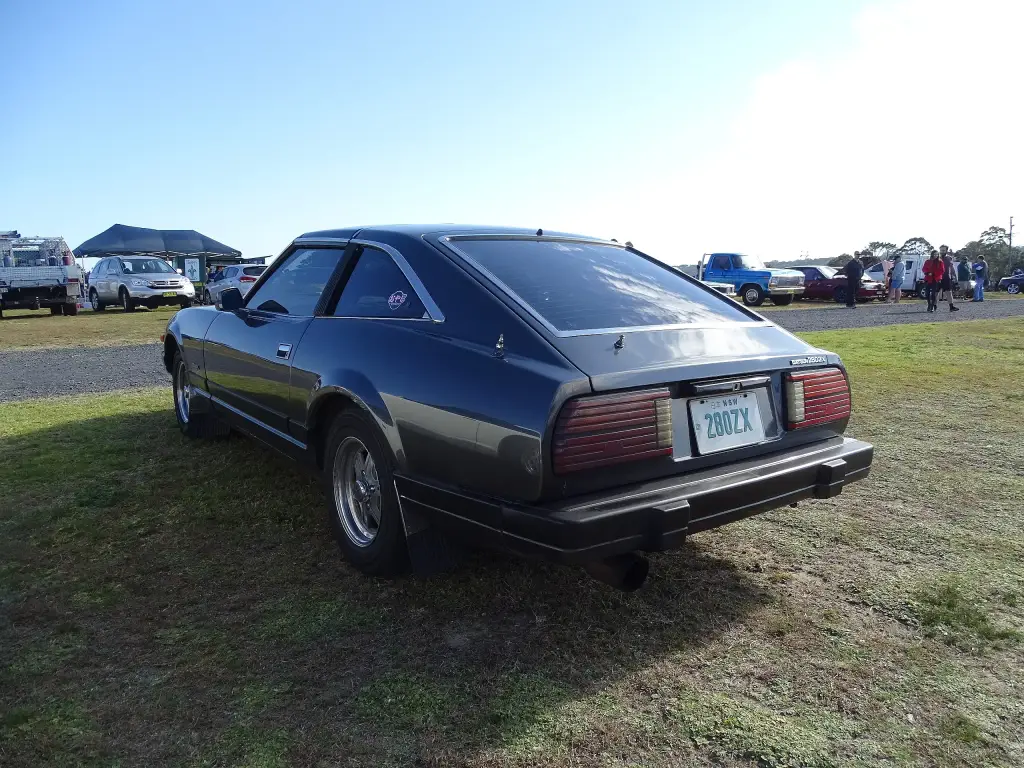
The Datsun 280ZX was the second generation of Nissan’s Z-car, built from 1978 to 1983 and sold as the Fairlady Z in Japan. It kept the L28 straight-six but was otherwise a complete redesign, softer and heavier than the 240Z and far more focused on comfort. Motor Trend named it Import Car of the Year for 1979.
Datsun 280ZX at a glance
| Maker | Nissan (Datsun), Japan |
|---|---|
| Production | 1978–1983 (S130) |
| Sold as | Datsun 280ZX, Fairlady Z, Fairlady 280Z |
| Bodies | two-seater and 2+2, coupé |
| Engine | 2.8 L L28 straight-six; 2.0 L L20 in Japan |
| Power, 1979 | 135 hp (101 kW) |
| Turbo | from 1981 |
| Wheelbase | 2,304 mm (two-seater), 2,319 mm |
| Drag coefficient | 0.385, down from 0.467 |
| Fuel tank | 80 litres |
| Award | Motor Trend Import Car of the Year 1979 |
| Replaced by | Nissan 300ZX, 1984 |
History of the Datsun 280ZX
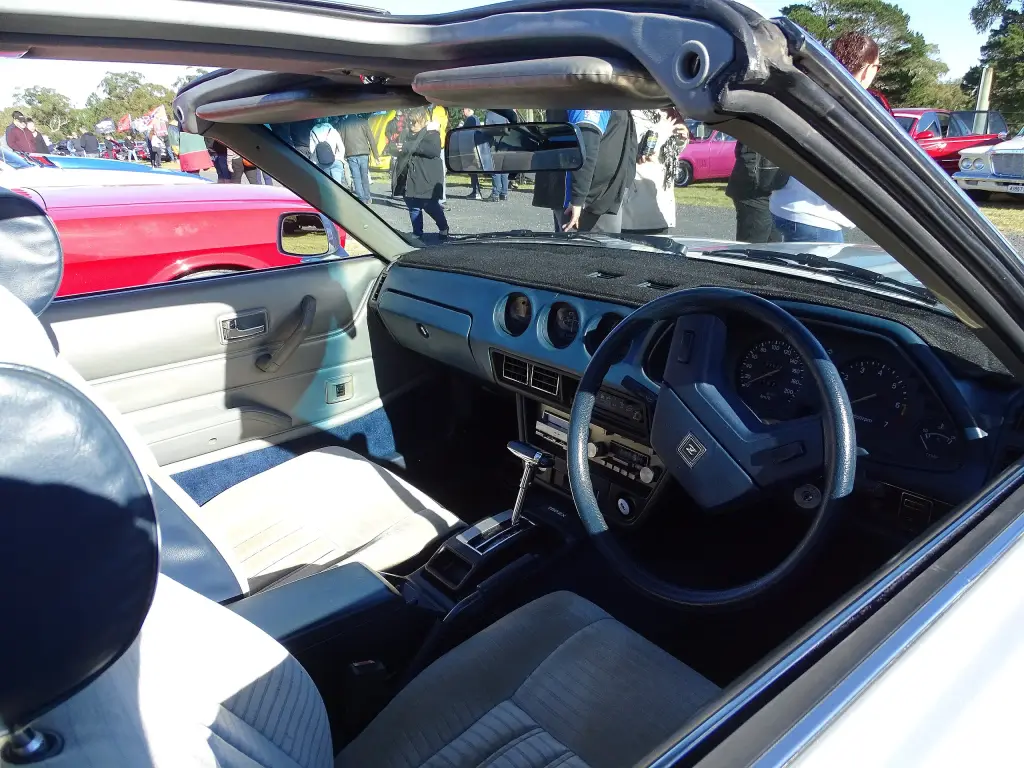
The 280ZX was a complete redesign that kept only the L28 engine and parts of the driveline from the 280Z. Where the first Z had been a sports car, the ZX was a grand tourer: softer suspension, better sound insulation, more comfortable seats and equipment that included high-end audio systems. Both two-seat and four-seat 2+2 bodies were offered, and many components, among them the rear axle and the power steering, came from the Datsun 810 luxury sedan.
Aerodynamics drove the shape. By closing the open grille of the first-generation car and refining the body in a wind tunnel, Nissan cut the drag coefficient from 0.467 to 0.385 and the lift coefficient from 0.41 to 0.14, while the centre of gravity fell and weight distribution came close to 50:50. The tail was stretched to take an 80-litre fuel tank. The suspension followed the contemporary Bluebird 910, with MacPherson struts in front and semi-trailing arms at the rear, and the two-seater’s wheelbase grew from 2,304 to 2,319 mm.
Early cars felt slower than the 240Z even though the engine was larger. Part of the difference was that Nissan had moved to the SAE net standard of measuring power, which gave lower figures than the old gross ratings, but the designers had also deliberately traded acceleration for fuel economy. The gap was closed in 1981 with the 280ZX Turbo, which also brought power-assisted rack-and-pinion steering in place of the recirculating-ball system; the naturally aspirated cars received it a year later.
In North America the 280ZX was sold under the Datsun name and, from 1979 to 1983, co-branded “Datsun by Nissan” as Nissan phased in its global brand. Two trim levels were offered, a plain two-seater and a fully equipped 2+2 GL, with the GL package also available on the two-seater. Leather seats were optional, a digital instrument cluster arrived in 1982, and the T-bar roof could be ordered with the GL. The 280ZX was replaced by the Nissan 300ZX in 1984.
Design and features
- Comfort over handling: softer springs, more sound insulation and better seats than the 240Z.
- Aerodynamic body: a drag coefficient of 0.385 and a lift coefficient of 0.14.
- Big tank: 80 litres, useful for a car meant for long journeys.
- Turbo from 1981: the first really quick ZX, with power rack-and-pinion steering.
- Grand Luxe trim: the plush GL package, also offered on the two-seater.
Datsun 280ZX versions
- 280ZX two-seater (1978–1983): the shorter-wheelbase car.
- 280ZX 2+2 GL: four seats and the full equipment list.
- 280ZX Turbo (1981–1983): the performance version.
- Fairlady 200Z: the Japanese model with the smaller 2.0-litre L20.
The 280ZX replaced the Datsun 240Z, 260Z and 280Z and borrowed parts from the Datsun 810. More models are in the Datsun collection.
Video: Datsun 280ZX talking to you from 1982
Video by Nick Barcenas on YouTube.
Sources
- Nissan Fairlady Z (S130), English Wikipedia: design, engineering, equipment, marketing
- Datsun 280ZX, German Wikipedia: model line and market names