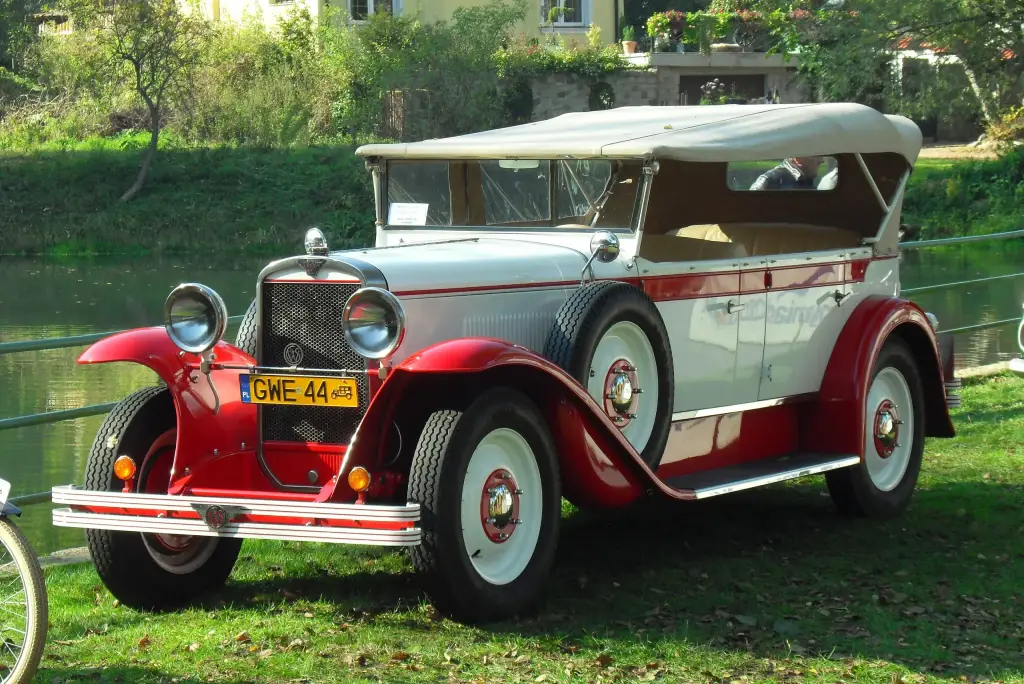
The CWS T-1 was the first serially built car made in Poland. It was designed by Tadeusz Tański at the Centralne Warsztaty Samochodowe (CWS) in Warsaw, with bodies drawn by Stanisław Panczakiewicz, and it remains famous for a simple idea: the whole car could be dismantled and assembled again with one spanner.
CWS T-1 at a glance
| Maker | Centralne Warsztaty Samochodowe (CWS), Warsaw |
|---|---|
| Production | 1927–1931 |
| Designer | Tadeusz Tański; bodies by Stanisław Panczakiewicz |
| Engine | four-cylinder OHV, liquid-cooled, 2,984 cm³ |
| Power | 61 PS (45 kW) at 3,200 rpm |
| Top speed | 105 km/h |
| Fuel consumption | 18 l/100 km |
| Clutch and gearbox | dry single-plate clutch, manual gearbox |
| Brakes | drums on all four wheels |
| Mass | 1,150–1,800 kg depending on body |
| Bodies | torpedo, kareta, berlina, cabriolet, pick-up, van |
| Built | about 800 (other estimates: no more than 400) |
History of the CWS T-1
Designed for Polish conditions
Tadeusz Tański began work on the car in 1922, and the project took shape over the next few years. In 1924 an engine was built and fitted to the chassis of an imported car; in 1925, under the engineer Władysław Mrajski, a prototype with its own chassis and body was completed. Testing followed the same year, and the design was ready for production. The car was built at the Centralne Warsztaty Samochodowe in Warsaw, which gave it its name, and every version shared the T-1 chassis, hence the T in the model designation.
Series production, 1927–1931
Serial production started in 1927. The offer covered open and closed passenger bodies as well as light commercial versions, and about 800 CWS T-1 cars and derivatives were made — roughly 500 passenger cars and 300 chassis with other bodies, although some sources put the total at no more than 400. The last batch of 60 finished cars left the factory in 1931. In 1930 the CWS works were absorbed by the state industrial group PZInż, but production continued under the old name. The end came with the licence agreement signed with Fiat on 21 September 1931: the Polski Fiat 508 was to be built at the former CWS works, and the contract required the production of competing models to stop.
In army service
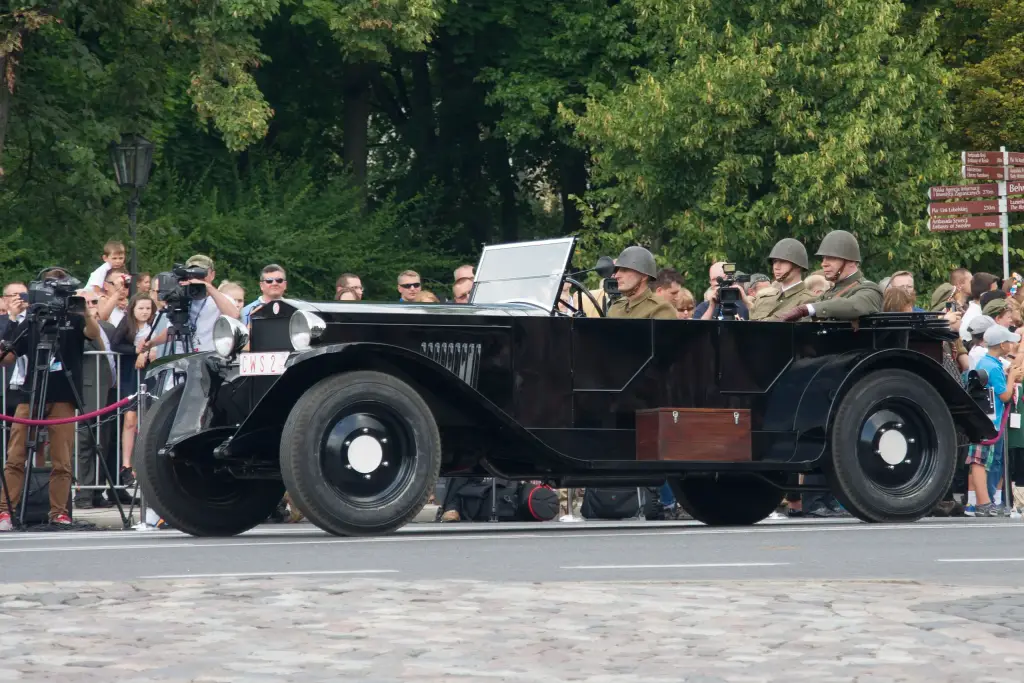
The CWS T-1 was also used by the Polish Army, which fitted it with extra equipment: a pennant rod on the front wing, a box for hand grenades and a rack for two rifles, a pneumatic horn beside the electric one, a shovel, a two-tonne jack, a 12 mm steel tow rope seven metres long and covers for the radiator, lamps and windscreen. In the first days of the September 1939 campaign the cars were evacuated towards Pińsk in Polesie; after the Red Army took the eastern borderlands they fell into Soviet hands near Kostopol. Many were destroyed in the fighting and the occupation, but a few survived the war and were still in use in the 1950s.
Design and features
- One spanner for the whole car: every screw and nut had the same thread, M10×1.5, and the same 17 mm head; only the spark plugs, with an M18 thread, needed a second tool. The timing gear and the gearbox were built from sets of identical gears.
- Simple engineering: a steel-and-wood longitudinal frame, leaf springs with friction dampers front and rear, a dry single-plate clutch and a gearbox locked with a Yale lock against theft.
- Modern engine for its day: a liquid-cooled four-cylinder with OHV valve gear, an aluminium-alloy block and cylinder head, and a crankshaft on three main bearings.
- Four-wheel drum brakes: large-diameter drums worked on all four wheels, at a time when many small cars still relied on brakes on two wheels only.
- Wood-and-steel bodies: coachwork was built in the traditional Polish way, which kept the cars easy to repair in workshops short of tools.
CWS T-1 versions
- Torpedo: open four-door passenger body.
- Kareta: closed four-door body with seven seats, also listed as a Pullman body.
- Berlina: closed two-door passenger body.
- Cabriolet: a “false cabriolet”, in fact a semi-convertible with a fixed frame.
- Pick-up and van: a two-door cab with an open load bed or a closed delivery body.
- Ambulance: a wood-and-steel medical body with two stretchers on the left and a bench for medical staff, shown at the Poznań national exhibition in 1929.
- Postal and PKO ambulances: mobile post offices and savings-bank vehicles built from 1930, with sorting tables or armoured cash lockers.
The T-1 was the best-known product of the Warsaw works; more vehicles from the maker are gathered in the CWS collection, and the later CWS motorcycle has its own article on the CWS M-111.
Video: CWS – Wejherowskie wskrzeszenie klasyka. Północny Bazar – odc. 2
Video on YouTube.
Sources
- CWS T-1, English Wikipedia: design, production, bodies, one-tool construction
- CWS T-1, Polish Wikipedia: history, production numbers, army equipment, special bodies
- CWS T-1, German Wikipedia: engine, chassis, weights, versions