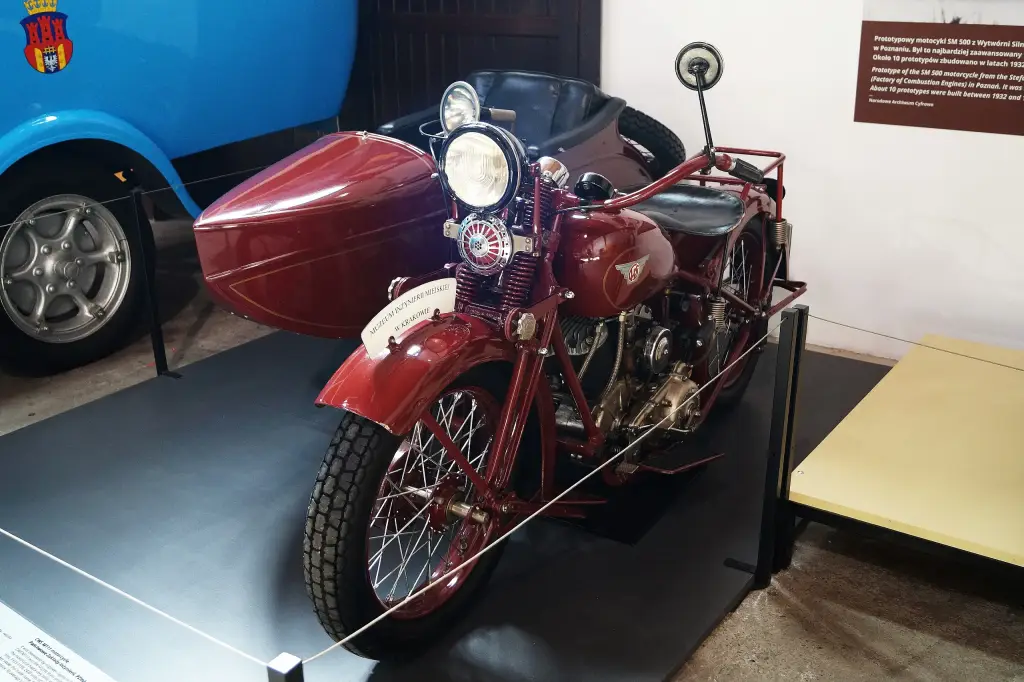
The Sokół 1000, also known as the CWS M-111, was the heaviest motorcycle built in Poland before the Second World War. PZInż made it for civilian riders and for the Polish Army, and a sidecar combination was the standard form in which it left the works.
CWS M-111 at a glance
| Also known as | CWS M111 |
|---|---|
| Maker | PZInż, formerly Centralne Warsztaty Samochodowe, Warsaw |
| Production | 1933–1939 (Polish Wikipedia: 1934–1939) |
| Engine | air-cooled four-stroke V-twin, 995 cm³ |
| Bore × stroke | 83 × 92 mm |
| Power | 18 hp at 3,000 rpm (other data: 22 hp at 4,000 rpm) |
| Gearbox | three-speed, hand change |
| Final drive | chain |
| Top speed | 100 km/h |
| Mass | 270 kg solo, 375 kg with sidecar |
| Fuel | 20 l tank, 7.5 l/100 km |
| Built | about 3,400 |
Based on the English Wikipedia article on the Sokół 1000 and the Polish Wikipedia article on the Sokół 1000 M111; the two give different starting years for production (1933 and 1934).
History of the CWS M-111
Replacing the Harley-Davidson
In late 1927 the Polish Army drew up a specification for a general-purpose heavy motorcycle to replace the Harley-Davidson machines it had used until then. By 1932 the Centralne Warsztaty Samochodowe had prepared a short series of roughly 200 CWS M55 motorcycles with sidecars. The bike followed the Harley-Davidson layout and its engine was almost a direct copy of an Indian design, but the machine proved less reliable than expected.
A new design from PZInż
In 1931 the state group Państwowe Zakłady Inżynierii decided to prepare a completely new heavy motorcycle for the army. Subsidised by the state, PZInż tested and modified the earlier M55 design extensively to fit the specification. The new machine was first named CWS M III, and the brief asked for reliability, ease of use and resistance to harsh conditions and poor servicing. The result was slightly outdated by the standards of the day, very heavy for its class and expensive: the civilian version sold for 4,200 złoty, about US$800 or £170, only a little less than an average car of the period. In return it was extremely reliable and durable.
Production and service
Production of the 1000 began in 1933 and lasted until the outbreak of the Second World War in 1939; the Polish Wikipedia gives 1934 as the starting year. The motorcycle was made almost entirely in Poland, with less than 5 per cent of parts imported, and quality stayed high throughout: every tenth machine was checked in detail and all of them were road-tested before delivery. Its durability made it much faster off-road than many of the American machines it replaced. The Sokół 1000 was also the basis for the Sokół M121 trike prototype, whose sidecar wheel was powered, and its engine was used in railway draisines.
Design and features
- Air-cooled V-twin: 995 cm³ with an 83 × 92 mm bore and stroke and a 5:1 compression ratio, fed by a Zenith MC 22 carburettor and rated at 18 hp at 3,000 rpm, or 22 hp at 4,000 rpm in other sources.
- Sturdy frame: a double closed tubular frame with a trapezoidal Harley-Davidson-type front fork and a rigid rear end.
- Brakes on three wheels: mechanical drum brakes worked on the front and rear wheels and on the sidecar wheel as well.
- Soft sidecar mounting: one of the notable Polish innovations of the design, it made the combination easier to handle and faster off-road.
- Electrical equipment: a Bosch or Era RD 6 V 45 W dynamo and a ZAT Tudor 6 V 20 Ah battery, with Bosch or Magnet ignition.
CWS M-111 versions
- Sidecar combination: the standard completion of the model, with a sidecar designed by Stanisław Panczakiewicz.
- Civilian version: sold to private riders at 4,200 złoty.
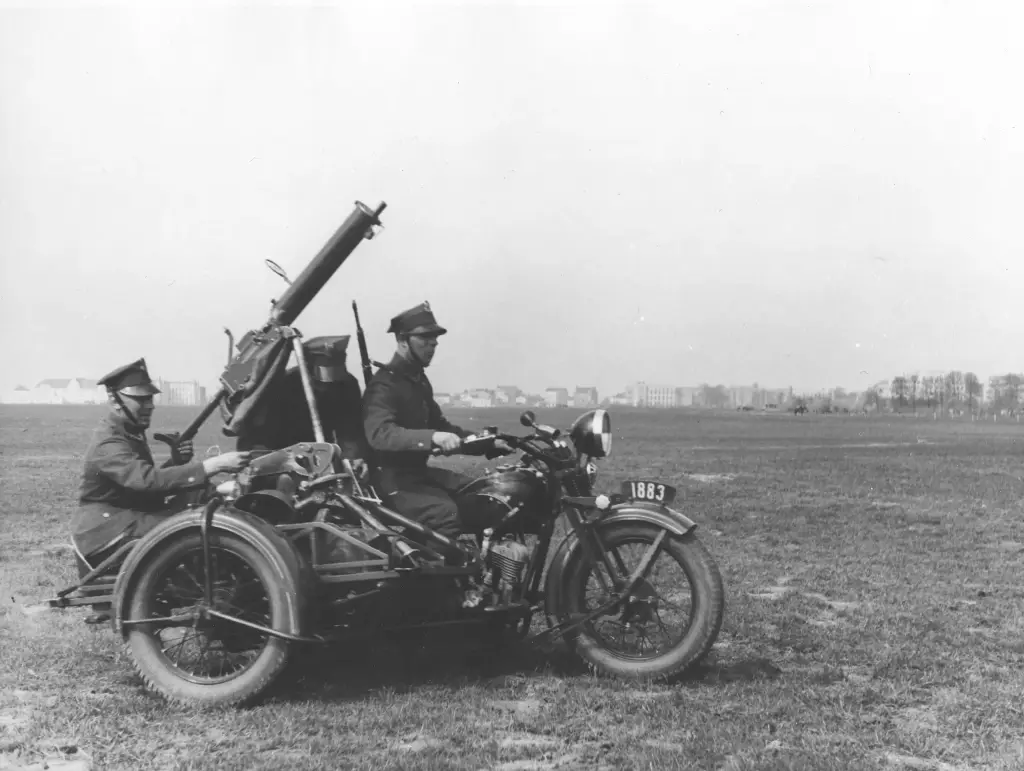
- Military version: bought by the Polish Army, which had specified the machine in the first place.
- Sokół M121 trike: a prototype three-wheeler with a powered sidecar wheel.
- Railway draisines: the Sokół 1000 engine also powered small rail vehicles.
The Sokół 1000 was the last motorcycle to come out of the Warsaw works; earlier vehicles from the same maker are gathered in the CWS collection, including the CWS T-1 car.
Video: SOKÓŁ 1000-CWS M111
Video on YouTube.
Sources
- Sokół 1000, English Wikipedia: history, production, sidecar mounting, M121 trike
- Sokół 1000 M111, Polish Wikipedia: specification, dimensions, masses, production numbers, price