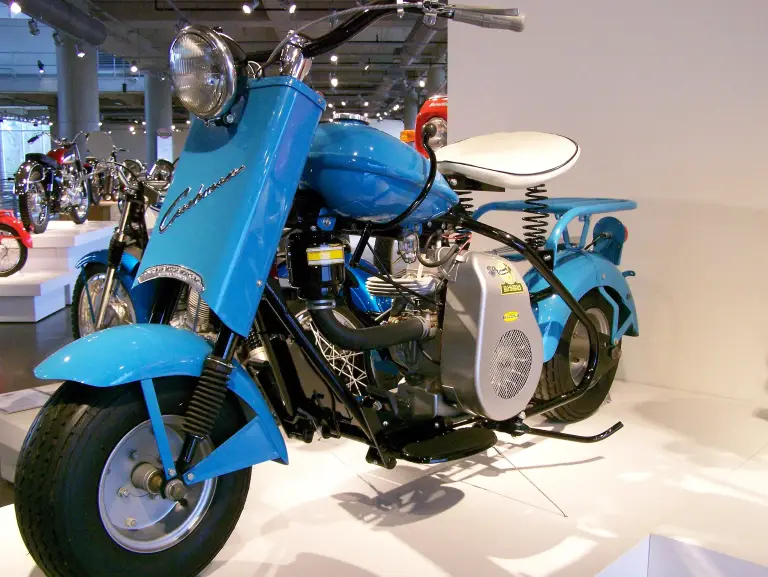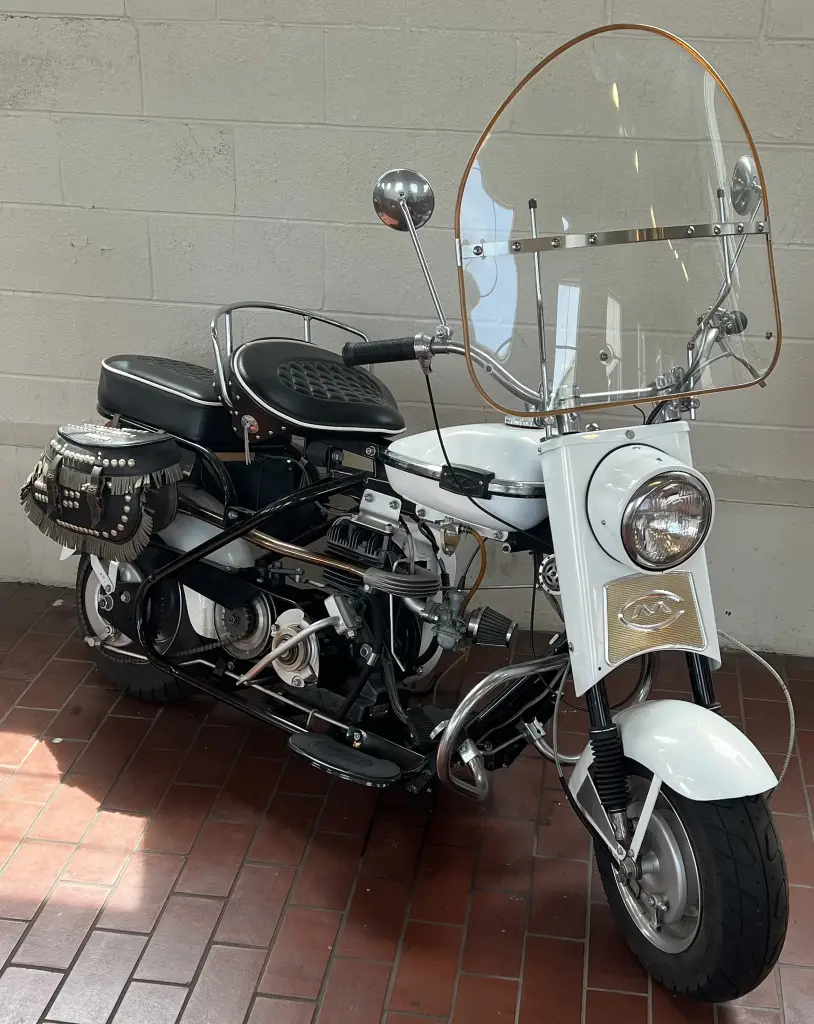
The Cushman Eagle was the most successful motor scooter of the American manufacturer Cushman Motor Works, built from 1949 for about sixteen years. With its exposed engine, sprung saddle and teardrop tank it looked less like a scooter and more like a small motorcycle.
Cushman Eagle at a glance
| Maker | Cushman Motor Works, Lincoln, Nebraska |
|---|---|
| Production | 1949–1965, some sold as 1966 models |
| Model number | Model 52 Eagle |
| Layout | exposed engine, sprung saddle, teardrop tank |
| Engine at launch | side-valve single, 318 cm³ |
| Engines offered | M7 4.8 bhp, M8 Husky 8.95 bhp, M9 8 bhp |
| Gearbox | two-speed, hand lever along the right of the tank |
| Top speed | about 80 km/h, maker’s claim |
| Weight | 250–335 lb (110–152 kg) for Cushman scooters |
| Fuel consumption | 75 mpg–US, maker’s claim |
| Scooters built in 1958 | 15,000 |
The Eagle has no article of its own on Wikipedia; this page is based on the Cushman company article in English and the Cushman brand article in German.
History of the Cushman Eagle
A new generation in 1949
Cushman Motor Works began in Lincoln, Nebraska, in 1903 and had been building Auto-Glide scooters since 1936 as a way of selling its Husky engines during the Great Depression. In the Second World War its light scooters served the United States armed forces, among them the Model 53 Airborne, designed to be dropped by parachute with airborne troops. The Eagle appeared in 1949 as the Model 52, a new generation in which little of the familiar scooter shape remained apart from the small steel wheels: the engine sat uncovered in the frame, the saddle was sprung and the fuel tank above the frame was teardrop-shaped, all cues borrowed from motorcycles. It became the most successful model in the Cushman scooter range and stayed in production for approximately sixteen years.
Engines and gearbox
The first Eagles used a side-valve single-cylinder engine of 318 cm³, coupled to a two-speed gearbox whose lever ran along the right-hand side of the tank; the maker claimed a top speed of about 80 km/h. At various times three single-cylinder engines were offered: the M7 of 4.8 bhp, the M8 Husky of 8.95 bhp and the M9 of 8 bhp. Cushman scooters of the period generally had an automatic centrifugal clutch that let the rider accelerate by twisting the right-hand grip, although on a Cushman the throttle turned forward rather than back.
The end of the scooters
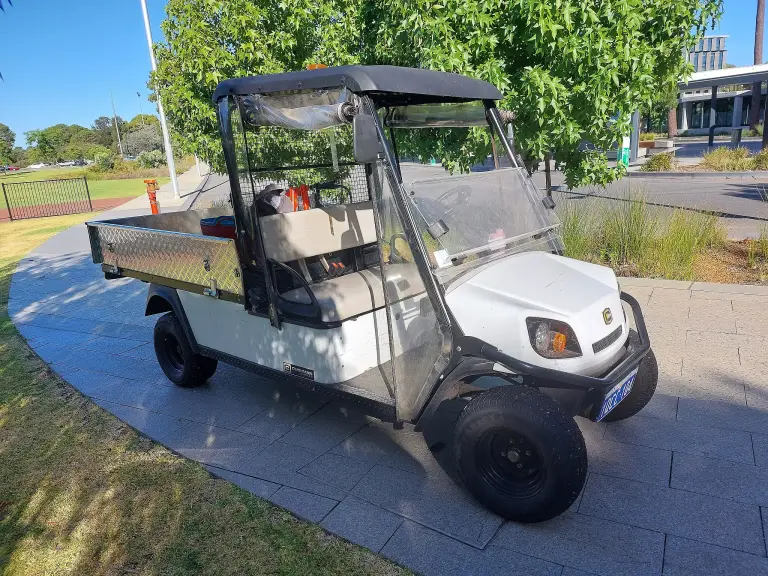
Cushman built 15,000 scooters in 1958 alone. When the Outboard Marine Corporation took over the company at the beginning of the 1960s, the range was revised and the Eagle was joined by the Silver Eagle, which used an OMC aluminium engine of 9 bhp and a two-speed gearbox. Scooter production ended in 1965, although some remaining Eagles were sold as 1966 models. Cushman then concentrated on golf carts, industrial vehicles and turf maintenance equipment, and the brand later passed through Ransomes of Great Britain to Textron. Cushman scooters were also built under licence in Belgium as Belgian Cushman.
Design and features
- Motorcycle-style layout: an exposed engine, a sprung saddle and a teardrop tank above the frame.
- Three engine choices: the 4.8 bhp M7, the 8.95 bhp M8 Husky and the 8 bhp M9.
- Two-speed gearbox: shifted by a lever running along the right-hand side of the tank.
- Economical running: Cushman claimed 75 mpg–US and a cost of a penny a mile for its scooters.
- Small steel wheels: the last reminder of the scooter the Eagle had grown out of.
Cushman Eagle versions
- Model 52 Eagle (1949): the original version with the 318 cm³ side-valve engine.
- M7-engined Eagle: 4.8 bhp single.
- M8 Husky-engined Eagle: 8.95 bhp.
- M9-engined Eagle: 8 bhp, the last of the single-cylinder engines.
- Silver Eagle: the 9 bhp OMC-engined version that followed at the start of the 1960s.
- 1966-model Eagles: leftover scooters sold after production ended in 1965.
The Eagle shared the Cushman range with the economy Highlander and, much later, the Shuttle. More scooters and light vehicles are in the Cushman collection.
Video: 1953 Cushman Eagle 765
Video on YouTube.
Sources
- Cushman (company), English Wikipedia: history, models, end of production
- Cushman (Marke), German Wikipedia: Model 52, engines, gearbox