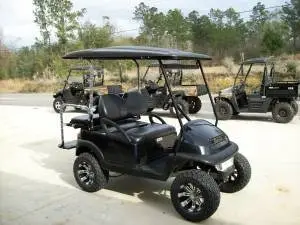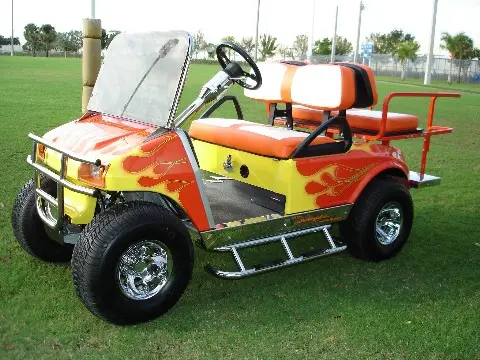
The Club Car DS was the golf car that made the company’s name. Launched in 1980 and named after its designer, Dom Saporito, it remained the firm’s main golf model for almost a quarter of a century, until the Precedent took its place in 2004.
Club Car DS at a glance
| Maker | Club Car, Augusta, Georgia |
|---|---|
| Produced | 1980–2004 |
| Named after | designer Dom Saporito |
| Role in the range | the company’s main golf car line |
| Layout | two-seat open golf car, electric or petrol |
| Petrol engine, to 1991 | Kawasaki FZ340 |
| Petrol engine, from 1992 | Kawasaki FE290, 286 cc |
| Electric motor (DS Player) | 3.5 hp |
| Batteries (DS Player) | six 8-volt |
| Top speed (DS Player) | 8.0–30.6 km/h in seven settings |
| Replaced by | Club Car Precedent, 2004 |
Club Car has no separate Wikipedia article for the DS; this page is based on the sections about the model in the English and German articles on the company.
History of the Club Car DS
Club Car had been building golf cars since 1958, when the company, then called Landreath Machine, made its first three-wheeled carts in Houston, Texas. By 1980 the business had long since moved to Augusta, Georgia, and it was there that a new model appeared with the simple name DS: the initials of the designer Dom Saporito. It was an electric golf car aimed at the courses and resorts that formed the company’s core market, and it quickly became the cart most people pictured when they thought of Club Car.
The DS was not a single unchanging vehicle. Over more than two decades it was built with electric and petrol drivetrains, in fleet and personal versions, and with a long list of body styles and accessories. Until 1991 the petrol cars used Kawasaki FZ340 engines; for 1992 the engine was replaced by the smaller Kawasaki FE290 of 286 cc. The electric DS Player of the later years had a 3.5 hp motor, six 8-volt batteries with an on-board charger and computer, self-adjusting rack-and-pinion steering and mechanical two-wheel drum brakes. Its controller could be programmed in seven speed steps, giving anything from 8.0 to 30.6 km/h.
The petrol DS Player used a single-cylinder four-stroke Kawasaki engine of 9.5 hp with a 12-volt battery, and ran at between 19.3 and 24.1 km/h. The model’s long life ended in 2004, when Club Car introduced the Precedent and made it the new standard golf car; the DS has remained a familiar sight on courses ever since, and a large aftermarket of parts and accessories grew up around it.
Design and features
- Long production run: built from 1980 to 2004, one of the longest-lived golf car designs.
- Two drivetrains: electric versions with six 8-volt batteries, and petrol cars on Kawasaki engines.
- Programmable speed: the electric DS Player could be set in seven steps from 8.0 to 30.6 km/h.
- Simple mechanicals: rack-and-pinion steering and drum brakes, easy to service on a golf course.
- Designer name: the initials come from Dom Saporito, who styled the car.
Club Car DS versions
- DS electric (1980–2004): the standard fleet golf car.
- DS Player electric: 3.5 hp motor with six 8-volt batteries and a programmable controller.
- DS Player petrol: 9.5 hp single-cylinder Kawasaki four-stroke.
- Early petrol cars: Kawasaki FZ340 engine up to 1991.
- Later petrol cars: Kawasaki FE290, 286 cc, from 1992.
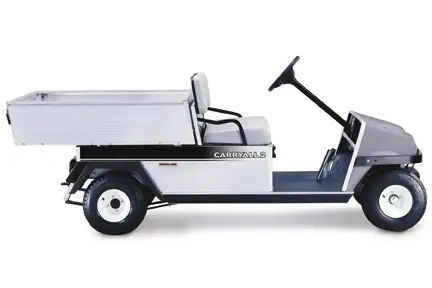
The DS was replaced by the Club Car Precedent, and the company’s utility range grew out of models such as the Carryall. More vehicles are in the Club Car collection.
Sources
- Club Car, English Wikipedia: DS line, designer, end of production
- Club Car, German Wikipedia: engines, DS Player specifications