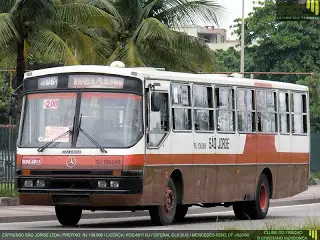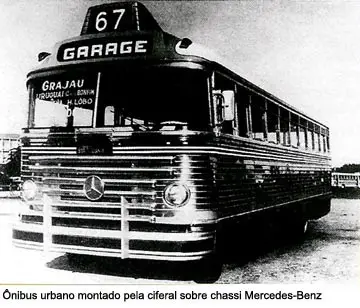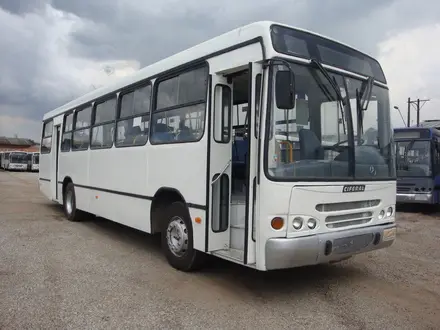
The Ciferal Turquesa was an urban bus body produced by the Brazilian coachbuilder Ciferal between 1999 and 2003. It closed the line of city models that the company had developed in Rio de Janeiro, and it was built during the years in which Ciferal passed from state-backed ownership to the Marcopolo group.
Ciferal Turquesa at a glance
| Maker | Ciferal (Comércio e Indústria de Ferro e Alumínio), Brazil |
|---|---|
| Type | urban (city) bus body |
| Production | 1999–2003 |
| Plant | Xerém, Duque de Caxias, Rio de Janeiro state |
| Owner | Ciferal; from 2001 the Marcopolo group |
| Predecessor in the city range | Padron Cidade II (1998–1999) |
| Successor | Citmax (2003–2008) |
| Product | body only, mounted on a chassis supplied by the customer |
| Chassis makes used by Ciferal | Mercedes-Benz, Scania, Magirus, FNM |
| Range in 1999 | city models Padron Cidade II and Turquesa |
The Turquesa itself appears in the Portuguese Wikipedia article on Ciferal only as a line in the list of discontinued urban models. The rest of the material used here is the history of the company around it. Based on one source.
History of the Ciferal Turquesa
Ciferal before the Turquesa
Ciferal — short for Comércio e Indústria de Ferro e Alumínio — was founded in October 1955 by Fritz Weissmann in a small shed in Ramos, in the north of Rio de Janeiro. Weissmann had spent the years before that experimenting with duralumin bodies, and the new firm began with a capacity of ten aluminium bodies a month. Orders were scarce at first and the company spent 1956 repairing and reselling used micro-buses; the first vehicle of its own, a city bus on a Mercedes-Benz LP312 chassis, was finished in May 1957, in a year when a fire in the works limited output to 26 bodies.
For most of the 1960s Ciferal built coaches rather than city buses, and by the end of that decade it was the largest maker of coach bodies in Brazil. City production was restarted in 1971 with 105 vehicles, and the Ramos factory was enlarged in 1972 to 38,824 square metres, enough for 1,200 buses a year. City bodies passed coaches in 1975, with 551 against 514, and reached their peak in 1979 at 761. That growth was fed by large orders from Goiânia and Curitiba and by exports to Venezuela, where 100 bodies went out on Mack chassis; by then the city range had also reached the north of the country, in 1972.
The 1990s: a new plant and a new owner
The 1980s were difficult. Payment delays in 1981 led to strikes, and in 1982 the factory was occupied by the military police during a wage dispute; production was reopened by a court-appointed administrator in December 1982, and in April 1986 the state of Rio de Janeiro took control through its development bank. In the 1990s the company left Ramos for the former FNM works and in 1992 settled in Xerém, in the municipality of Duque de Caxias.
The city range of that decade moved quickly: Padron Rio (1991–1994), GLS Bus (1994–1998), Padron Cidade I (1997–1998) and Padron Cidade II (1998–1999). The Turquesa arrived in 1999 as the next step in that series, at the very end of the company’s independent life.
Turquesa under Marcopolo
In 2001 Marcopolo bought Ciferal and turned the Xerém works into one of its largest bus factories, with the emphasis on urban vehicles. The Turquesa stayed in production for two more years and was replaced in 2003 by the Citmax, which remained in the catalogue until 2008. After that the plant built Marcopolo’s own Torino, and the Ciferal name gradually disappeared from the buses themselves.
Design and features
- End of an era: the Turquesa belongs to the last city range designed before Marcopolo took over Ciferal in 2001.
- Body-only product: like every Ciferal, it was an encarroçadora — the customer supplied the chassis and Ciferal built the body on it.
- Aluminium heritage: Ciferal had grown on duralumin bodies, which weighed up to 30 per cent less than steel ones but cost more to build.
- Built at Xerém: production took place in the Duque de Caxias works that replaced the old Ramos factory in 1992.
- Short life: four years in the catalogue, split almost evenly between independent Ciferal and the Marcopolo group.
Ciferal Turquesa versions
- Turquesa (1999–2001): built while Ciferal was still independent, alongside the Padron Cidade II.
- Turquesa (2001–2003): produced after the Marcopolo takeover, in the same Xerém plant.
- Chassis versions: the body could be mounted on chassis from several makers, following Ciferal’s practice with Mercedes-Benz, Scania, Magirus and FNM units.
The Turquesa followed the Ciferal GLS in the city range and was replaced by the Citmax. The history of the works is on the Ciferal collection page, and the São Paulo branch of the family is described in the article on the Ciferal Condor.
Video: Ciferal Turquesa on a Mercedes-Benz chassis
Video by ECCP09 on YouTube.
Sources
- Ciferal, Portuguese Wikipedia: company history, plants, model list with dates