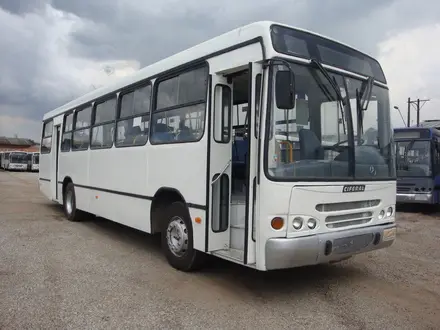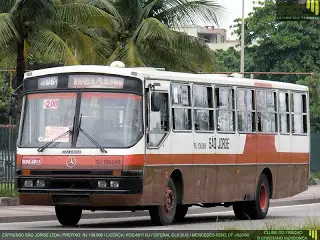
The Ciferal GLS was a Brazilian bus body produced from 1994 to 1998. It came in two versions, the urban GLS Bus and the GLS Intermunicipal for longer intercity runs, and it was one of the models with which Ciferal replaced the generation of the late 1980s in the middle of the decade.
Ciferal GLS at a glance
| Maker | Ciferal (Comércio e Indústria de Ferro e Alumínio), Brazil |
|---|---|
| Versions | GLS Bus (urban) and GLS Intermunicipal |
| Production | 1994–1998 for both versions |
| Plant | Xerém, Duque de Caxias, Rio de Janeiro state |
| Owner | Ciferal, then owned by the state of Rio de Janeiro through its development bank |
| Range before it | Pódium (1988–1992) and Mega Bus (1991–1994) |
| Range after it | Padron Cidade I (1997–1998) and Padron Cidade II (1998–1999) |
| Product | body only, mounted on a chassis supplied by the customer |
| Example in the video | GLS Bus on a Mercedes-Benz OH-1420 chassis |
The GLS is listed in the Portuguese Wikipedia article on Ciferal as GLS Bus (1994–1998) and GLS Intermunicipal (1994–1998); the history around it comes from the same page. Based on one source.
History of the Ciferal GLS
Ciferal in the early 1990s
Ciferal was founded in 1955 by Fritz Weissmann in Ramos, Rio de Janeiro, and made its name with duralumin bus bodies, which weighed up to 30 per cent less than steel. After the financial collapse of 1981–1982 and the court-administered restart, the state of Rio de Janeiro took control of the company in April 1986 through the Banco de Desenvolvimento do Rio. In the 1990s the works moved out of Ramos to the old FNM factory and, in 1992, to Xerém in Duque de Caxias.
The late 1970s had been the high point of the Rio company. With three factories in operation in 1978 it was the third largest body builder in Brazil, with 12.2 per cent of the market; it began exporting to Chile and won a contract for 200 trolleybuses for the Companhia Municipal de Transportes Coletivos of Sao Paulo, a city that planned to buy as many as 1,280 of them. The heavy investment in that programme, together with the dispute with Ciferal Paulista, was behind the payment crisis of late 1981.
The range changed quickly in those years. The Pódium coach of 1988–1992 was followed by the Mega Bus city body of 1991–1994 and the Padron Rio of 1991–1994, and the Cursor coach appeared in 1994–1995. The GLS belongs to that same wave of renewal.
Two bodies under one name
The GLS was listed in two forms. The GLS Bus was an urban body, meant for the city fleets that had been Ciferal’s main market since the 1970s. The GLS Intermunicipal was its counterpart for services between towns, a segment in which Ciferal had a long history: the company’s first coach of 1958 already carried a washroom moulded in one piece of fibreglass, and coaches had kept it alive through the years when city orders were rare.
Both versions were produced from 1994 to 1998, the same period in which Ciferal returned to a shorter model cycle: the Padron Cidade I followed in 1997 and the Padron Cidade II in 1998, so that the GLS was replaced within four years of its launch.
After the GLS
The GLS was the last urban body of the independent period to carry a plain name of its own. Marcopolo bought Ciferal in 2001 and made Xerém one of its largest bus plants, concentrating on urban vehicles; the Padron Cidade series and then the Turquesa took the city range into the new century.
Design and features
- Two markets, one model: GLS Bus for city work, GLS Intermunicipal for services between towns.
- Body on customer chassis: Ciferal built bodies only; the running gear came from makers such as Mercedes-Benz, Scania, Magirus and FNM.
- Aluminium tradition: the company had built its reputation on duralumin structures, lighter than steel but more expensive.
- Short cycle: in production for four years before the Padron Cidade I and II took over.
Ciferal GLS versions
- GLS Bus (1994–1998): the urban version, used by city operators.
- GLS Intermunicipal (1994–1998): the intercity version of the same body.
- Mercedes-Benz OH-1420 example: the bus in the video is a GLS Bus on that chassis.
The GLS was replaced by the Turquesa line of city models, and its São Paulo cousin is described in the article on the Ciferal Condor. More buses of the maker are on the Ciferal collection page.
Video: Ciferal GLS Bus on a Mercedes-Benz OH-1420 chassis
Video by ECCP09 on YouTube.
Sources
- Ciferal, Portuguese Wikipedia: company history, plants, model list with dates