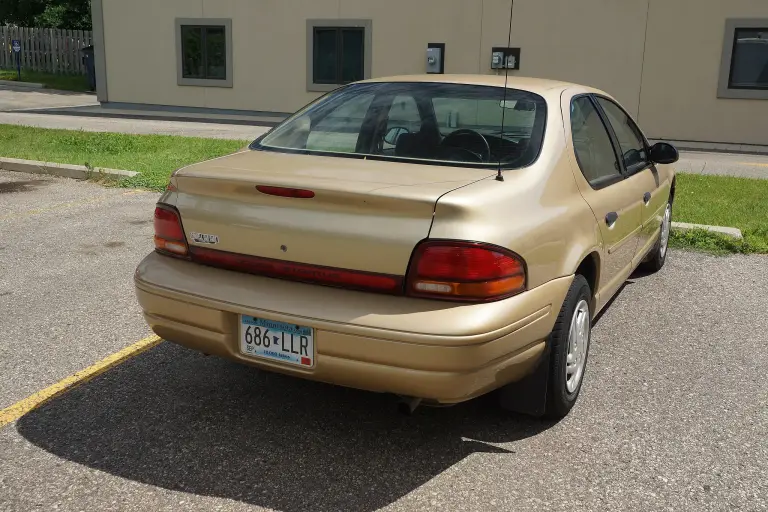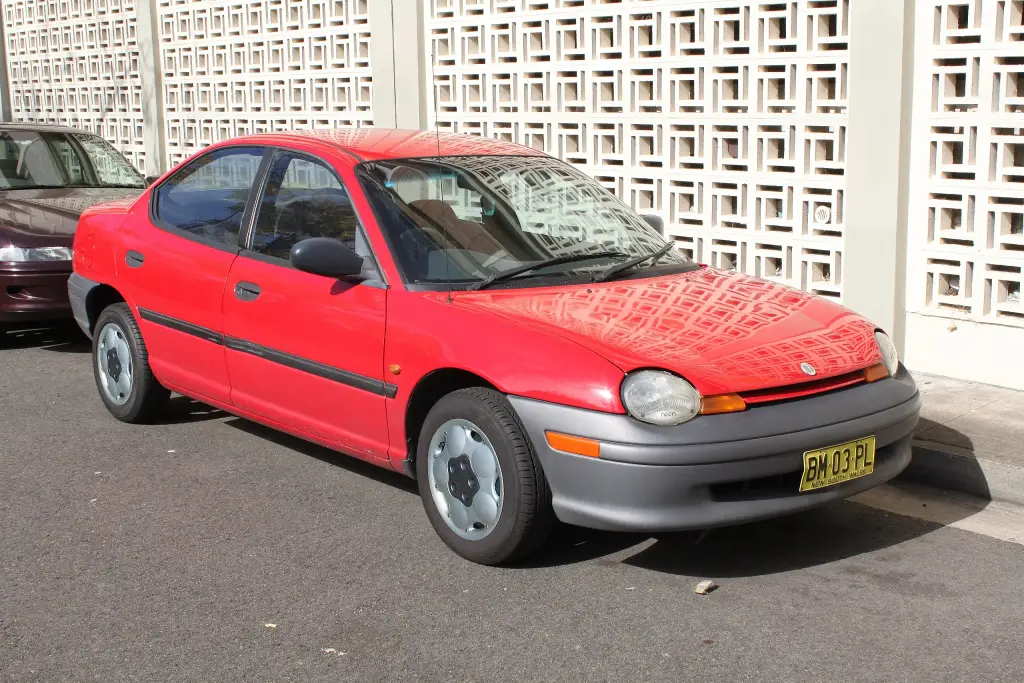
The Chrysler Neon was the name under which Chrysler’s compact car was sold in Europe, Australia, Japan, South Africa and South America, while North American buyers knew it as a Dodge or Plymouth. Built from the 1995 to 2005 model years on the front-wheel-drive PL platform, it was the first compact car to become profitable for an American manufacturer.
Chrysler Neon at a glance
| Production | 1995–2005 model years |
|---|---|
| Chrysler-badged markets | Europe, Mexico, Japan, South Korea, Egypt, Australia, South Africa, South America |
| Platform | Chrysler PL, front-wheel drive |
| Engines | 2.0 L SOHC, 132 hp; 2.0 L DOHC, 150 hp |
| Transmissions | five-speed manual or three-speed TorqueFlite automatic |
| Bodies | four-door sedan and two-door coupe |
| Built at | Belvidere, Illinois and Toluca, Mexico |
| DOHC 0–60 mph | 7.6 seconds (Neon R/T) |
| Awards | gold IDEA91 for the 1991 concept |
| Developed as | project “Counterattack” |
History of the Chrysler Neon
From AMC to Chrysler
Development began in the mid-1980s at American Motors as a replacement for the Renault Alliance, and continued after Chrysler bought AMC in 1987, combining the AMC design team with Chrysler engineers who had worked on the L platform. The PL project was codenamed “Counterattack”, a reference to Lee Iacocca’s claim that the big three could no longer match Japanese innovation, quality and efficiency. The goal was a car that was lightweight, economical, powerful and comfortable in an American way, costing no more than a bit under US$4,000 to build and selling for no more than US$8,000. Led by Tom Gale, the design kept a three-box layout but followed the cab-forward ideas first seen on the Lamborghini Portofino and Eagle Optima.
The 1991 concept
Chrysler showed the Neon as a Dodge concept at the 1991 Frankfurt Motor Show, built with recycled components and designed to be almost entirely recyclable, with an onboard trash compactor. It was a four-door sedan whose doors slid open from the centre with no B-pillar, and it had a full-length retractable fabric roof; power came from a 100 hp 1.1-litre two-stroke three-cylinder supplied by Mercury Marine. The concept won a gold IDEA91 award, and although the sliding doors, fabric roof, compactor and two-stroke engine were dropped, its rounded roofline, circular headlamps and minimalist grille shaped the production car.
Production
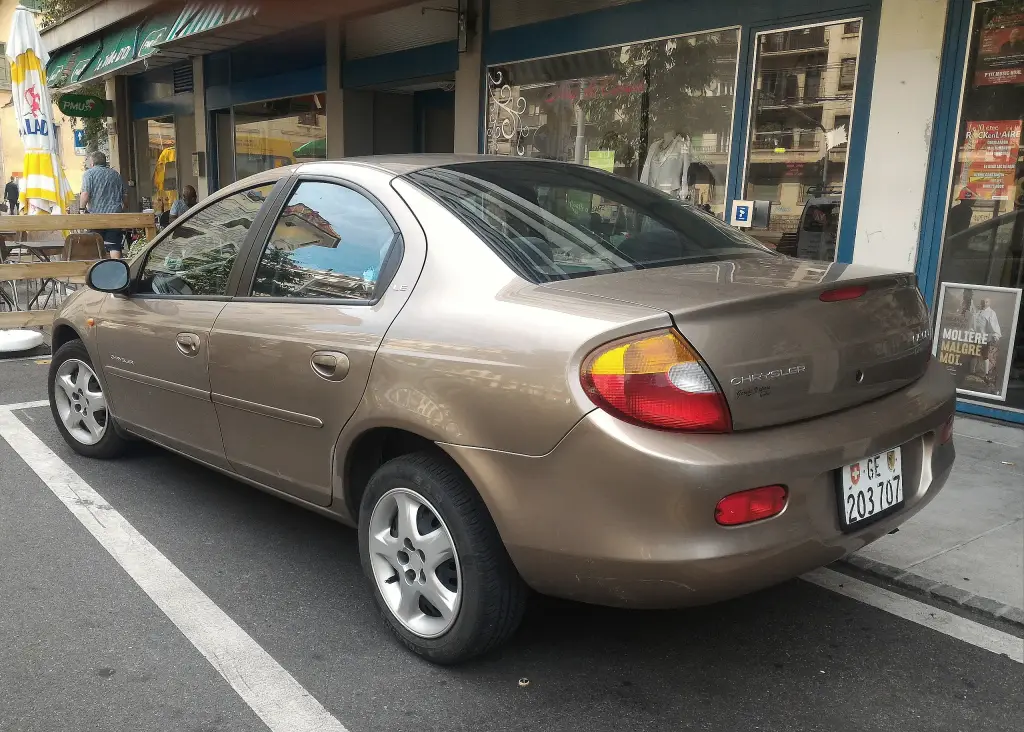
The first-generation Neon was introduced at the 1993 Frankfurt show and went on sale in January 1994 for the 1995 model year as a four-door sedan and a two-door coupe. Engines were SOHC and DOHC versions of Chrysler’s 2.0-litre four, with 132 hp and 150 hp respectively, and buyers chose a three-speed Torqueflite automatic or a five-speed manual. In the United States and Canada the car was sold as a Dodge and a Plymouth; in Mexico and the Gulf states as a Dodge and a Chrysler; and in Europe, Australia and other export markets as the Chrysler Neon. Bob Lutz said at the launch that Detroit’s old rule — “good, fast or cheap, pick any two” — no longer applied. The Japanese press called the Neon a “Japanese car killer”, though only 994 were sold there between June and December 1996, partly because its width put it in a higher tax bracket. Car and Driver timed a DOHC five-speed Neon R/T at 7.6 seconds to 60 mph, and the car was competitive in SCCA Solo autocross and showroom-stock racing. Second-generation cars carried on to the 2005 model year.
Design and features
- Cab-forward compact: a rounded roofline and minimalist grille taken from the 1991 concept.
- Two 2.0-litre engines: 132 hp SOHC and 150 hp DOHC versions.
- Value engineering: designed to be built for under US$4,000 and sold for under US$8,000.
- Unusual options policy: rear doors had no power windows, and some base colours had moulded-in bumper covers.
- Racing success: competitive in SCCA Solo autocross and showroom-stock road racing.
Chrysler Neon versions
- Chrysler Neon (export): the European, Australian, Japanese and Latin American name.
- Sedan and coupe: four-door and two-door notchback bodies.
- Neon R/T: the DOHC five-speed performance version.
- Second generation: the later car that continued to 2005.
The Neon replaced the LeBaron as Chrysler’s small car and shared its cab-forward thinking with the Cirrus; its packaging ideas reappeared in the PT Cruiser. More cars are in the Chrysler collection.
Video: Chrysler Neon review (1998)
Video by Men and Motors on YouTube.
Sources
- Chrysler Neon, English Wikipedia: development, concept, engines, markets
- Chrysler Neon, Wikimedia Commons: photographs