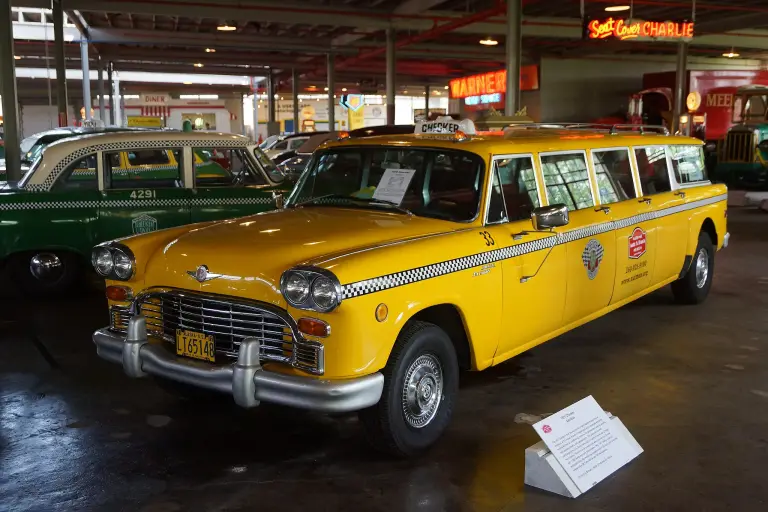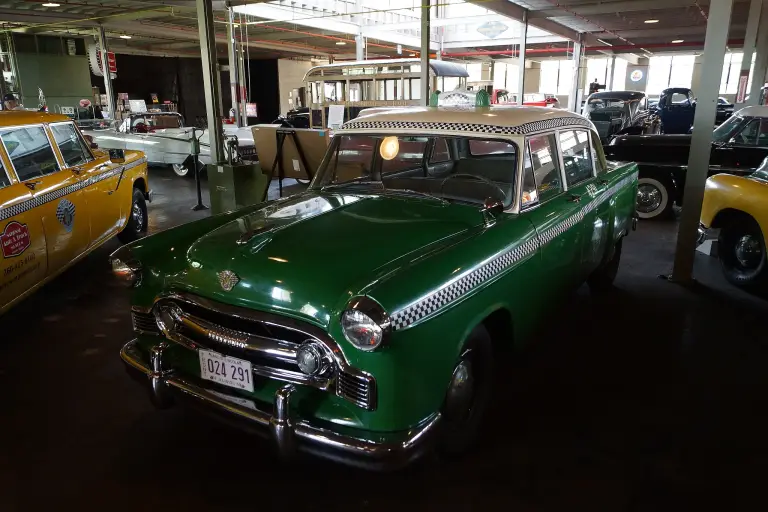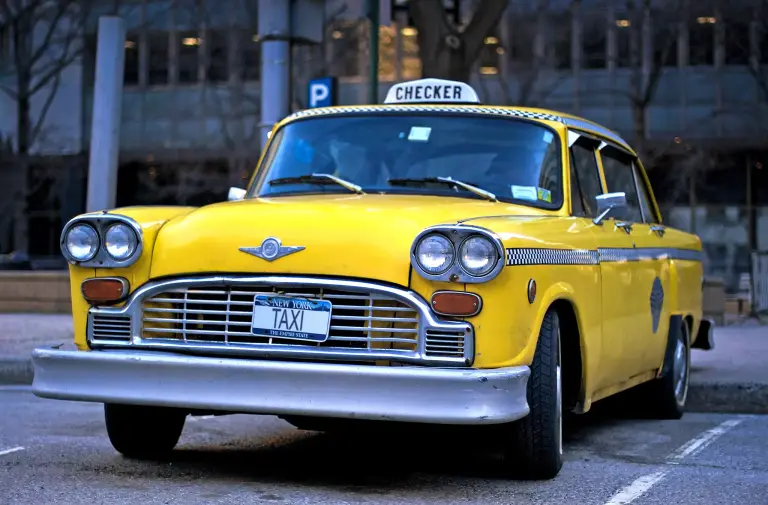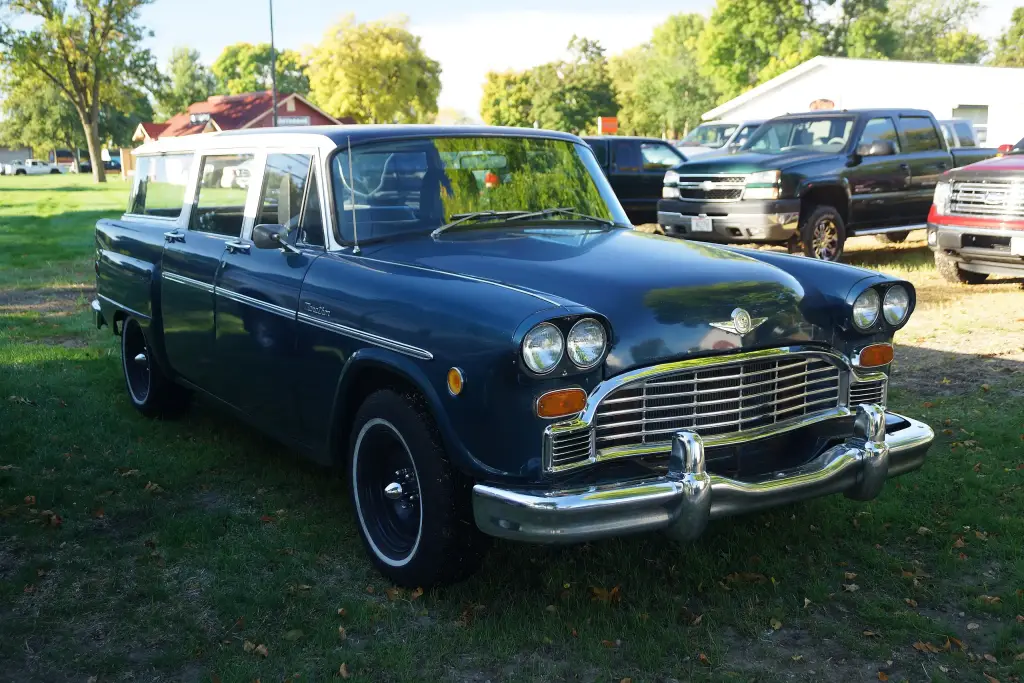
The Checker Marathon was produced by the Checker Motors Corporation of Kalamazoo, Michigan, between 1960 and 1982. It was marketed as a passenger car for private buyers, while the closely related Taxi was aimed at fleet customers; in practice most production went to fleets, and the Marathon became the defining American taxi of its era.
Checker Marathon at a glance
| Maker | Checker Motors Corporation, Kalamazoo, Michigan |
|---|---|
| Production | 1960–1982 |
| Introduced | September 1960 for the 1961 model year |
| Bodies | four-door sedan and four-door station wagon |
| Extended bodies | six-door nine-seater and eight-door twelve-seater Aerobus |
| Chassis codes | A10 originally, A11 for taxis and A12 for passenger cars from 1963 |
| Wheelbase | 120 in; 129 in for the Town Custom limousine |
| Engines | Continental six, then Chevrolet sixes and V8s, a Perkins diesel in 1969 |
| Final car built | 1982 |
| Last New York cab retired | 1999, after nearly one million miles |
History of the Checker Marathon
The Marathon arrived in September 1960 for the 1961 model year, alongside and later replacing the Checker Superba Custom. It differed from the Superba in its better interior appointments, and at first it kept the Superba’s A10 body code, with A9 used for taxis. Its full-width egg-crate grille set it apart from the narrower Superba front with its inboard parking lights. Marathons came as four-door sedans and four-door station wagons, and in the rarer six-door nine-seater and eight-door twelve-seater Aerobus forms.
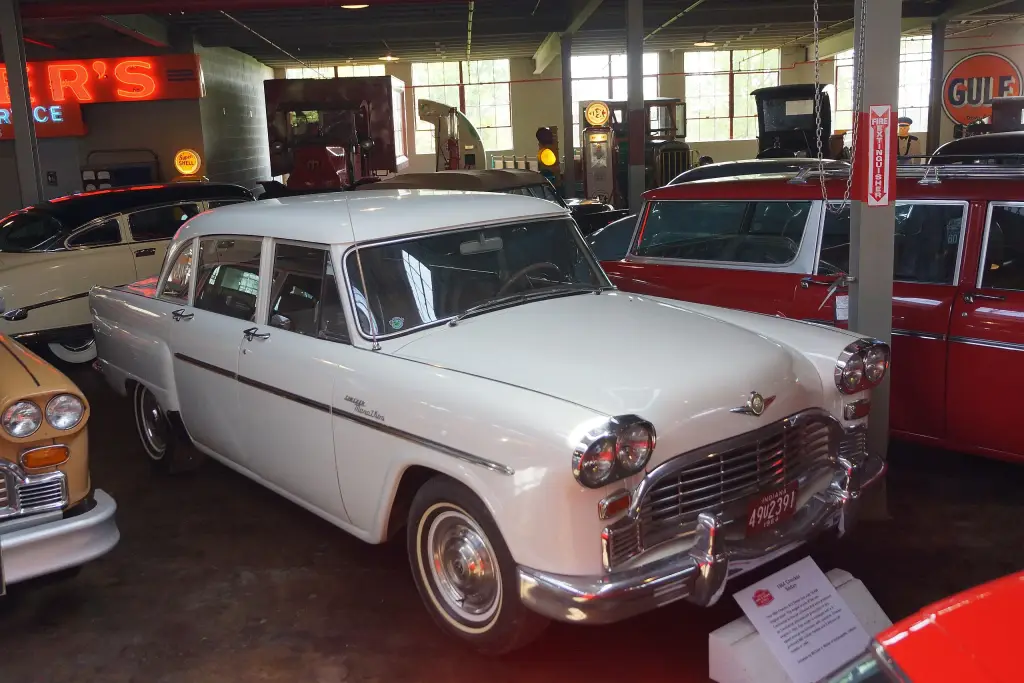
After a minor facelift for 1963, the chassis codes changed to A11 for taxis and A12 for passenger versions. That year also brought the Marathon Town Custom, a limousine on a longer wheelbase of 129 inches against the standard 120, seating eight; it carried the A19E code, later changed to A12E. Checker had no nationwide dealer network and sold most of its output for fleet service, which suited a car designed to be cheap to run and easy to repair.
With the exception of the 5 mph bumpers mandated in 1974 and steady mechanical changes, the Marathon remained virtually unchanged through its 21-year run, while Checker kept the car compliant with safety and emissions rules. Small changes make it possible to date a Checker: front parking and direction lamps went from white to amber in 1963, front lap belts became standard in 1964, front and rear lap belts in 1966, and 1967 brought an interior safety package with an energy-absorbing steering column, padded dash and recessed knobs plus a dual-chamber brake master cylinder. Side marker reflectors appeared in 1969, headrests and a locking steering column in 1970, and the heavy silver-painted girder bumpers in 1974. Catalytic converters arrived in 1975, parallel-action wipers and a new Chevrolet-style steering wheel in 1978.
Engines began as Continental L-head inline sixes, with overhead-valve units for the wagons, and were exchanged for Chevrolet sixes and small-block V8s for 1965. The 1969 L-48 350 V8 made 300 hp gross, and in the same year the Perkins 4.236 four-cylinder diesel was offered for a single season. By 1973 the 350 was rated at 145 hp; for 1980 the line changed entirely, with a 3.8-litre V6 replacing the inline six and a smaller 4.4-litre V8 alongside the Oldsmobile 5.7-litre diesel V8.
The final Marathon was built in 1982, when Checker left car manufacturing. In 1983 the company began remanufacturing cabs at its Kalamazoo Cab Services division, work that continued as late as 1997, and it went on making body stampings for General Motors, Ford and Chrysler for another 27 years, until bankruptcy liquidation in January 2009. For decades the Marathon was the taxi of choice in New York and many other American cities, helped by its size, robust construction, bolt-on rear quarter panels and the near-total absence of yearly styling changes. The last New York City Checker cab retired in 1999; operated by Earl Johnson since 1978, it had covered nearly a million miles with three engine replacements. Marathons also served police departments, notably in Kalamazoo, and in the late 1960s and early 1970s black Vatican-plated A12 Marathons carried Pope Paul VI’s entourage in motorcades.
Design and features
- One shape for 21 years: a full-width egg-crate grille and almost no annual styling changes.
- Fleet engineering: bolt-on rear quarter panels and simple mechanicals kept city cabs running.
- Model-year clues: amber lamps, lap belts, headrests and girder bumpers date individual cars.
- Long service life: the last New York example covered nearly a million miles.
Checker Marathon versions
- Marathon sedan: the standard four-door on the 120-inch wheelbase.
- Marathon station wagon: the load-carrying four-door estate.
- Town Custom (1963): an eight-seat limousine on the 129-inch wheelbase, code A19E and later A12E.
- Taxi (A11) and passenger (A12): separate chassis codes for fleet and private buyers from 1963.
- Aerobus: six- and eight-door extended versions on longer wheelbases.
The fleet version is covered in the Checker Taxi article, the extended airport model in Checker Aerobus, and the earlier A-series code in Checker A11. More cars are in the Checker collection.
Sources
- Checker Marathon, English Wikipedia: model history, changes, engines, fleet use
- Checker Taxi, English Wikipedia: company background and the 1959–1982 A-series