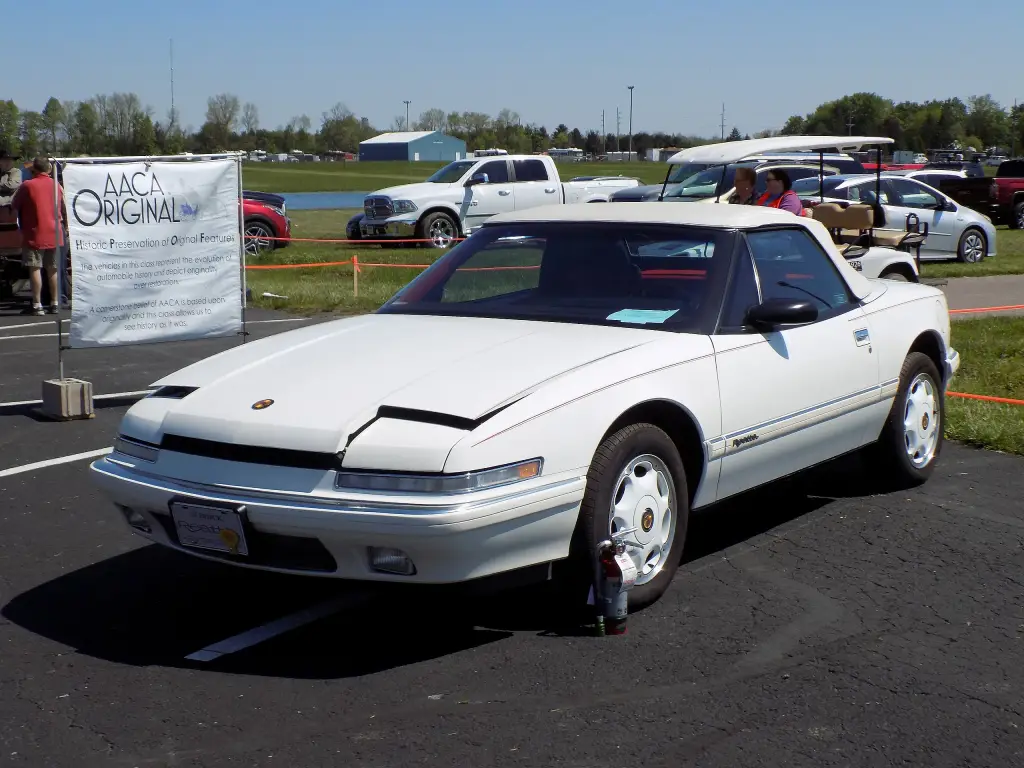
The Buick Reatta is a two-door, two-seat grand tourer built from 1988 to 1991. It was Buick’s first two-seater and its first convertible since the 1985 Riviera, and it was assembled in a small, purpose-built plant in Lansing, Michigan.
Buick Reatta at a glance
| Maker | Buick, General Motors |
|---|---|
| Production | 1988–1991 |
| Class | two-seat grand tourer |
| Bodies | coupe (1988–91), convertible (1990–91) |
| Engine | 3.8 L Buick 3800 V6 |
| Power | 165–170 hp (123–127 kW) |
| Torque | 210–220 lb·ft |
| Top speed | limited to 125 mph (201 km/h) |
| Economy | 18 mpg city, 27 mpg highway |
| Built at | Reatta Craft Center, Lansing, Michigan |
| Price (1988) | $25,000 |
| Total production | over 21,000 in four years |
Based on one source, the English Wikipedia article on the Reatta.
History of the Buick Reatta
The Reatta used a shortened version of the GM E platform shared with the seventh-generation Riviera, with a transverse front-mounted Buick 3800 V6 driving the front wheels. Power was 165–170 hp and 210–220 lb·ft, with the highest output in the final year. It had fully independent suspension, four-wheel disc brakes with ABS, and a top speed electronically limited to 125 mph. Economy was rated at 18 mpg in the city and 27 on the highway.
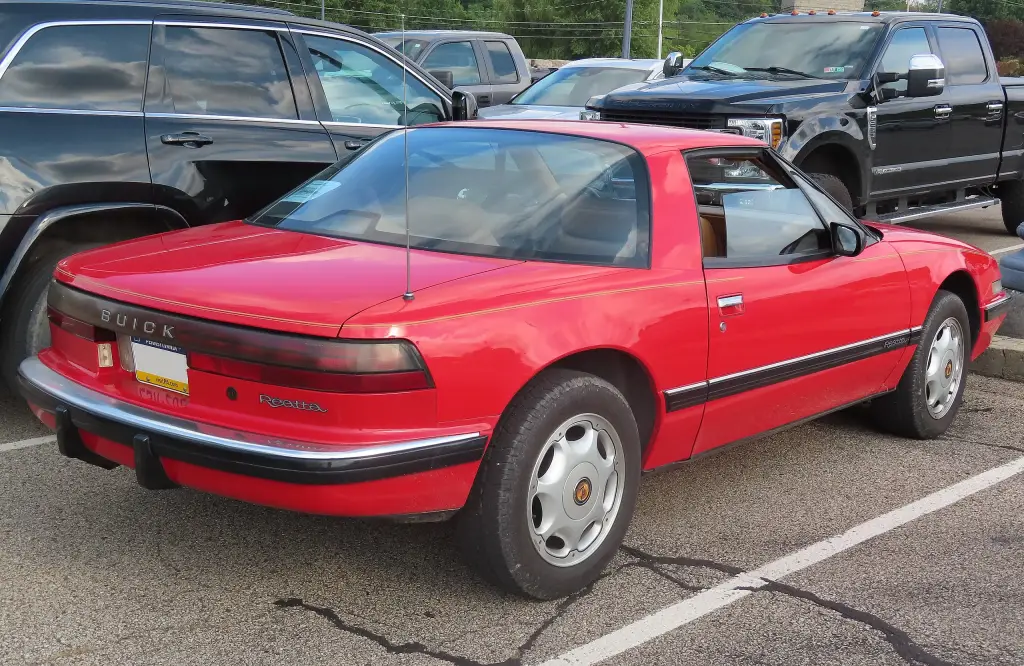
It was built under an unusual programme at the Reatta Craft Center in Lansing. Instead of a conventional line, teams of workers assembled the car at a series of stations, after which robots moved it on; paint was applied on site by PPG under subcontract. The first pilot car was finished in December 1986, series production began in January 1988 and ended on 10 May 1991, with more than 21,000 cars built in four years.
Inside there were twin bucket seats with lockable bins behind them and a lockable hatch through to the boot. Options at launch included 16-way power seats instead of six-way, side mouldings in black or body colour and pinstripe delete. A sunroof became optional late in 1988, and keyless entry was standard from 1989. The 1988 list price was $25,000.
The Reatta is also the only Buick with fully pop-up headlamps, where the whole assembly rises. The Riviera of 1965–69 and the Skyhawk of 1987–89 hid theirs behind moving covers. From 1988 to 1989 the car had a touchscreen interface called the Electronic Control Center, covering radio, climate, trip computer, a configurable overspeed alarm and diagnostics. It was the second car with a touchscreen after the 1986 Riviera; later cars went back to buttons.
For 1990 the interior was redesigned with a driver’s airbag and an optional CD player, and the convertible arrived with a manually operated top by ASC, protected by a rigid tonneau cover when folded. For 1991 the L27 engine and 4T60-E transmission replaced the earlier units and the car gained a new ABS system, 16-inch wheels, automatic headlamps and a cup holder. Buick announced the end of production in early 1991, and GM did not offer another Buick convertible until the Cascada in 2016.
Two dealer specials were built. In 1988 about fifty-five «Select Sixty» coupes went to Buick’s top sixty dealers, in black with tan interiors and unique hood emblems; in 1990 the programme returned with 65 white convertibles.
Design and features
- Pop-up headlamps: the only Buick with a fully rising headlamp assembly.
- Touchscreen: the Electronic Control Center of 1988–89.
- Craft Center assembly: built at stations by teams, not on a line.
- Convertible: added for 1990 with an ASC-designed manual roof.
Buick Reatta versions
- Coupe (1988–91): the original body style.
- Convertible (1990–91): with a rigid tonneau cover.
- Select Sixty (1988, 1990): dealer special editions.
- 1991 cars: L27 engine, 4T60-E gearbox, 16-inch wheels.
The Reatta shared its platform with the seventh-generation Riviera and sits alongside the Regal in Buick’s performance history. More Buicks are in the Buick collection.
Sources
- Buick Reatta, English Wikipedia: engineering, production programme, equipment, convertible, specials