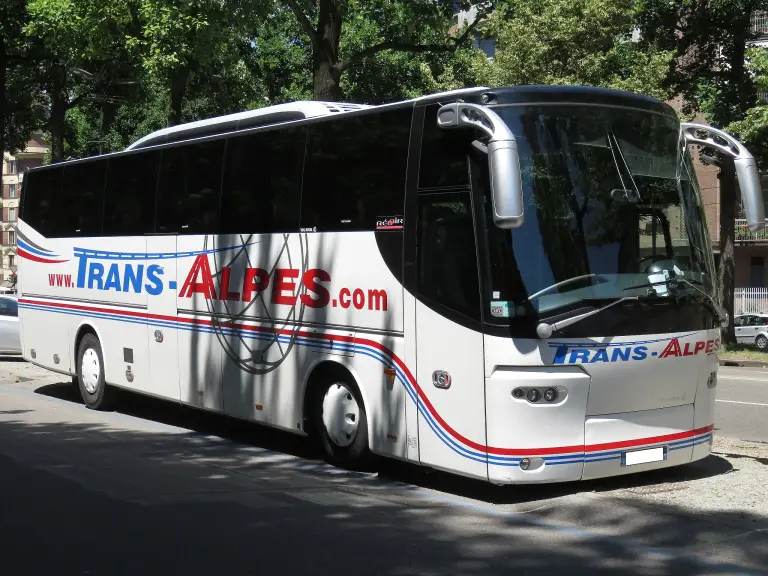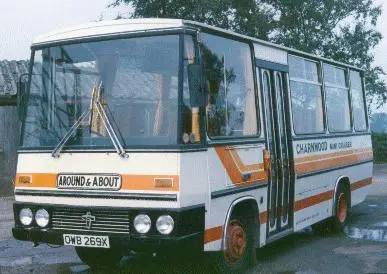
The Bova Europa was the Dutch coachbuilder’s touring coach of the late 1970s. Introduced in 1977 as the successor to the Benelux, it was built at Valkenswaard with angular bodywork and sold particularly well in Britain, until the Futura replaced it in September 1982.
Bova Europa at a glance
| Maker | Bova, Valkenswaard, Netherlands |
|---|---|
| Production | 1977–1982 |
| Predecessor | Bova Benelux |
| Successor | Bova Futura, introduced September 1982 |
| Type | touring coach |
| Body | integral, self-supporting |
| Styling | angular lines, in contrast to the later Futura |
| Strongest market | the United Kingdom |
| Calypso derivative | coach on the Europa underframe with Duple bodywork |
The Europa has no Wikipedia article of its own; this page is based on the model notes in the English article on VDL Bova and the Dutch article on the Valkenswaard works. Free photographs of the Europa were not found, so the article uses the record’s existing picture.
History of the Bova Europa
Bova’s second integral coach
Bova began as a timber business founded in 1878 by Jacob Bots, and the name BOVA came from his son Simon: it stood for Bots Valkenswaard. For years the company built bus bodies on chassis from several makers, including DAF, Scania Vabis, Mercedes-Benz, Büssing and Bedford, before switching to integral, self-supporting construction in 1970.
The first integral type was the Benelux, which stayed in production for seven years and was offered both as a touring coach and as a regional bus. In 1977 it was succeeded by the Europa, designed specifically as a touring coach. The Europa was very successful, above all in the United Kingdom, and it shared the angular lines typical of the period rather than the rounded, aerodynamic shape that came after it.
Replaced by the Futura
In September 1982 Bova introduced the Futura as the Europa’s successor. The contrast between the two was deliberate: where the Europa was angular, the Futura had a distinctive convex aerodynamic front, and that new shape gave the model its name. The Europa’s underframe did not disappear with the coach, however; it was used for the Calypso, a coach with Duple bodywork.
Bova itself later became part of the VDL Groep, which bought the company in 2003 and renamed it VDL Bova. From 2010 the individual VDL coach brands were discontinued and VDL Bova became part of VDL Bus & Coach, building the Futura line that had started with the Europa’s replacement.
Design and features
- Touring coach design: the Europa was conceived as a coach rather than as a bus or interurban vehicle.
- British success: the model sold especially well in the United Kingdom.
- Angular styling: a squared-off shape that contrasted with the aerodynamic Futura that followed.
- Integral construction: a self-supporting body, as Bova had adopted in 1970 with the Benelux.
Bova Europa versions
- Europa coach (1977–1982): the standard touring coach.
- Bova Calypso: a coach built on the Europa underframe with Duple bodywork.
- Late Europas: the last examples sold alongside the first Futuras in 1982.
The Europa was replaced by the Bova Futura in 1982, and its place at the top of the range was later taken by the Bova Magiq. More coaches are in the Bova collection.
Sources
- VDL Bova, English Wikipedia: products, Calypso, company history
- VDL Bus Valkenswaard, Dutch Wikipedia: Benelux, 1977 Europa, British market
- VDL Futura, English Wikipedia: 1982 replacement, angular Europa styling