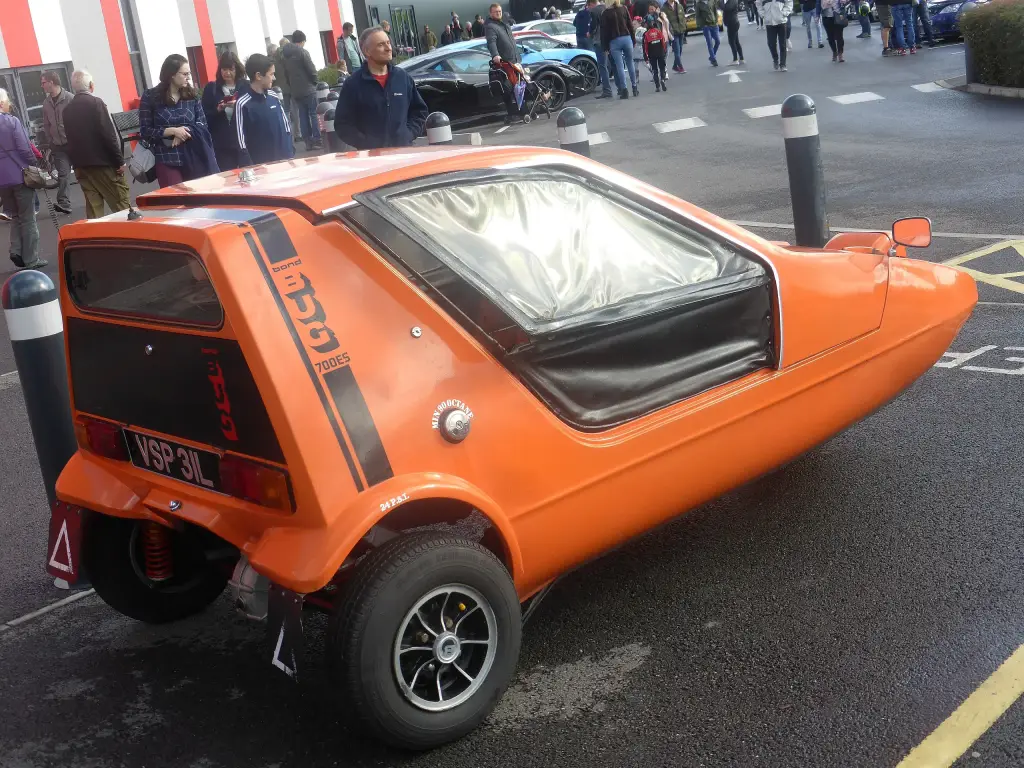
The Bond Bug is a small British two-seat, three-wheeled car designed by Tom Karen of Ogle Design for Bond Cars and built from 1970 to 1974. Its wedge-shaped glassfibre body has a lift-up canopy and side screens instead of conventional doors, and under the rear body sits a 700 cc Reliant four-cylinder engine.
Bond Bug at a glance
| Maker | Bond Cars Ltd, then Reliant, Tamworth |
|---|---|
| Production | 1970–1974 |
| Designer | Tom Karen, Ogle Design |
| Layout | three wheels, two seats, front-mounted engine |
| Engine | 700 cc Reliant light-alloy four-cylinder |
| Power | 29 bhp (700, 700E); 31 bhp (700ES) |
| Body | glassfibre, lift-up canopy, side screens |
| Top speed | 76 mph (122 km/h) |
| Price at launch | £629 |
| Colour | tangerine orange as standard |
based on one source
History of the Bond Bug
From Reliant Rogue to Bond Bug
Reliant had wanted a sportier version of its Regal three-wheeler since the Regal 3/25 appeared in 1962, and Ogle made design sketches for such a car as early as 1964. That study, called the Reliant Rogue, was never built because management feared such a strange-looking vehicle would damage the Reliant brand. After Reliant bought Bond Cars Ltd in 1969, the design was handed back to Tom Karen of Ogle and reworked as a Bond.
The chassis and running gear
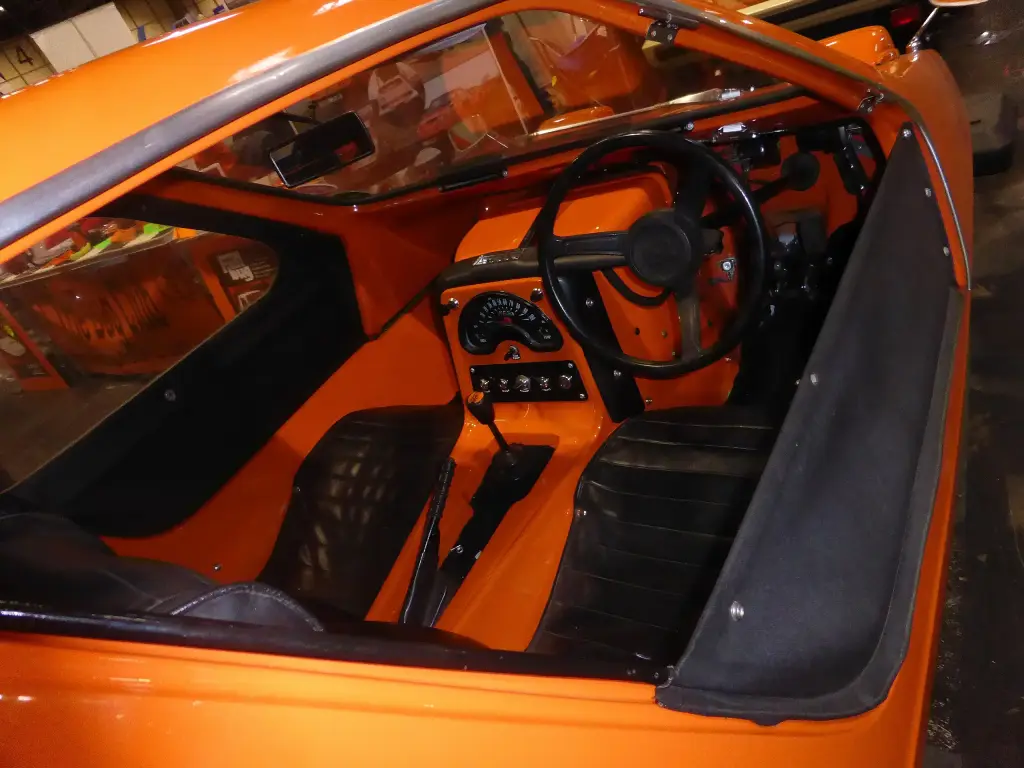
The Bug was built on chief engineer John Crosthwaite’s new chassis and mixed Reliant Regal parts with running gear intended for the Reliant Robin 750, which would only appear in 1974. The original concept was explored by cutting down a production Regal, shortening the rear so that it ended over the rear axle. The engine was the front-mounted 700 cc Reliant light-alloy four-cylinder.
Launch and production
The car was launched with an upbeat message from Reliant’s Ray Wiggin, who said the fact it had three wheels was “quite incidental”. It was sold in bright tangerine orange, although six white cars were built for a Carreras Rothmans cigarette promotion. Despite the three-wheeler image, the Bug could reach 76 mph, more than the UK national speed limit and comparable with a basic 850 cc Mini. It was not cheap, though: at £629 it cost slightly more than a basic Mini at £620.
The end and after
Reliant launched the Bond Bug 750 in late 1973, but fewer than 200 were sold before production ended in 1974, as Reliant closed other lines to free capacity for the new Reliant Robin 750. Ogle later studied four-wheeled versions under the code name FW9, and in 1990 Mike and Gary Webster bought the original moulds and produced four-wheeled Bug kit cars; fewer than 30 kits are known to have been sold. In 1994 Reliant showed the Sprint, a complete redesign of the Bug with the sharp edges rounded off by Tom Karen.
Design and features
- Lift-up canopy: the whole front of the body tilts up and the sides are closed with screens instead of doors.
- Wedge shape: Ogle’s glassfibre body is wide at the rear and low at the front, with no attempt to look like a conventional car.
- Light and quick: a low seating position gives a go-kart impression, and the 700 cc engine pushes the car to 76 mph.
- 700ES equipment: a higher-compression cylinder head, more padding over the engine cowl, twin mudflaps, an ashtray, a rubber front bumper and a spare wheel.
Bond Bug versions
- 700 and 700E: the standard models with 29 bhp.
- 700ES: the range-topping version with a redesigned cylinder head, 8.4:1 compression and 31 bhp.
- Bug 750: launched in late 1973 with running gear from the Robin 750; fewer than 200 sold.
- Webster Bug: four-wheeled kit cars built from the original moulds from 1990, in convertible and closed forms.
The Bug shared its engine layout with the Bond 875, and more British three-wheelers are in the Bond collection.
Video: Bond Bug
Video on YouTube.
Sources
- Bond Bug, English Wikipedia: design, engine, production, variants