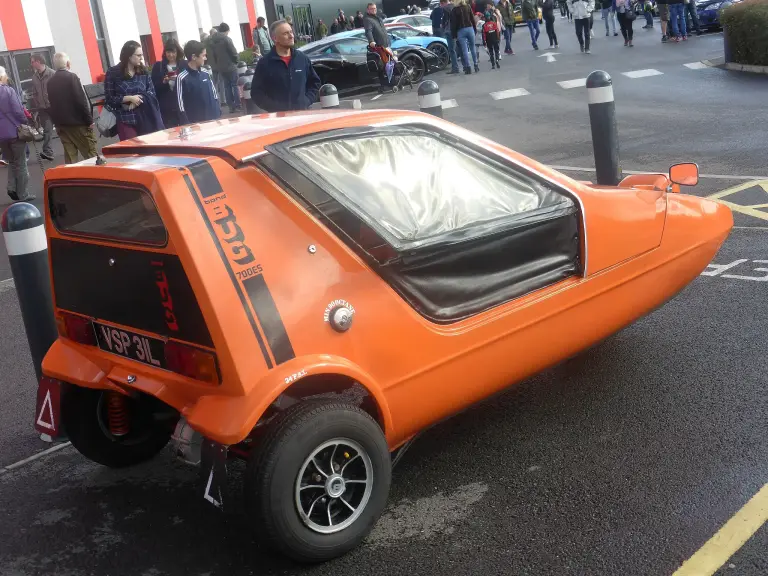
The Bond 875 is a small three-wheeled car partly designed by Lawrence “Lawrie” Bond and manufactured by Bond Cars Ltd in Preston from 1965 to 1970. Its 875 cc four-cylinder engine sits at the rear, as in the Hillman Imp, and the light glassfibre body helped it outperform the Imp it borrowed its running gear from.
Bond 875 at a glance
| Maker | Bond Cars Ltd, Preston |
|---|---|
| Production | 1965–1970 |
| Engine | 875 cc Rootes four-cylinder, rear-mounted |
| Power | 34 bhp |
| Compression | 8:1, able to run on 2-star petrol |
| Weight | under 400 kg (882 lb) |
| Top speed | 80 mph (129 km/h) |
| 0–60 mph | 16 seconds |
| Fuel economy | 50–55 mpg imperial |
| Tyres | Michelin X radial |
| Price new | £500–£506 |
based on one source
History of the Bond 875
A rear-engined three-wheeler
The 875 was announced in August 1965, although volume production only got under way in the summer of 1966. It used the lower-compression 8:1 version of the 875 cc four-cylinder engine from the Commer Imp Van, made by the Rootes Group. Crucially for the way the car drove, the engine was mounted at the rear, unlike most other British three-wheelers of the time. Bond installed the Imp engine as a complete package with the Imp’s transmission, rear suspension and rear wheels.
Light body, good performance
Because the body was glassfibre with aluminium doors and the car weighed less than 400 kg, performance was better than that of the Imp. The low-compression engine could run on cheaper 2-star petrol, and the low weight let the car qualify for motorcycle road tax and be driven on a motorcycle licence. To keep the weight down, the interior trim and fittings were minimal.
Racing and road tests
Racing driver John Surtees drove the car at Brands Hatch in 1965, setting a fastest lap of 1:22 for the 1.24-mile circuit and reaching over 100 mph. Bond track-tested a standard production version at Silverstone in 1966, recording a lap of 1:43.34 and 76 mph through a timing trap on the Hanger Straight, then refused to confirm or deny a racing version for 1967. Autocar tested the car in September 1966 and found it quick and economical, usefully ahead of the 850 cc Morris Mini, but unstable at high speed, with poor seats and detail finish.
Mark II and the Ranger
A van version called the Ranger was introduced in April 1967. Styling changes including rectangular headlamps, a new front grille, a larger bonnet opening and revised seats marked the Mark II in April 1968, which also brought a heater as standard equipment.
Design and features
- Rear engine: the Imp-derived engine and transmission sit behind the rear axle, giving traction and a different balance from most three-wheelers.
- Glassfibre body: a light shell with aluminium doors keeps the car under 400 kg.
- Motorcycle licence: the low weight allowed motorcycle road tax and a motorcycle licence.
- Economy: the low-compression engine ran on cheap 2-star petrol and returned 50–55 mpg.
Bond 875 versions
- 875 (1965–1970): the standard three-wheeled car.
- Ranger (1967): the van version, introduced in April 1967.
- Mark II (1968): rectangular headlamps, a new grille, a larger bonnet opening, revised seats and a standard heater.
The later Bond Bug used a front-mounted Reliant engine instead, and more Bond models are in the Bond collection.
Video: Bond Ranger 875 with Hillman Imp engine
Video on YouTube.
Sources
- Bond 875, English Wikipedia: development, specifications, road tests