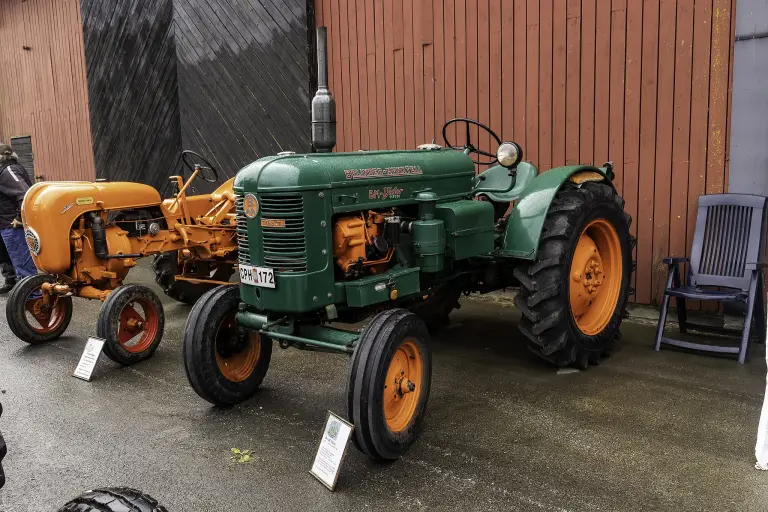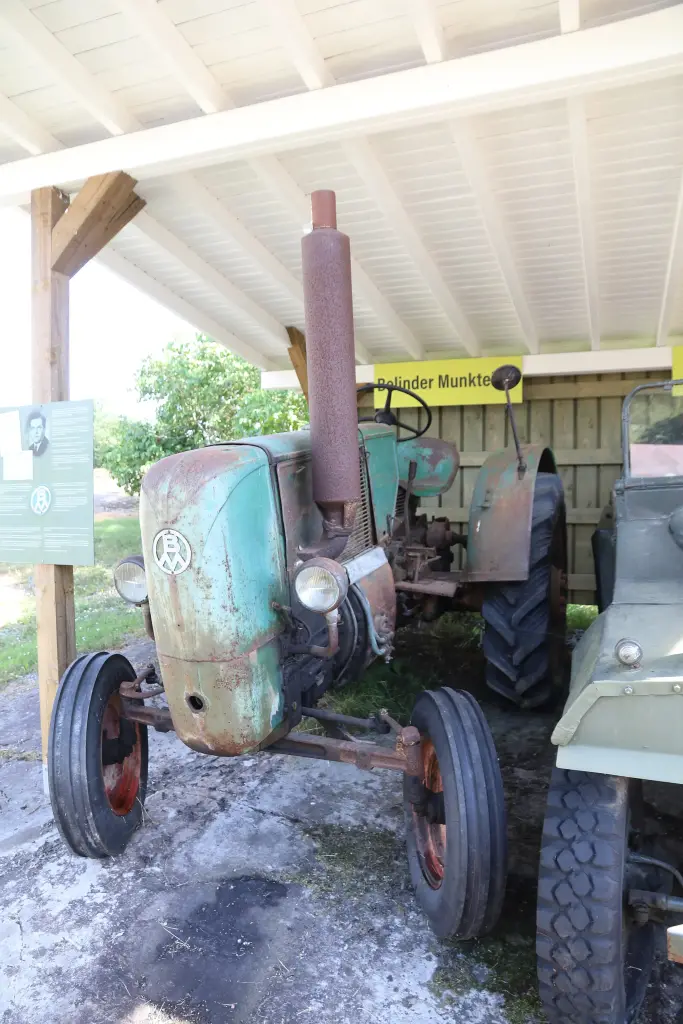
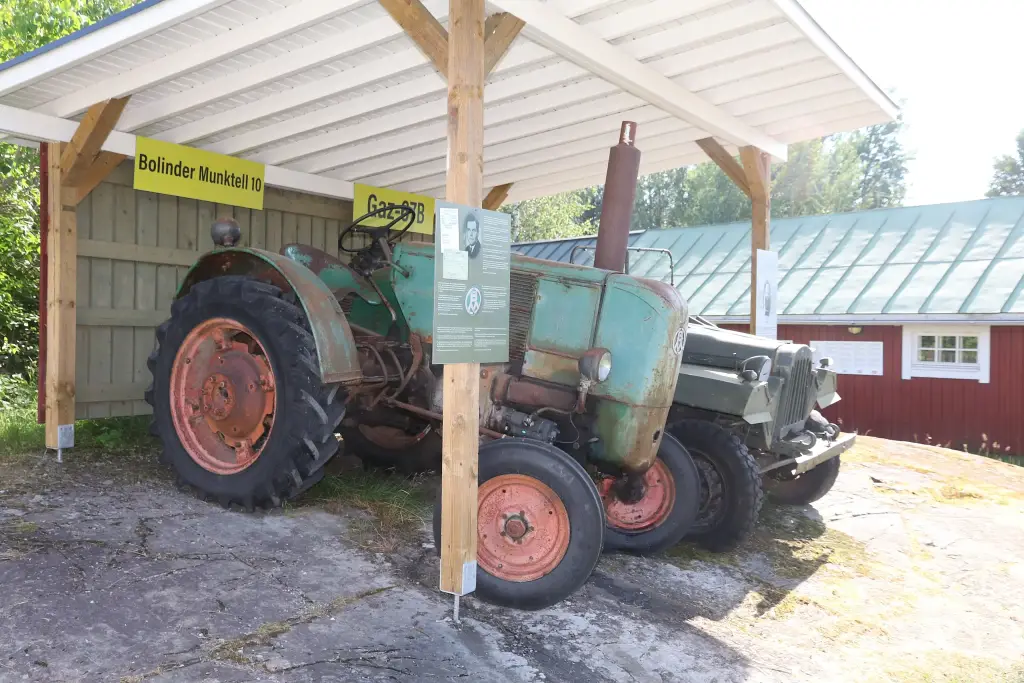
The Bolinder-Munktell BM 10 was a small Swedish farm tractor built in Eskilstuna between 1946 and 1953. It was the last Bolinder-Munktell tractor to use the hot-bulb engine that had made the company’s name, and with some 6,400 examples it was one of the most common machines of its kind in Sweden.
Bolinder-Munktell BM 10 at a glance
| Maker | AB Bolinder-Munktell, Eskilstuna, Sweden |
|---|---|
| Production | 1946–1953 |
| Built | about 6,400 |
| Engine | Bolinder W 3, two-cylinder two-stroke hot-bulb engine |
| Fuel | crude oil |
| Displacement | 2.71 litres |
| Power | 23 hp at 1,200 rpm |
| Gearbox | five forward, one reverse |
| Drive | two-wheel drive |
| Front width | 28 cm at the nose |
| Body | rear section shared with the Volvo T 20 series |
| Role | small and medium-sized farms |
The BM 10 has a page only on Swedish Wikipedia, based on the Munktell Museum; the English article covers the company rather than the model. Company history comes from both.
History of the Bolinder-Munktell BM 10
A merger of two workshops
AB Bolinder-Munktell was formed in Eskilstuna in 1932 by the merger of two old engineering firms, Munktells Mekaniska Verkstad, founded by Johan Theofron Munktell in 1832, and J. & C.G. Bolinders Mekaniska Verkstad, founded in Stockholm by Jean and Carl Gerhard Bolinder in 1845. Bolinders were known above all for semi-diesel, or hot-bulb, marine engines, and tractor production had begun in 1913 with the 30-40. After the merger the abbreviated brand BM stood for both names.
The BM 10 and the Volvo connection
The BM 10 appeared in 1946, two years after Volvo had begun to take an interest in the company; Handelsbanken sold its shares to Volvo in 1950 and the tractor maker became a subsidiary. The BM 10 was developed together with Volvo, and its rear section is the same as that of the Volvo T 20 series. The two firms went different ways under the bonnet: Volvo used its own four-cylinder engines, while Bolinder-Munktell stayed with its two-cylinder two-stroke hot-bulb units.
The end of an engine type
The BM 10 was the last Bolinder-Munktell tractor with a hot-bulb engine, a type in which the cylinder head has to be heated before the engine will fire. It was aimed at smaller and medium-sized farms, while the larger BM 20 was meant for big holdings. Production ended in 1953 and the model was followed by tractors with more conventional diesel engines. The company itself was renamed Volvo BM AB in 1973 and became Volvo Construction Equipment in 1995.
Design and features
- Hot-bulb engine: the Bolinder W 3 is a two-cylinder two-stroke unit with side injection that runs on crude oil.
- Narrow nose: the front of the tractor was only 28 cm wide, which made it easy to work between rows.
- Simple transmission: five forward gears and one reverse, with two-wheel drive.
- Shared rear end: the back of the tractor is common with the Volvo T 20 series, a result of joint development.
- Exhaust position: the exhaust pipe originally pointed backwards and was later turned upwards.
Bolinder-Munktell BM 10 versions
- Early BM 10: rearward-pointing exhaust as built at the start of production.
- Later BM 10: upward-pointing exhaust pipe.
- BM 20: the larger stablemate for big farms, also with a two-cylinder hot-bulb engine.
- Volvo T 20 series: the Volvo version of the shared chassis, with a four-cylinder Volvo engine.
The next step in the range was the Bolinder-Munktell BM 230 Victor, which used a proper diesel engine. Other machines of the marque are in the Bolinder-Munktell collection.
Video: Bolinder-Munktell BM 10
Video on YouTube.
Sources
- Bolinder-Munktell BM 10, Swedish Wikipedia: production years, engine, transmission, production total
- Bolinder-Munktell, English Wikipedia: company history, merger, Volvo ownership
- Bolinder-Munktell, Swedish Wikipedia: company history, product list