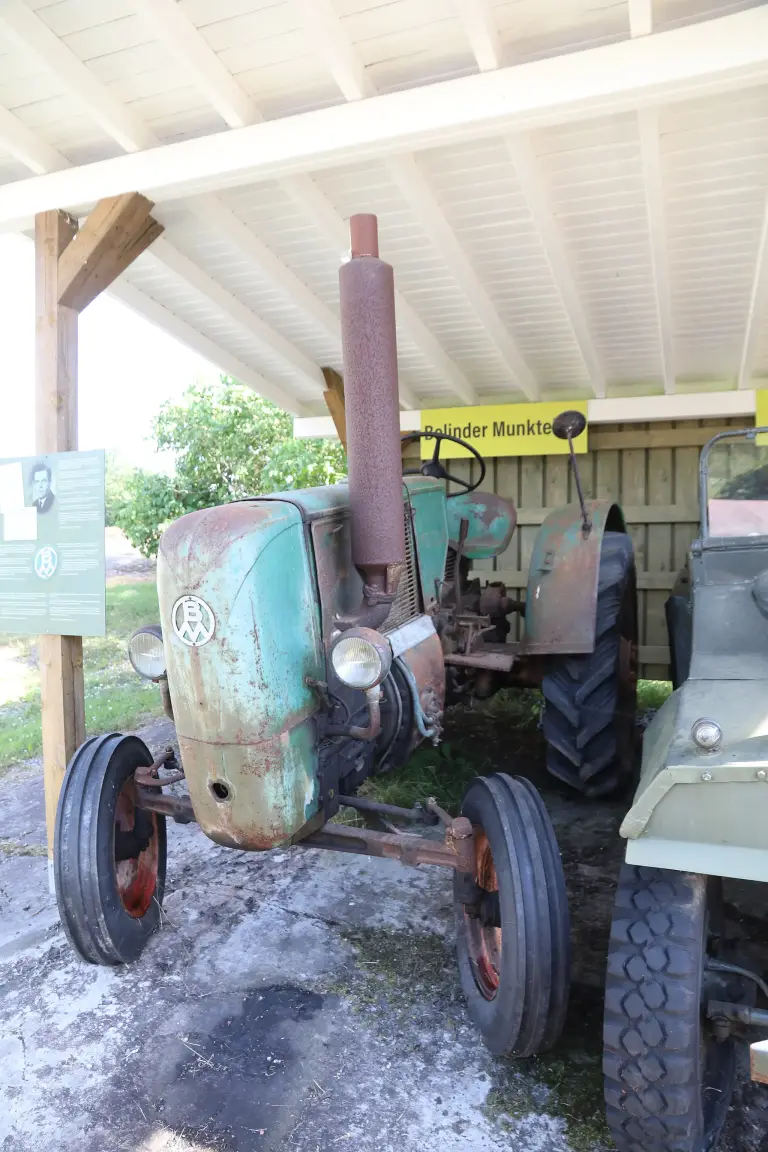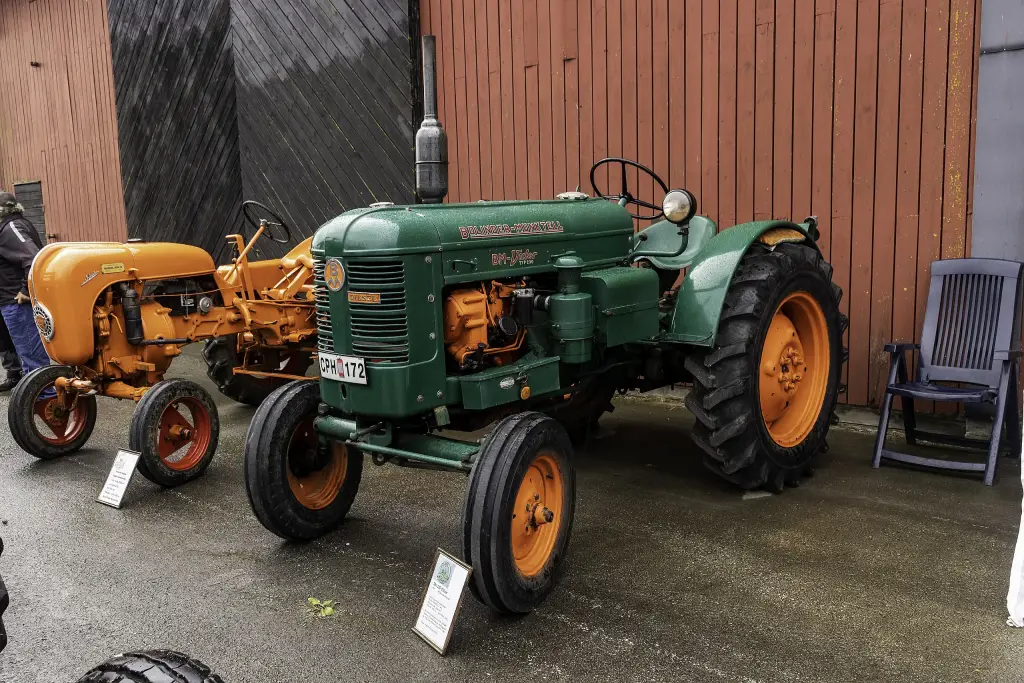
The Bolinder-Munktell BM 230 Victor was a Swedish farm tractor built between 1955 and 1961. It was sold both as a BM and as the Volvo T 230, and its combination of pulling power, low fuel consumption and simple durability made it one of the most popular tractors of its day in Sweden.
Bolinder-Munktell BM 230 Victor at a glance
| Maker | Bolinder Munktell, Eskilstuna, Sweden |
|---|---|
| Production | 1955–1961 |
| Also sold as | Volvo T 230 |
| Engine | Bolinders 1052, two-cylinder diesel |
| Displacement | 2.24 litres |
| Bore and stroke | 104.77 mm × 130 mm |
| Power | 33 hp at 2,000 rpm |
| Maximum torque | 14.5 kpm at 800 rpm |
| Gearbox | five forward, one reverse |
| Top speed | 22.9 km/h forward, 4.2 km/h reverse |
| Fuel tank | 55 litres |
| Wheelbase | 1,850 mm |
| Length and width | 2,850 mm and 1,670 mm |
| Weight | 1,650 kg |
The Victor has an article only on Swedish Wikipedia, which cites Olov Hedell’s company history and the Traktorkalendern; the English article covers the company rather than the model.
History of the Bolinder-Munktell BM 230 Victor
A Volvo-owned tractor maker
Bolinder-Munktell had been part of Volvo since 1950, when Handelsbanken sold its shares, and the two makes were sold side by side. The BM 230 Victor of 1955 was therefore also marketed under the Volvo name as the T 230, and the model became the most produced tractor in the company’s history. The works in Eskilstuna had been building tractors since 1913, at first with hot-bulb engines; the Victor marked the move to a modern diesel.
Why farmers liked it
The Victor was quickly taken up for its pulling power, its fuel economy and the toughness of its construction. It was not a refined machine: the power take-off is not independent of the transmission, there is no differential lock, and the three-point linkage can only raise and lower the implement, without draft or position control. There are no doors either, so the driver climbs in and out from the back. Even so the model has acquired a certain cult status among collectors of veteran tractors.
Beyond the farm
The Victor’s chassis was used by ÖSA as the basis for the BMB 230 Bamse, a fully tracked forestry machine. Production of the tractor ended in 1961, by which time Bolinder-Munktell was preparing the larger models that carried the marque into the Volvo BM years; in 1973 the company itself took the name Volvo BM AB.
Design and features
- Two-cylinder diesel: the Bolinders 1052 gives 33 hp at 2,000 rpm from 2.24 litres, with maximum torque at only 800 rpm.
- Economy and pull: low fuel consumption and strong low-speed torque were the reasons farmers bought it.
- Simple engineering: no independent power take-off, no differential lock and a basic three-point lift.
- Cab without doors: entry and exit are from the rear of the tractor.
- Long production run: six years, 1955 to 1961, and the most produced model in the company’s history.
Bolinder-Munktell BM 230 Victor versions
- BM 230 Victor: the tractor as sold under the Bolinder-Munktell name.
- Volvo T 230: the same machine sold through the Volvo dealer network.
- BMB 230 Bamse: a tracked forestry machine built by ÖSA on the Victor chassis.
- BM 10: the earlier two-cylinder hot-bulb tractor of the range.
The Victor followed the hot-bulb Bolinder-Munktell BM 10 in the range. More machines of the marque are in the Bolinder-Munktell collection.
Video: Bolinder Munktell Typ 230 Viktor
Video on YouTube.
Sources
- Bolinder Munktell 230 Victor, Swedish Wikipedia: production, engine data, transmission, dimensions
- Bolinder-Munktell, English Wikipedia: company history, Volvo ownership, model list
- Bolinder-Munktell, Swedish Wikipedia: company history, most produced model