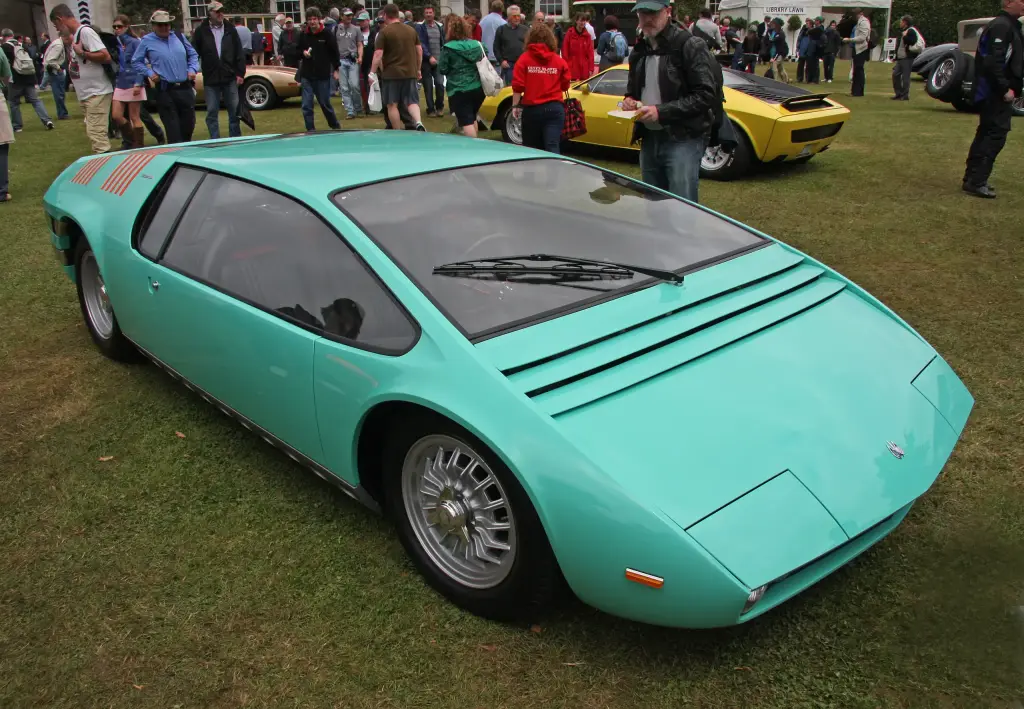
The Bizzarrini Manta was a concept car designed by Giorgetto Giugiaro and shown at the Turin motor show in October 1968. It was the first design study from Italdesign, the studio Giugiaro had just founded, and its one-box shape, only 1.06 m tall, is regarded as a landmark for the design of later mid-engined sports cars.
Bizzarrini Manta at a glance
| Designer | Giorgetto Giugiaro, Italdesign |
|---|---|
| Shown | Turin motor show, October 1968 |
| Type | concept car, not roadworthy at the time |
| Base chassis | Bizzarrini P538-003, raced at Le Mans in 1966 |
| Engine | production Chevrolet V8 |
| Layout | mid-engined, rear-wheel drive |
| Body | one-piece, one-box style, acid green |
| Height | 1.06 m |
| Seats | three, driver in the centre |
| Built by | Autocostruzioni S.D. in 45 days |
| Later colours | red for Tokyo, silver, then back to acid green |
| Whereabouts | lost 1969–1980, later in the United States |
Accounts differ on whether the Manta really used a P538 chassis: some authors point to technical differences, and the Italdesign website once named an Iso Grifo instead. Giugiaro himself confirmed the P538 origin in 2008.
History of the Bizzarrini Manta
Giorgetto Giugiaro had run the design office at Bertone from 1959 and held the same position at Carrozzeria Ghia from 1965. After leaving Ghia at the beginning of 1967 he set up a small studio of his own, Ital Styling, and then went into partnership with Aldo Mantovani, Fiat’s long-serving production manager. In February 1968 they founded SIRP, Studi Italiani Realizzazione Prototipi, which was renamed Italdesign later that year. Its first design study was to be presented at the Turin motor show in October 1968.
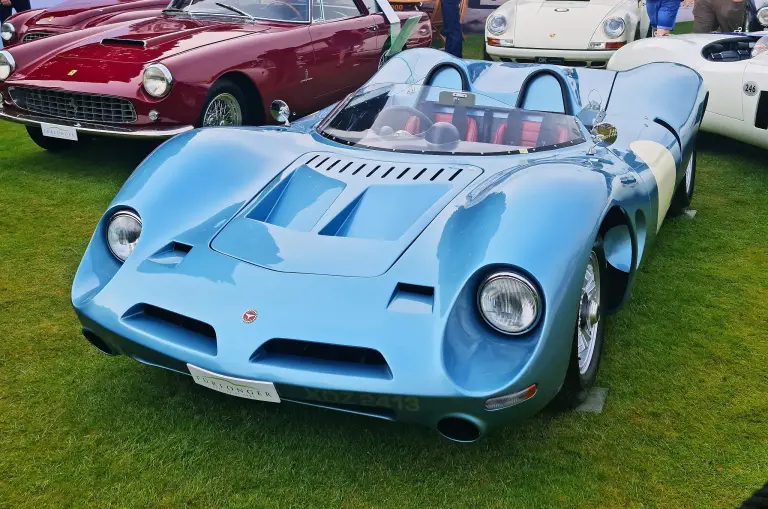
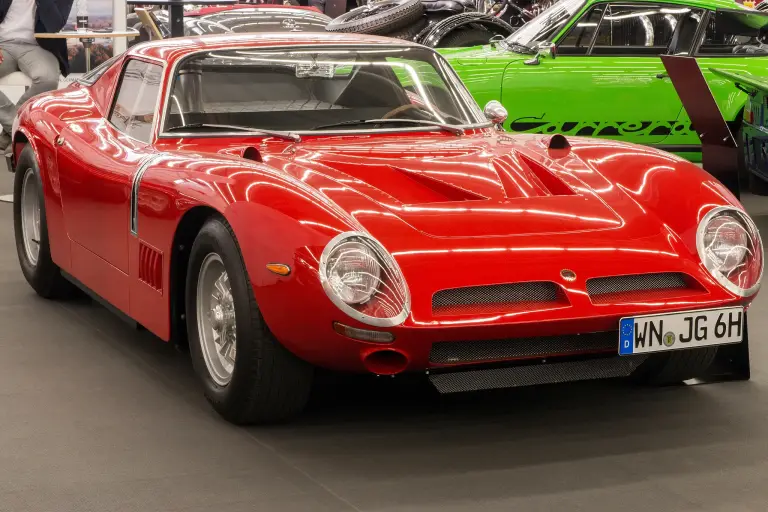
The technical basis came from Bizzarrini, the Tuscan sports car maker, which was already in financial trouble. Bizzarrini had designed the P538 racing car in 1966 as a companion to the road-going GT 5300, but it was entered in only two competitions and was no longer legal from 1967 after a change in the rules. Only four P538s were built up to 1968 and one was destroyed early on. The chassis P538-003, which the works team had taken to the 24 Hours of Le Mans in 1966, was therefore out of date and for sale, and Giugiaro bought it in the summer of 1968.
The show car was assembled in 45 days by the specialist firm Autocostruzioni S.D., and at that stage it was not driveable. It appeared in Turin in October 1968 in a light green paintwork described as acid green. Soon afterwards it was shown at the Tokyo motor show in red, and then at a show in Los Angeles. On the way back to Italy the car disappeared in 1969 and was lost for about ten years; it surfaced again in 1980 at an auction by the Italian customs. It passed to Giovanni Giordanengo, whose workshop had built replicas of classic sports cars, then to a Swedish collector and later to the United States. It has since been made driveable with help from Autocostruzioni S.D. and is shown regularly in America; after a period in silver it again wears its original acid green.
The name refers to the manta ray. Charles “Chuck” Jordan, a designer at General Motors, noticed it in Turin, and Opel took the word — which Italdesign had not protected — for its own coupé presented shortly afterwards.
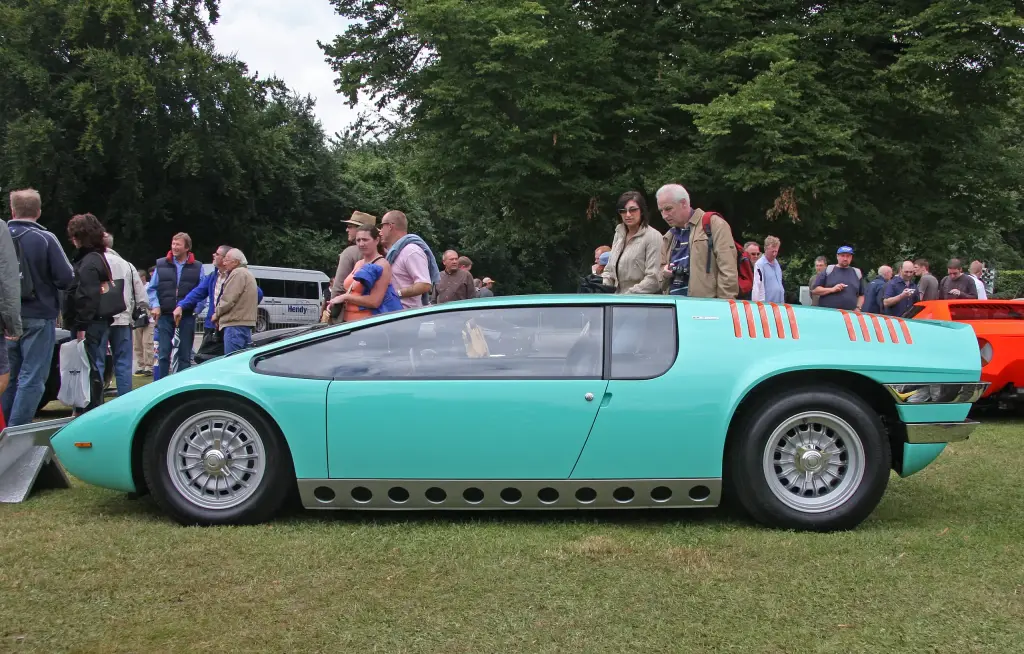
The Manta is 1.06 m tall and its body is a single unit in what became known as the one-box style: the nose runs without a step into the windscreen, which in turn flows into the flat rear of the roof. A second window below the windscreen, covered by louvres that can be opened, improves the view forward. The passenger cell sits far forward while the engine compartment behind the driver takes up a great deal of room, a proportioning that underlines the mid-engined layout. The one-piece side windows reach well past the doors into the wings and swing into the cabin when the doors open. The rear of the roof is glazed and a further vertical glass panel is set into the slightly tapered tail.
The Manta is a three-seater, with the driver in the middle and a passenger seat on either side. Pininfarina had shown the same arrangement in 1966 on the Ferrari 365 P Speciale, but in the Manta it followed from the chassis: the P538 had been designed for racing, and its driving position sat almost in the centre of the car for better weight distribution. The engine is a large-series Chevrolet eight-cylinder.
Design and features
- First Italdesign car: the studio’s opening design study, shown in Turin in October 1968.
- One-box body: a single flowing form from nose to tail, only 1.06 m tall.
- Central driving position: three seats abreast, with the driver in the middle.
- Racing chassis: the P538-003 chassis that ran at Le Mans in 1966.
- Troubled history: lost for about a decade after 1969 and rediscovered at a customs auction.
Bizzarrini Manta versions
- Turin, 1968: acid green, as first shown.
- Tokyo, 1968: repainted red for the Tokyo motor show.
- Later repaint: silver before the return to acid green.
- Running car: made driveable decades after its debut with help from Autocostruzioni S.D.
The Manta was built on the chassis of the Bizzarrini P538, the racing car that shared its V8 with the Bizzarrini 5300 GT. More cars are in the Bizzarrini collection.
Video: #1693. Bizzarrini manta italdesign 1968 (Prototype Car)
Video on YouTube.
Sources
- Bizzarrini Manta, English Wikipedia: design, chassis, presentation
- Bizzarrini Manta, German Wikipedia: Italdesign history, body design, later history, name
- Bizzarrini P538, French Wikipedia: history of the P538 chassis