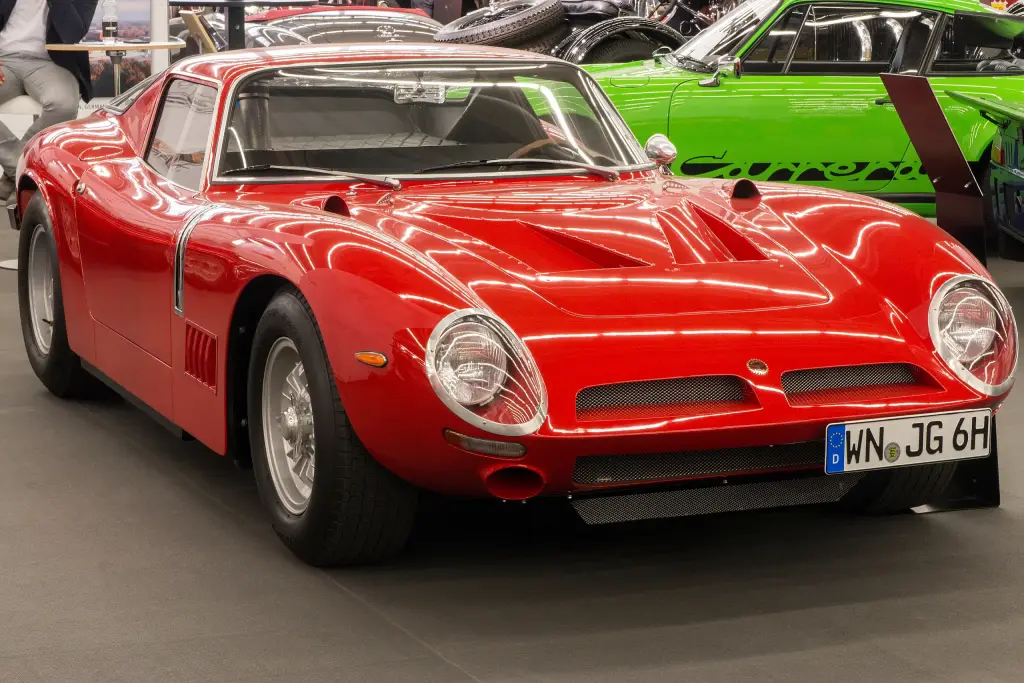
The Bizzarrini 5300 GT was the road-going version of a racing car that Giotto Bizzarrini built for himself after Iso refused to develop one. Launched in 1965, it used a Chevrolet V8 in a low coupé body inspired by the Iso Grifo A3C, and it remained in production until 1969, when the company closed after making 133 cars.
Bizzarrini 5300 GT at a glance
| Maker | Bizzarrini, Livorno, Italy |
|---|---|
| Production | 1965–1969 |
| Built | 133 |
| Engine | 5,385 cc Chevrolet V8, 11:1 compression, one Holley four-barrel carburettor |
| Power | 365 hp |
| Gearbox | Borg-Warner four-speed manual |
| Transmissions offered | two sets of ratios, short or long |
| 0–100 km/h | just under 6.5 seconds |
| Top speed | 250 km/h with short gearing, 280 km/h with long |
| Body | two-door coupé |
| Design basis | Iso Grifo A3C by Giorgetto Giugiaro |
| Factory tuning kit | four Weber 45 DCOE carburettors and new camshafts, about 400 hp |
The 5300 GT has a full article only on the Italian Wikipedia; the English Wikipedia covers the company and its models as a whole. This page uses both.
History of the Bizzarrini 5300 GT
Giotto Bizzarrini had worked for Alfa Romeo and Ferrari before joining Iso Rivolta, where he designed the Iso Grifo. He wanted a competition version of the Grifo, but Renzo Rivolta, who preferred road cars, refused, and in 1964 the two men parted ways. Bizzarrini set up his own company in Livorno, first as Società Prototipi Bizzarrini and from 1966 as Bizzarrini S.p.A. To be allowed to race, the rules required a number of road cars to be built, and the 5300 GT was created for that purpose in 1965.
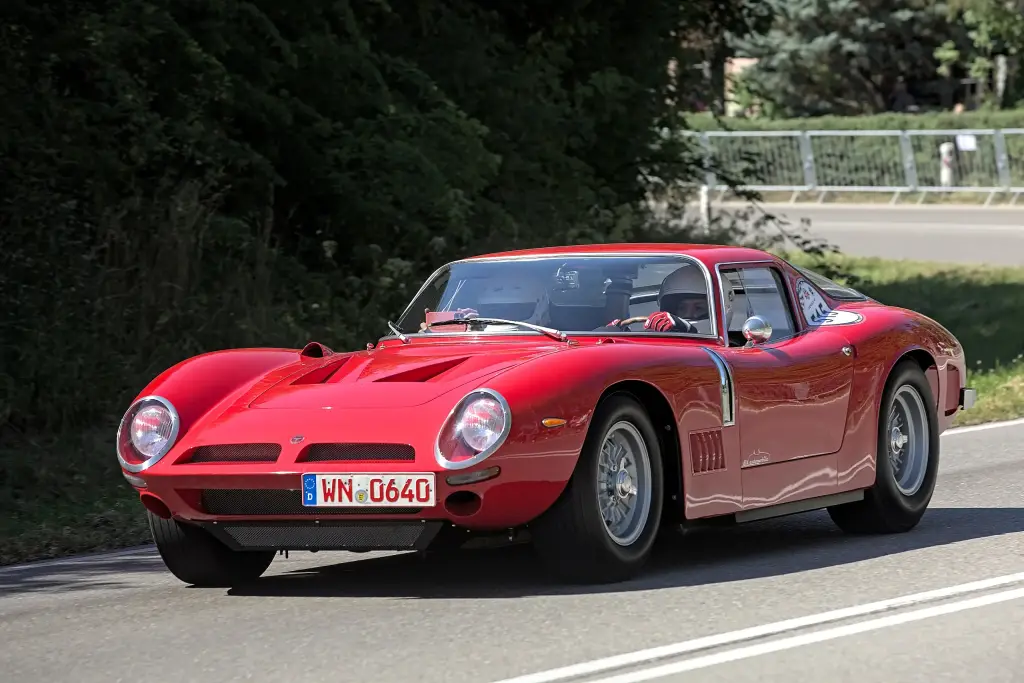
The car followed the lines Giorgetto Giugiaro had drawn for the Iso Grifo A3C, a lightweight aluminium-bodied racer. The 5300 GT Strada was the road version: a compact two-door coupé with a low roofline and a cabin that made few concessions to comfort. Its seat was not adjustable at all. Each one was built to measure for its owner at the factory, and the driving position was semi-reclined, close to the floor.
Two levels of trim were offered. In the spartan version the main instruments — speedometer, rev counter and fuel gauge — sat in the centre of the leather-trimmed dashboard next to the transmission tunnel, with oil temperature, oil pressure and water temperature gauges ahead of the driver. The more comfortable version gathered almost all the instruments into a heavy wooden console behind the steering wheel, and added a radio, mounted in front of the passenger or on top of the central tunnel, together with air conditioning.
Power came from a Chevrolet-derived V8 of 5,385 cc with a compression ratio of 11:1, fed by a single Holley four-barrel carburettor and rated at 365 hp. The gearbox was a four-speed Borg-Warner manual, and customers could choose between two sets of ratios: with the short transmission the car reached 100 km/h in a little under 6.5 seconds and 250 km/h, while the long transmission raised the top speed to about 280 km/h.
Bizzarrini later sold an upgrade for cars already delivered. It consisted of a special manifold carrying four twin-choke Weber 45 DCOE carburettors and camshafts with different profiles; with the kit the engine produced about 400 hp and the car could approach 300 km/h. The conversion appeared on competition cars and on road cars alike, and many owners brought their cars back to the factory to have it fitted.
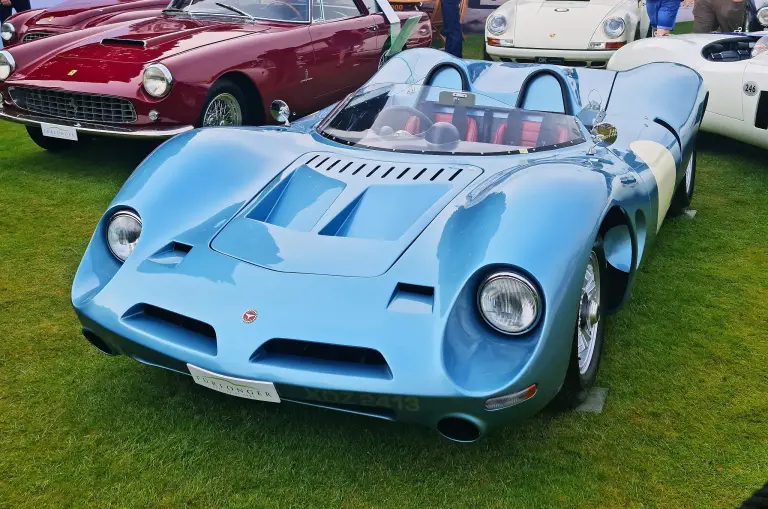
Production ended in 1969. Bizzarrini had built some 140 cars in all, 133 of them 5300 GTs, before the company failed; the model range also included the 5300 GT Spyder S.I. and the P538S racing car. The Bizzarrini name was bought in 2020 by Pegasus Brands, which announced plans to restart production.
Design and features
- Racing homologation: the road car existed so that Bizzarrini could take his Grifo-based racer to the track.
- Chevrolet V8: 5,385 cc and 365 hp as standard, with a factory kit taking it to about 400 hp.
- Purposeful cabin: a low, semi-reclined driving position and a seat moulded to its owner rather than adjustable.
- Two characters: a spartan instrument layout with centre gauges, or a comfortable version with wood, radio and air conditioning.
- Choice of gearing: short ratios for acceleration or long ones for a 280 km/h top speed.
Bizzarrini 5300 GT versions
- 5300 GT Strada (1965–1969): the standard road coupé.
- Spartan version: centre-mounted main instruments, secondary gauges ahead of the driver.
- Comfort version: instruments in a wooden console, plus radio and air conditioning.
- Weber conversion: four twin-choke carburettors and new camshafts, about 400 hp and close to 300 km/h.
- 5300 GT Spyder S.I.: the open version listed among the company’s models.
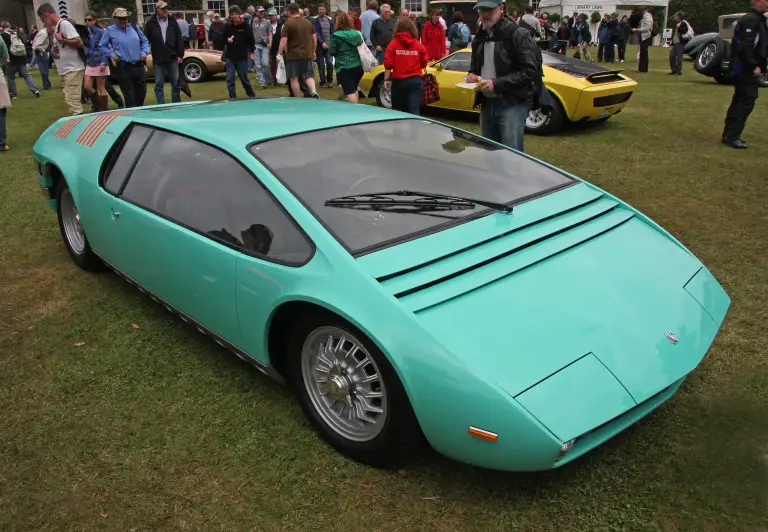
The 5300 GT was developed from Bizzarrini’s work on the P538 racing programme, and its chassis later underpinned the Bizzarrini Manta show car. More cars are in the Bizzarrini collection.
Video: 1967 Bizzarrini 5300 GT America in Paris
Video on YouTube.
Sources
- Bizzarrini 5300 GT, Italian Wikipedia: development, production total, engineering, performance, tuning kit
- Bizzarrini, English Wikipedia: company history, Giotto Bizzarrini, model range