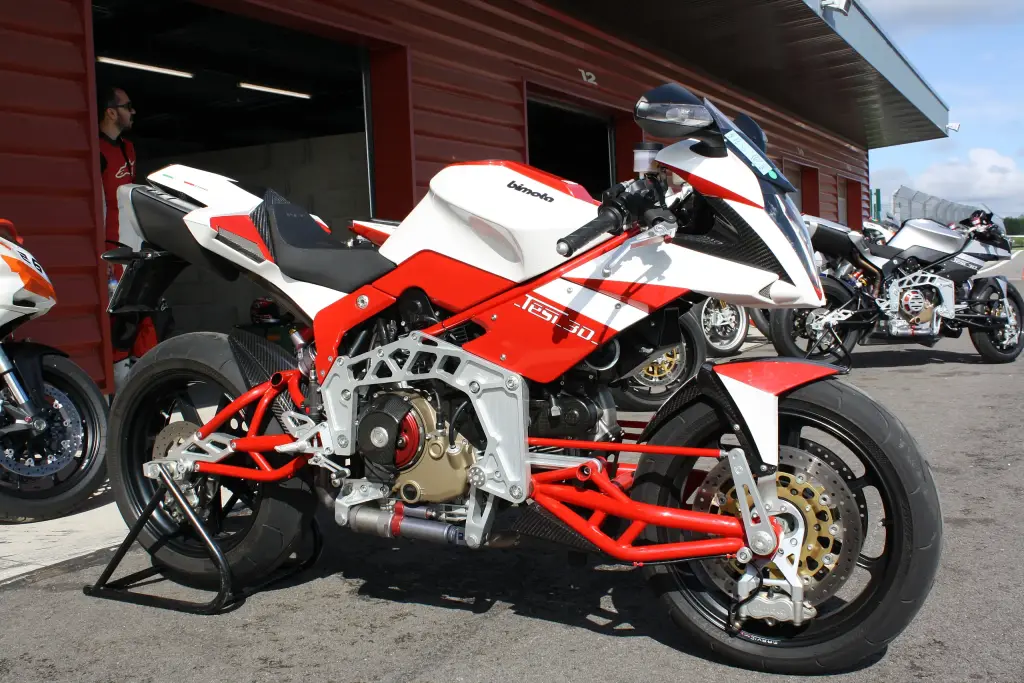
The Bimota Tesi 3D is the 2007 generation of Bimota’s Tesi line, whose front wheel is carried by a swingarm with hub-center steering instead of a telescopic fork.
Bimota Tesi 3D at a glance
| Manufacturer | Bimota, Rimini, Italy |
|---|---|
| Model | Tesi 3D, presented in 2007 |
| Engine | Ducati L-twin |
| Front suspension | Swingarm with hub-center steering |
| Rear suspension | Swingarm |
| Frame | Omega-shaped side plates |
| Tesi 3D units | 123 |
| Tesi 3D Evo units | 32 |
| Gold-plate series | 39 |
| Predecessors | Tesi 1D (1990), Tesi 2D (2002) |
This article covers the Tesi line with the Tesi 3D as its focus. It is based on the English and Italian Wikipedia articles on the Bimota Tesi and the Italian Wikipedia article on Bimota.
History of the Bimota Tesi 3D
The Tesi line began with a prototype presented at the Milan motorcycle show in 1983. It was powered by a Honda VF 400 F engine, had a carbon-fibre monocoque under the engine and used a hydraulic steering system called DCS (Dive Control System). In 1984 a second prototype raced in the Austrian and Italian rounds of the World Endurance Championship with a Honda VF 750 F engine producing 90 hp at 10,000 rpm, and in 1985 the frame became two Peraluman 35 omega-shaped beams.
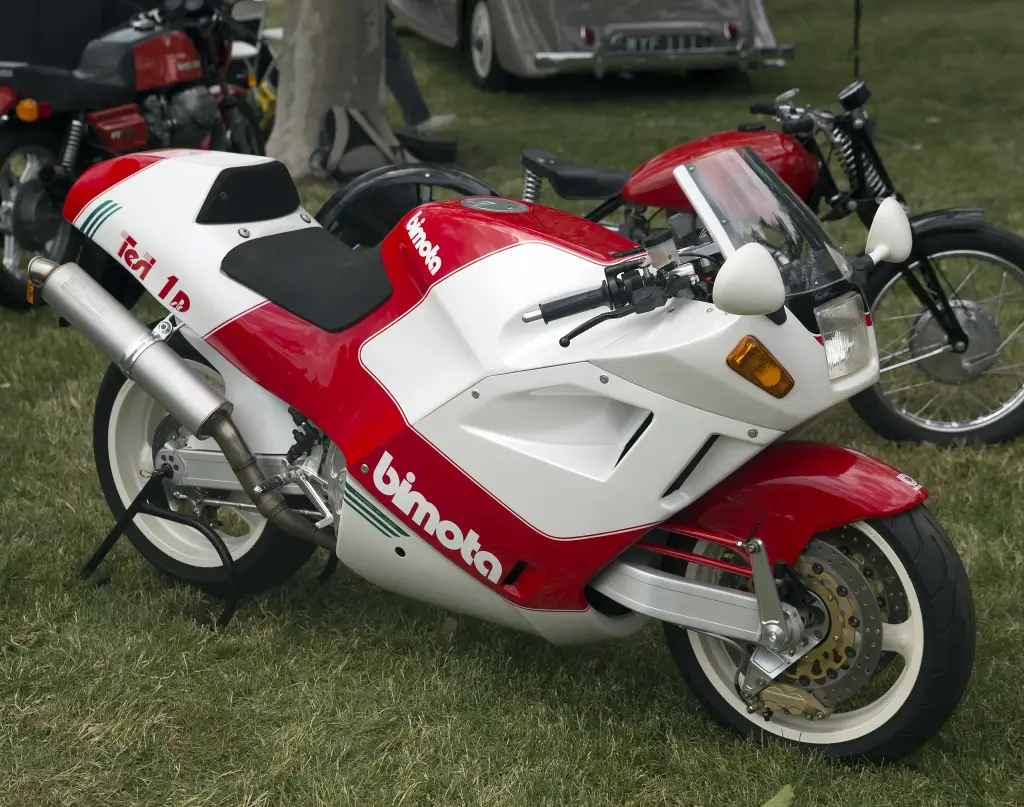
The hydraulic steering was abandoned in 1987 in favour of a linkage system on a Yamaha FZ 750-engined prototype, and in 1988 Bimota chose Ducati as the engine supplier because the Ducati crankcases were better suited to acting as a structural element. The first road-legal Tesi, the Tesi 1/D, was commercialised in 1990 and the line was discontinued in 1994. It returned in 2002 with the Tesi 2/D, developed by the Italian tuner Vyrus, and continued in 2007 with the Tesi 3/D.
How the Tesi front end works
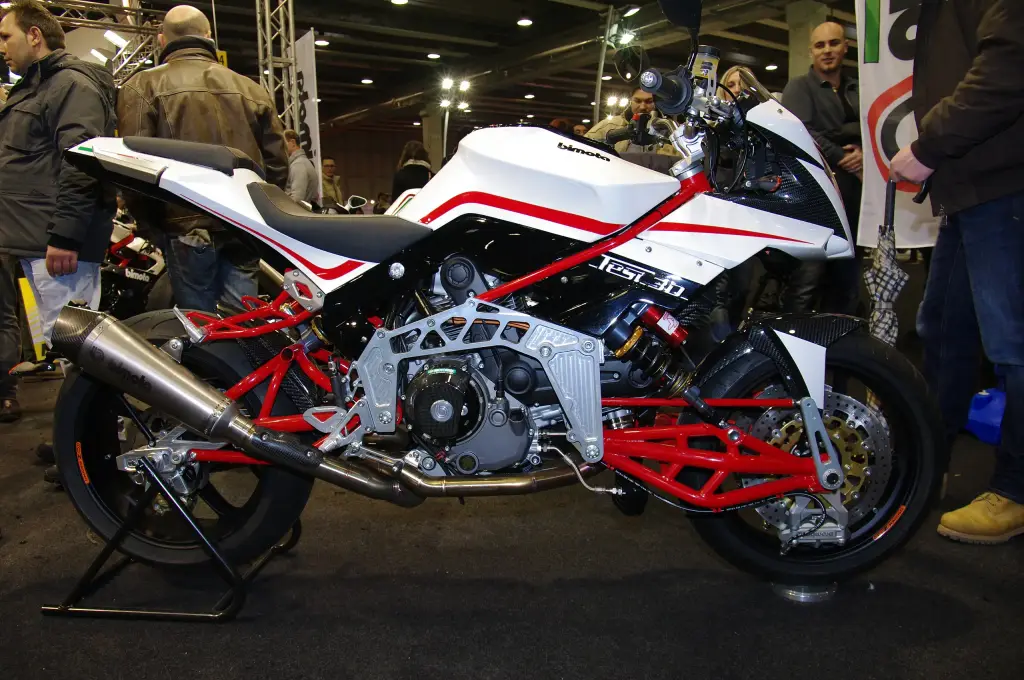
Instead of a telescopic fork, the Tesi uses a front swingarm and hub-center steering. The front and rear swingarms are connected by an omega-shaped frame, and the wheel hub contains two tapered bearings and an axle connected through a linkage to a small steering column on the left side of the bike. The layout separates steering from suspension, so the bike does not dive under braking and its geometry can be adjusted without affecting handling. The drawback is a large number of components, higher cost and a wider turning circle; the Tesi 3D reduced the last problem with a tubular trellis swingarm.
The Tesi 3D was presented in 2007, developed by the technician Acquaviva from the Tesi 1D project, with steel-tube trellis front and rear swingarms. It was built in 123 examples, followed by 32 Tesi 3D Evo machines and a further 39 examples with a gold plate and special paint. After Kawasaki took a stake in Bimota in 2019, the line continued with the Kawasaki-engined Tesi H2 in 2020.
Design and features
- Front suspension: a swingarm with hub-center steering instead of a telescopic fork.
- Frame: two omega-shaped side plates connecting the front and rear swingarms.
- Benefit: no fork dive under braking and independent adjustment of geometry.
- Tesi 3D: tubular trellis front and rear swingarms to reduce the turning circle.
- Engine: a Ducati L-twin, as on the production Tesi models.
Bimota Tesi 3D versions
- Tesi 1D: the first road-legal Tesi, commercialised in 1990.
- Tesi 2D: the 2002 version developed by Vyrus.
- Tesi 3D: the 2007 generation, built in 123 examples.
- Tesi 3D Evo: a further 32 examples.
- Tesi H2: the 2020 Kawasaki-engined version.
See also: the Bimota 500 Vdue, the Bimota DB8, the Bimota SB8K and the Bimota collection.
Bimota Tesi 3D questions and answers
What is the Bimota Tesi 3D?
The 2007 generation of Bimota’s Tesi line, with hub-center steering and a front swingarm instead of a telescopic fork.
How does the Tesi front suspension work?
A front swingarm carries the wheel, and steering is transmitted through linkages to a hub in the wheel center.
Why does the Tesi not dive under braking?
Because steering and suspension are separated, unlike in a telescopic fork.
How many Tesi 3D were built?
123 examples, followed by 32 Tesi 3D Evo machines and 39 gold-plate examples.
When did the Tesi line begin?
With a prototype at the Milan show in 1983; the first road-legal Tesi 1D followed in 1990.
Video: 2012 BIMOTA 3D TESI張煒安試駕
Video by moto1hk on YouTube.
Sources
- Bimota Tesi, English Wikipedia: history, hub-center steering, prototypes and models
- Bimota Tesi, Italian Wikipedia: architecture, development and the Tesi 3D trellis swingarm
- Bimota, Italian Wikipedia: Tesi 3D production numbers and the gold-plate series