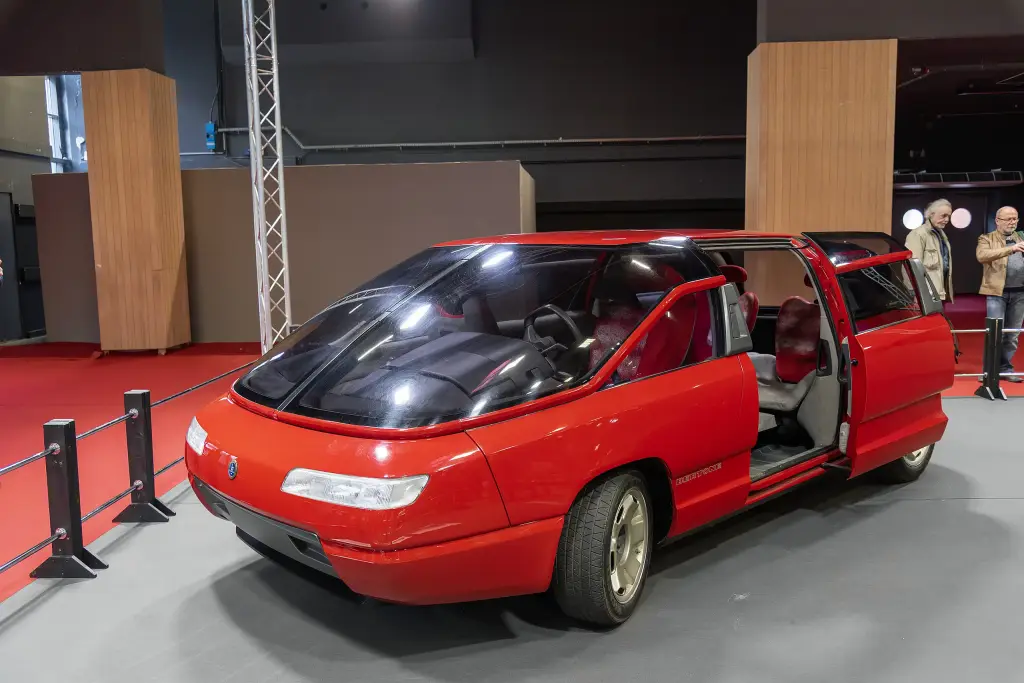
The Bertone Genesis is a concept car built by Bertone using Lamborghini mechanical parts and shown at the Turin Motor Show in 1988. It is a five-door minivan with gull-wing front doors, a Countach V12 behind the front seats and a thoroughly unusual interior; it never reached production.
Bertone Genesis at a glance
| Maker | Bertone, for Lamborghini |
|---|---|
| Shown | Turin Motor Show, 1988 |
| Type | five-door minivan concept |
| Engine | 5.2 L V12, Lamborghini Countach Quattrovalvole |
| Power | 455 bhp (339 kW) |
| Gearbox | three-speed TorqueFlite automatic |
| Drive | rear-wheel drive |
| Weight | about 1,800 kg |
| Seats | five |
| Doors | gull-wing front, sliding rear |
| Built | one |
History of the Bertone Genesis
A van with a supercar heart
The Genesis was Bertone’s answer to a question nobody had asked: what a Lamborghini people carrier might look like. Under the body sat the 5.2 L V12 of the Countach Quattrovalvole, 455 bhp (339 kW), driving the rear wheels through a three-speed TorqueFlite automatic of Chrysler origin. The combination made the Genesis considerably slower than the Countach it borrowed from, partly because the van weighed around 1,800 kg and partly because the three-speed gearbox had shorter ratios than the supercar’s manual.
Doors front and rear
The body is a five-door minivan, with gull-wing doors at the front and sliding doors at the back. That arrangement gave access to a cabin with five seats: two bucket seats in front, mounted over the engine, and three in the rear arranged in a V. The two outer rear seats had leg rests that pulled out from under the cushion; the third, set further forward between them, could swivel through 180 degrees to face backwards and could also be folded down.
A show car only
The Lamborghini LM002 had recently gone out of production, which freed assembly space that could in theory have been used for the Genesis or a vehicle like it. In practice the van was never intended to go beyond a design study. It remained a single prototype and is now part of the Bertone collection cared for by the ASI.
What it says about Bertone
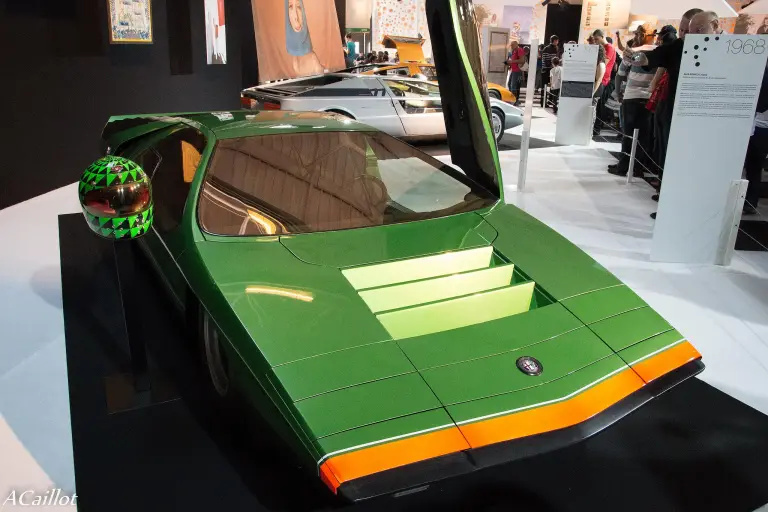
The Genesis belongs to the tradition of Italian show cars built to demonstrate what a coachbuilder could do with someone else’s mechanicals, the same tradition that produced the Carabo twenty years earlier on an Alfa Romeo chassis. Where the Carabo was a wedge for two, the Genesis was a family vehicle with the engine of a flagship: the point was the idea, not the sales figures.
Design and features
- Countach V12: the 455 bhp 5.2 L twelve of the Quattrovalvole, mounted behind the front seats.
- Gull-wing and sliding doors: front doors that lift, rear doors that slide, on a five-door body.
- Five-seat V layout: three rear seats in a V, the middle one swivelling through 180 degrees, with pull-out leg rests.
- Chrysler automatic: a three-speed TorqueFlite rather than a manual, which made the van slower than the Countach.
Bertone Genesis versions
- Genesis (1988): the only example, shown at Turin and never produced.
- Lamborghini LM002: the V12 off-roader whose end of production freed space Bertone might have used.
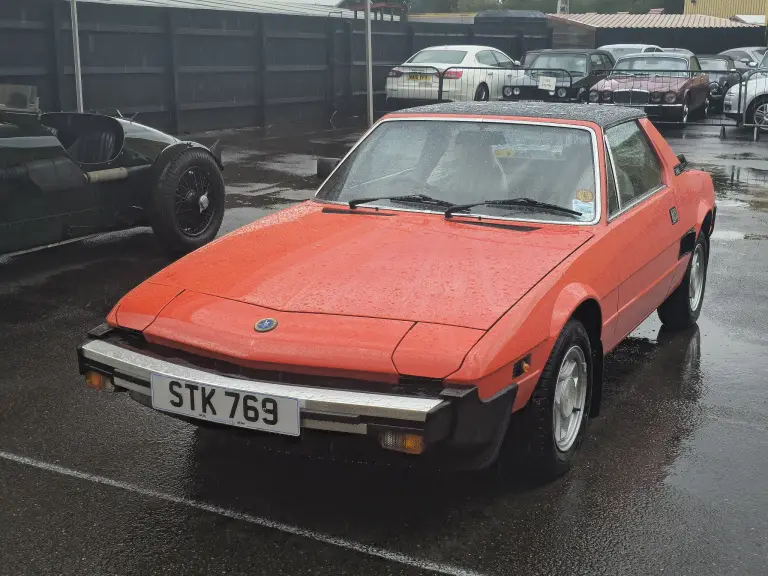
The Genesis is one of Bertone’s show cars, like the Carabo of 1968. The coachbuilder’s best-known production design is the Bertone X1/9. More cars are in the Bertone collection.
Video: Bertone Genesis for Lamborghini
Video on YouTube.
Sources
- Bertone Genesis, English Wikipedia: show, layout, engine, gearbox, weight, seats
- Bertone Genesis, Italian Wikipedia: Turin show, front engine mounting, Bertone collection