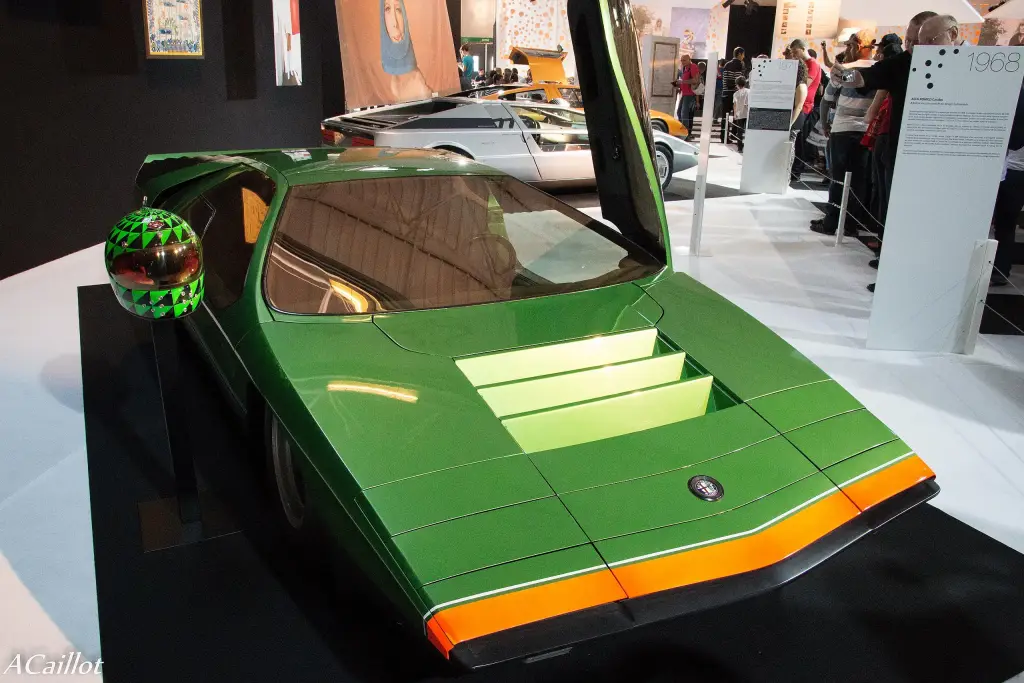
The Carabo is a concept car that Bertone showed at the Paris Motor Show in October 1968. It was drawn by Marcello Gandini on the chassis of an Alfa Romeo 33 Stradale, built in only ten weeks, and it is remembered as the first car with scissor doors and as one of the first of Gandini’s wedge shapes.
Bertone Carabo at a glance
| Maker | Carrozzeria Bertone for Alfa Romeo |
|---|---|
| Shown | Paris Motor Show, October 1968 |
| Designer | Marcello Gandini |
| Body | glassfibre, two-seat coupé |
| Chassis | Alfa Romeo 33 Stradale, No. 750.33.109 |
| Engine | 2.0 L V8, mid-mounted |
| Power | 230 bhp (172 kW) at 8,800 rpm |
| Torque | 200 N·m at 7,000 rpm |
| Gearbox | six-speed Colotti manual |
| Top speed | 250 km/h |
| Acceleration | 0–100 km/h in 6.5 s |
| Height | 990 mm |
| Built | one |
History of the Bertone Carabo
A beetle in glassfibre
The Carabo was the first of six dream cars built by Italian coachbuilders on the chassis of the Alfa Romeo 33 Stradale at the turn of the 1960s and 1970s. Its name comes from Carabus auratus, a ground beetle with brilliant metallic colours, and the car was painted to match: luminescent green with orange details, gold-tinted glass and doors that rose vertically like the insect’s wing cases. Bertone built the glassfibre body in just ten weeks.
The wedge
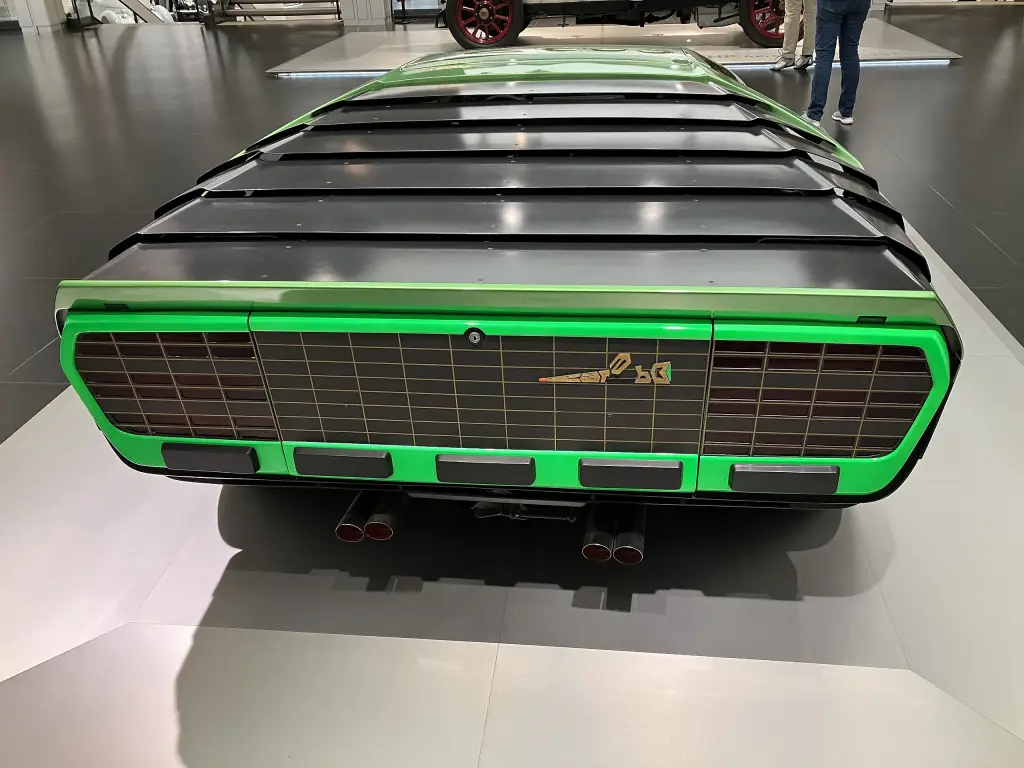
Gandini gave the Carabo an almost perfect wedge profile, only 990 mm high, split into two colour bands of metallic green and black. The front carried a thin orange strip along the bonnet edge, pop-up headlamps hidden behind three rotating panels and three cooling outlets on the bonnet. At the rear a fixed louvre of six black plastic slats let hot air out of the engine bay and cut rearward vision.
Scissor doors
The Carabo is credited as the first vehicle with scissor doors, opened vertically by a gas strut. The idea was taken up on later concept cars and production models, above all the Lamborghini Countach, which also inherited the overall wedge line drawn here in 1968. The squared-off shape of the Carabo is regarded as a landmark of car design: it set the pattern for the wedge-shaped supercars and show cars of the 1970s.
One car, two engines
The prototype used the mid-mounted 1,995 cm³ V8 of the 33 Stradale with twin ignition, 230 bhp at 8,800 rpm, a six-speed Colotti gearbox and a claimed top speed of 260 km/h with 0–100 km/h in 6.5 seconds. At some later date, for reasons that are not recorded, the original engine was replaced by the 2,593 cm³ V8 of the Alfa Romeo Montreal, rated at 200 bhp. The Carabo remained a one-off and is now kept with the other 33 Stradale dream cars in the Alfa Romeo museum at Arese. In 1976 Alfa Romeo and Bertone returned to the same chassis for the Navajo.
Design and features
- Scissor doors: the first car to use doors that lift vertically, an idea carried on to the Countach.
- Wedge body: a glassfibre shape only 990 mm tall, drawn in ten weeks and copied widely in the 1970s.
- Hidden lamps: pop-up headlights behind three rotating panels that sat flush when closed.
- Beetle colours: metallic green with orange, gold-tinted glass and vertical doors recalling a beetle’s wing cases.
- Running prototype: fully functional on the 33 Stradale chassis, not a mock-up.
Bertone Carabo versions
- Carabo (1968): the only example, with the 2.0 L V8 of the 33 Stradale.
- Montreal-engined state: the same car later fitted with the 2,593 cm³ V8 of the Alfa Romeo Montreal.
- Other 33 Stradale dream cars: five further show cars by Italian coachbuilders, including the Bertone Navajo of 1976.
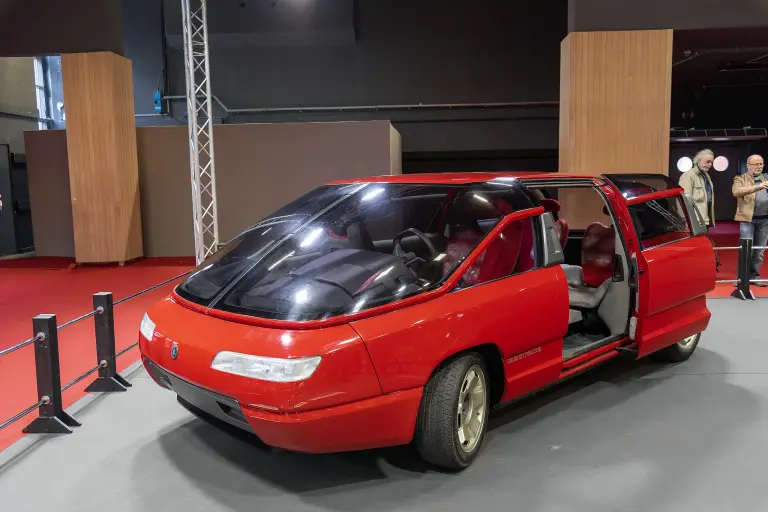
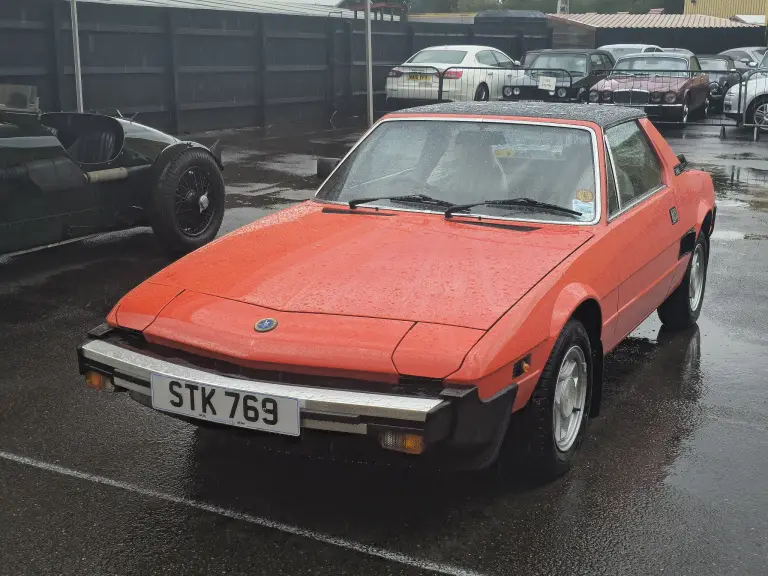
The Carabo belongs to the Bertone show cars, like the Bertone Genesis of 1988. The production car closest to it is the Bertone X1/9. More cars are in the Bertone collection.
Video: Alfa Romeo 33 Bertone Carabo – Dream Cars
Video on YouTube.
Sources
- Alfa Romeo Carabo, English Wikipedia: show date, designer, doors, chassis, engine, performance
- Alfa Romeo 33 Bertone Carabo, Italian Wikipedia: colours, body details, dimensions, engine swap, museum