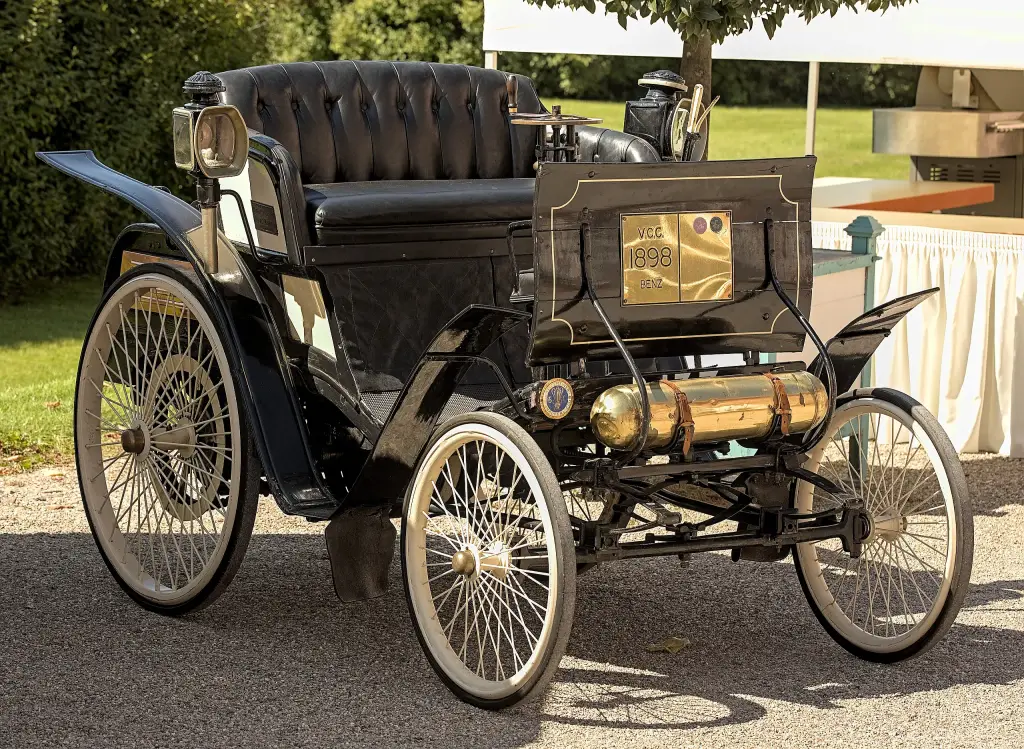
The Benz Velo was one of the first cars, introduced by Carl Benz in 1894 as the follow-up to the Patent-Motorwagen. Benz officially called it the Velocipede, and with more than 1,200 built it became the world’s first standardized serial-production car.
Benz Velo at a glance
| Maker | Benz & Cie, Mannheim |
|---|---|
| Production | 1894–1901 |
| Official name | Velocipede (Velo) |
| Engine | rear-mounted single-cylinder, 1045 cm³ (110 × 110 mm) |
| Power | 1.5 PS in 1894, 2.75 PS in 1896, 3 PS in 1900, 3.5 PS in 1901 |
| Top speed | 19 km/h (12 mph) with the 3 hp engine |
| Transmission | two-speed gearbox; optional third gear and reverse from 1896, standard from 1900 |
| Ignition | inductor at first, battery ignition from 1896 |
| Carburettor | surface type at first, float type from 1896 |
| Price | 2000–2200 ℬ for the Velo, 2500–2800 ℬ for the Comfortable |
| Built | 67 in 1894, 134 in 1895; over 1,200 in total |
The German Wikipedia covers the Velo, Velociped and Comfortable together; the older records for the Velociped and the Ideal are merged into this page.
History of the Benz Velo
From the Patent-Motorwagen
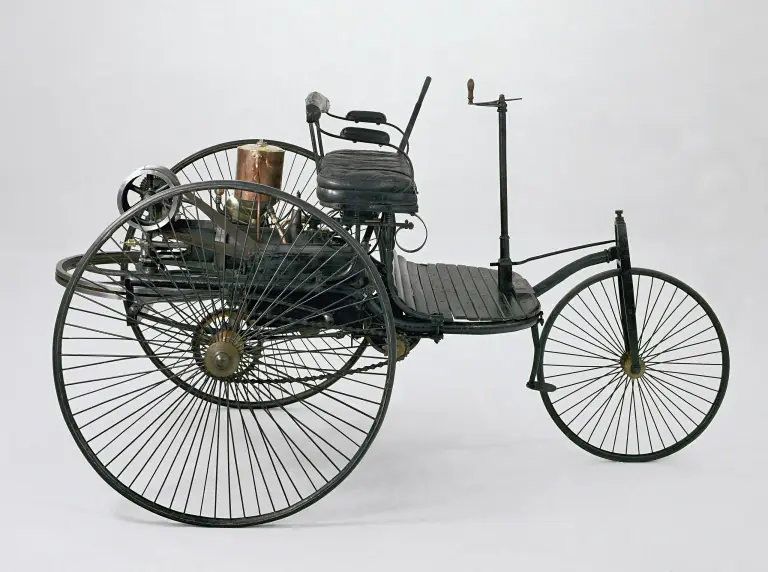
After perfecting two-wheel steering with suspension, Benz began making four-wheeled cars in 1893: larger, more expensive models such as the Vis-a-vis and the Viktoria. The Velo was the true successor to the Patent-Motorwagen, being a smaller and lighter vehicle. It returned to Benz’s first prototype in its use of light wire wheels, as on cycles. A three-wheel prototype of the Velo was created in 1893 and later used by the Benz children.
Engine and equipment
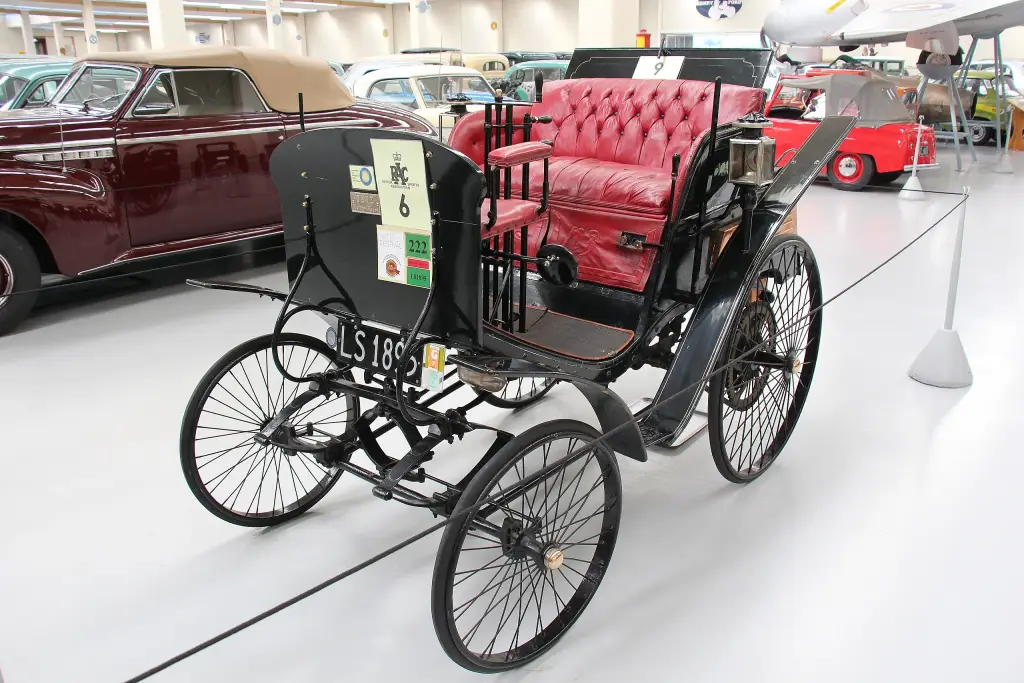
The car had a single-cylinder engine at the rear with a displacement of 1045 cm³, a bore and stroke of 110 mm by 110 mm. Power grew from 1.5 PS (1.1 kW) at 450 rpm in 1894 to 2.75 PS (2.1 kW) at 600 rpm in 1896, 3 PS (2.2 kW) at 700 rpm in 1900 and 3.5 PS (2.6 kW) at 800 rpm in 1901; with the 3 PS engine the top speed was 19 km/h (12 mph). At first there was a surface carburettor and an inductor for the ignition; from 1896 a float carburettor and battery ignition were offered, together with a starting crank. A two-speed gearbox passed the engine’s power to the rear wheels, and from 1896 a third gear and a reverse gear were available as options and became standard in 1900.
Sales and the Comfortable
Between 1894 and 1900 the cars were sold as the Velo (Velocipede) for 2000 to 2200 marks, and from 1896 to 1901 there was also the Comfortable (Velocipede Comfortable) for 2500 to 2800 marks. In total 1,200 vehicles of these types were built, and the Velocipede remained in production until 1901–1902.
Influence and firsts
The Velo inspired numerous copies, including Marshall (later Belsize) in Manchester, Star in Wolverhampton and Arnold in Paddock Wood, of which only twelve were built. It was particularly popular in France, where the Parisian bicycle manufacturer Émile Roger had been building Benz engines under licence and went on to build Benz automobiles as well, so that a majority of Benz cars were sold in France initially. A Velo was the first car introduced to South Africa, demonstrated to President Paul Kruger on 4 January 1897. A Velo also took part in the world’s first automobile race, the Paris–Rouen event organized by Le Petit Journal in 1894, and placed fifth overall; the winners, Panhard & Levassor and Peugeot, both used Benz engines.
Design and features
- First serial-production car: over 1,200 standardized cars built, a first for the industry.
- Light and simple: a small, light follow-up to the Patent-Motorwagen with wire wheels.
- Steady engineering: power rose from 1.5 to 3.5 PS between 1894 and 1901, with better carburettor and ignition from 1896.
- Wide influence: copied in Britain and built under licence in France by Émile Roger.
- Racing history: fifth overall in the 1894 Paris–Rouen race, the world’s first motoring competition.
Benz Velo versions
- Velo (Velocipede), 1894–1900: the standard car, 2000–2200 marks.
- Velocipede Comfortable, 1896–1901: a better-equipped version, 2500–2800 marks.
- 1893 three-wheel prototype: a single prototype, later used by the Benz children.
- Late cars from 1900: third gear and reverse gear standardized.
The Velo followed the Benz Patent-Motorwagen of 1885–1893. More early cars are in the Benz collection.
Sources
- Benz Velo, English Wikipedia: production figures, history, copies, race, South Africa
- Benz Velo, German Wikipedia: engine dimensions, power, equipment, prices