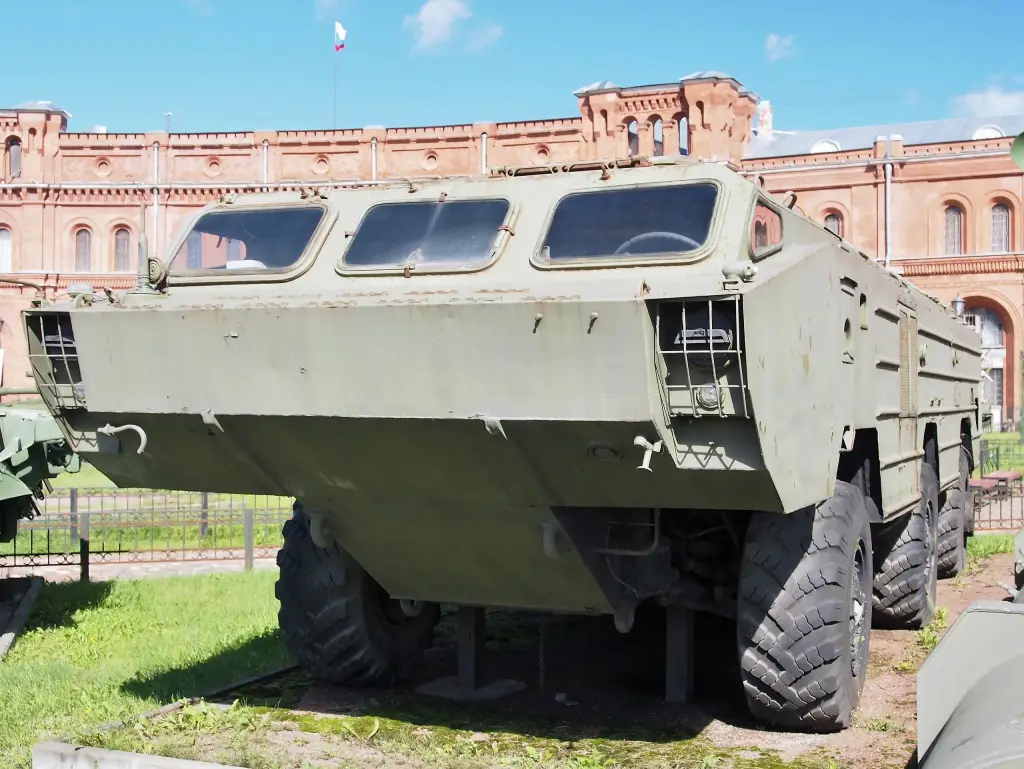
The BAZ-5921 was a special three-axle amphibious chassis built by the Bryansk Automobile Plant and used as the transporter-erector-launcher of the 9K79 Tochka tactical missile complex. It was developed from the BAZ-5937 family that carried the 9K33 Osa air-defence system, but the hull and the layout had to be designed almost anew.
BAZ-5921 at a glance
| Maker | Bryansk Automobile Plant (BAZ), Bryansk |
|---|---|
| Type | special three-axle amphibious chassis |
| Used for | 9K79 Tochka tactical missile complex, launcher 2P129 |
| Production | 1974–1990 |
| Layout | engine in the middle of the hull, launcher at the rear |
| Full mass | 17,800 kg |
| Road speed | 70 km/h |
| Speed on water | 8 km/h |
| Range | 650 km |
| Engine output | 300 hp at 2,600 rpm |
| Related chassis | BAZ-5937 of the 9K33 Osa |
| Derivatives | BAZ-5922, 59222, 59223, 5921M |
The BAZ-5921 has no English Wikipedia article; this page is based on the Russian and Ukrainian articles, with production dates from the article on the plant.
History of the BAZ-5921
The BAZ-5921 came out of the three-axle amphibious chassis family that the Bryansk design bureau began in the mid-1960s. The BAZ-5937, 5938 and 5939 series, with the engine at the rear, became the basis of the 9K33 Osa air-defence system; the BAZ-5921 and BAZ-5922 were derived from the same family for the 9K79 Tochka tactical missile complex. Many units were borrowed from the Osa chassis, but the load-bearing hull and the general arrangement had to be designed practically from scratch.
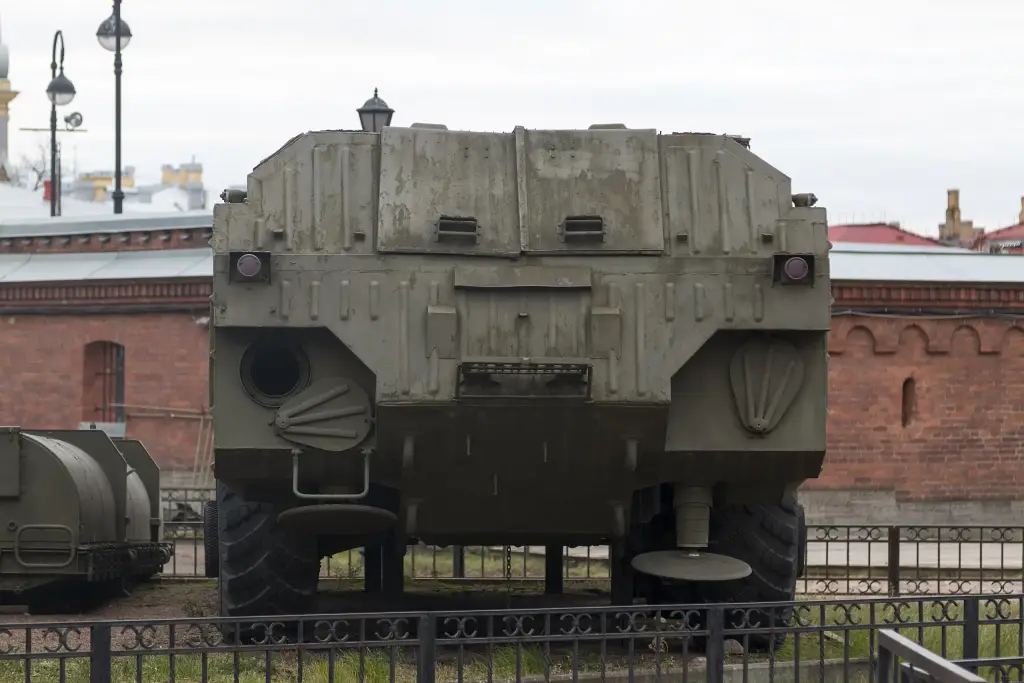
The reason for the new layout was the way the Tochka launches. On the Osa the antenna-launcher unit sat in the middle of the vehicle with the engine behind it; on the Tochka launcher the missile had to rise almost vertically, so the power unit was moved into the middle of the cargo bay, closer to the control compartment, and the launcher was placed at the rear.
Service and production
According to the plant’s own history, the BAZ-5921 was built for the Tochka complex between 1974 and 1990, alongside the BAZ-5937 for the Osa. Both were three-axle amphibians with all-wheel drive, built for military service rather than for the open market, and both were replaced in the 1980s by the later four-axle chassis of the plant.
Later versions
The chassis was adapted several times. The BAZ-5922 became the transporter-loader of the same complex; the BAZ-59222 was a rescue-service vehicle on that chassis, built in a small batch and operated in Lithuania; and the BAZ-59223 of 2005 was a transport version. At the end of the line the plant also tried the 260 hp KamAZ-7403 diesel in the BAZ-5921M and BAZ-5922M, but the engines, not designed to work in closed compartments, overheated and the vehicles never entered series production.
Design and features
- Amphibious: the chassis could swim at 8 km/h and was rated for a 650 km road range.
- 300 hp engine: enough for 70 km/h on the road with a full mass of 17,800 kg.
- Launch-oriented layout: the engine sat in the middle of the hull so that the missile could be raised almost vertically at the rear.
- Shared with the Osa: many units came from the BAZ-5937 family, which kept production and spares simple.
BAZ-5921 versions
- BAZ-5921: the launcher chassis of the 9K79 Tochka complex.
- BAZ-5922: transporter-loader with a changed hull, side windows, a canvas body for two missiles and a crane at the rear for reloading the launcher.
- BAZ-59222: rescue-service vehicle on the BAZ-5922 chassis, built in a small batch and used in Lithuania.
- BAZ-59223: transport version of 2005, able to carry up to 10,200 kg of cargo or 15–20 passengers.
- BAZ-5921M and 5922M: prototypes with a 260 hp KamAZ-7403 diesel; they overheated and were not produced.
The BAZ-5921 shares its ancestry with the Osa chassis and belongs to the Bryansk plant’s military programme. More vehicles from the same works are described in the BAZ-6306 article; the whole marque is in the BAZ collection.
Sources
- BAZ-5921, Russian Wikipedia: layout, specifications, versions
- BAZ-5921, Ukrainian Wikipedia: role and versions
- Bryansk Automobile Plant, Russian Wikipedia: production years, place in the plant’s range