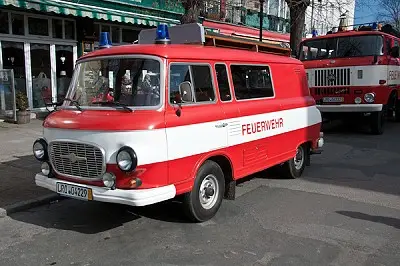
The Barkas B 1000 was a forward-control van made by the East German manufacturer Barkas from 1961 to 1988 in Chemnitz, then called Karl-Marx-Stadt. It was offered as a van, an eight-seat minibus and a pickup, and special-purpose vehicles were built on the same basis. With its 1,000 kg payload and spacious interior it earned a reputation for durability and reliability.
Barkas B 1000 at a glance
| Maker | VEB Barkas-Werke, Karl-Marx-Stadt (Chemnitz) |
|---|---|
| Production | 1961–1988 |
| Body styles | panel van, eight-seat minibus, pickup |
| Construction | body-on-frame, box-section or U-section rails |
| Engine | 1-litre liquid-cooled two-stroke straight-three |
| Gearbox | four-speed synchromesh manual |
| Engine position | ahead of the front axle, between driver and passenger |
| Suspension | independent, diagonal links with torsion bars |
| Brakes | hydraulic drums on both axles |
| Payload | 1,000 kg |
| Top speed | 95–100 km/h |
| Successor | Barkas B 1000-1, autumn 1989 |
based on one source
History of the Barkas B 1000
The van of the GDR
The B 1000 appeared at a time when East Germany needed a light commercial vehicle for deliveries, trades and passenger transport. Production of the four-door panel van began in June 1961, the minibus followed in spring 1964 and the pickup in spring 1965. All three shared the same forward-control layout, with the driver sitting above the front axle and the engine between the driver and the passenger. Special-purpose vehicles, from ambulances to workshop bodies, were built on the same chassis.
Twenty-seven years without a redesign
There were no major design alterations across the B 1000’s 27-year production period. It received only minor updates, in 1963 and 1972. In 1963 the single-circuit brake system was upgraded to a dual-circuit system and the column shifter was replaced with a regular central shifter. In 1972 the 220 W alternator was replaced with a 500 W unit and power output rose from 31 kW (42 hp) to 33 kW (44 hp).
The end of the line
The succeeding Barkas B 1000-1 was introduced in autumn 1989. It carried over the B 1000’s underlying design but was fitted with a different engine. In 1990 the manufacturing operations were sold to a Russian company, but production was never restarted.
Design and features
- Forward-control layout: the engine sits ahead of the front axle, between driver and passenger, leaving a long, flat load floor behind.
- Three body styles: panel van, eight-seat minibus and pickup, plus special-purpose bodies.
- Two-stroke three-cylinder: a 1-litre liquid-cooled engine with a four-speed synchromesh gearbox.
- Independent suspension all round: diagonal links with torsion bars and hydraulic shock absorbers.
- 1,000 kg payload: a generous figure for a van of this size, and the basis of its reputation for hard work.
Barkas B 1000 versions
- Panel van (from June 1961): the four-door delivery van, on a box-section frame.
- Minibus (from spring 1964): seating for eight, also on a box-section frame.
- Pickup (from spring 1965): a U-section frame, as used for special vehicles.
- Special-purpose vehicles: bodies for services and trades built on the B 1000 chassis.
- B 1000-1 (1989): the final development, with the same design and a different engine.
The B 1000 replaced the earlier Barkas V 901/2, and the B 1000-1 closed the line in 1989. More vehicles of the marque are in the Barkas collection.
Video: Das Ende vom Barkas B1000 part 1
Video on YouTube.
Sources
- Barkas B 1000, English Wikipedia: production, body styles, engineering, updates