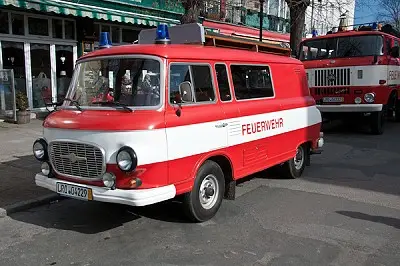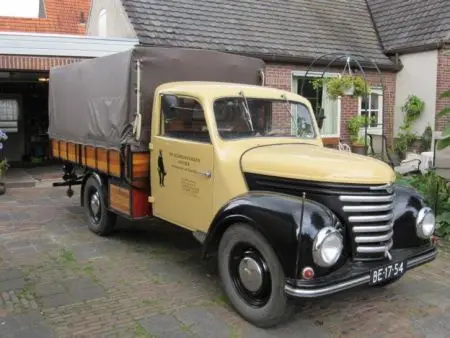
The Barkas V 901/2 was a light commercial lorry made by the East German manufacturer VEB Barkas-Werke in Hainichen, in the district of Karl-Marx-Stadt, from 1954 until 1961. Originally called the IFA V 901/2, it was renamed the Barkas V 901/2 in 1957. It succeeded the IFA Framo V 901 and was itself succeeded by the Barkas B 1000.
Barkas V 901/2 at a glance
| Maker | VEB Barkas-Werke, Hainichen |
|---|---|
| Production | 1954–1961 |
| Former name | IFA V 901/2 until 1957 |
| Body styles | pickup, minibus, panel van |
| Construction | body-on-frame, welded U-section rails |
| Wheelbases | 2,800 mm and 3,100 mm |
| Payload | 520, 690 or 900 kg |
| Engine | 900.5 cm³ water-cooled two-stroke straight-three |
| Power | 28 PS (20.6 kW) at 3,600 rpm |
| Torque | 7.25 kp·m (71 N·m) at 2,250 rpm |
| Gearbox | four-speed non-synchronised, rear-wheel drive |
| Top speed | 75 or 82 km/h, depending on axle ratio |
based on one source
History of the Barkas V 901/2
From IFA to Barkas
The vehicle began its life as the IFA V 901/2, the successor to the IFA Framo V 901. It was built from 1954 to 1961 and in 1957 took the name of its maker, becoming the Barkas V 901/2. Like most light commercial vehicles of its time it was a body-on-frame design with a front engine and rear-wheel drive, which allowed many kinds of body to be fitted to the same chassis: pickup trucks, minibuses and panel vans.
Engineering
The V 901/2 is a two-axle lorry with a frame made from welded U-sections. It was available with two wheelbase options, 2,800 mm and 3,100 mm, and three different payload options of 520, 690 and 900 kg. The rear axle is a leaf-sprung live beam axle, while in front the V 901/2 has independent suspension with suspension arms and leaf springs. Hydraulically operated drum brakes are fitted on all four wheels, and steering is by rack and pinion.
The engine and the end of production
Power comes from a water-cooled, straight-three, two-stroke Otto engine with a cylinder bore of 70 mm and a piston stroke of 78 mm, displacing 900.5 cm³. It is rated at 28 PS (20.6 kW) at 3,600 rpm and produces a maximum torque of 7.25 kp·m (71 N·m) at 2,250 rpm. The torque reaches the rear wheels through a dry single-disc clutch and a non-synchronised constant-mesh four-speed gearbox. Depending on the axle-drive ratio the V 901/2 can reach a top speed of either 75 or 82 km/h. Production ended in 1961, when the forward-control Barkas B 1000 took over.
Design and features
- Body-on-frame construction: a chassis of welded U-sections that could carry pickup, minibus and panel-van bodies.
- Two wheelbases: 2,800 mm and 3,100 mm to suit different bodies and loads.
- Three payload ratings: 520, 690 or 900 kg.
- Two-stroke three-cylinder: 900.5 cm³, 28 PS and 71 N·m of torque.
- Independent front suspension: suspension arms and leaf springs, with a live beam axle at the rear.
Barkas V 901/2 versions
- Pickup: an open load bed on the standard chassis.
- Minibus: a passenger body for eight and more people.
- Panel van: a closed body for deliveries and trades.
- Short and long wheelbase: 2,800 mm or 3,100 mm.
- Light, medium and heavy payload: 520, 690 or 900 kg.
The V 901/2 was replaced in 1961 by the Barkas B 1000. More vehicles of the marque are in the Barkas collection.
Video: DDR IFA FRAMO BARKAS 901 LIEFERWAGEN OLDTIMER CLASSIC CAR LKW BARKAS
Video on YouTube.
Sources
- Barkas V 901/2, English Wikipedia: production, bodies, engineering, performance