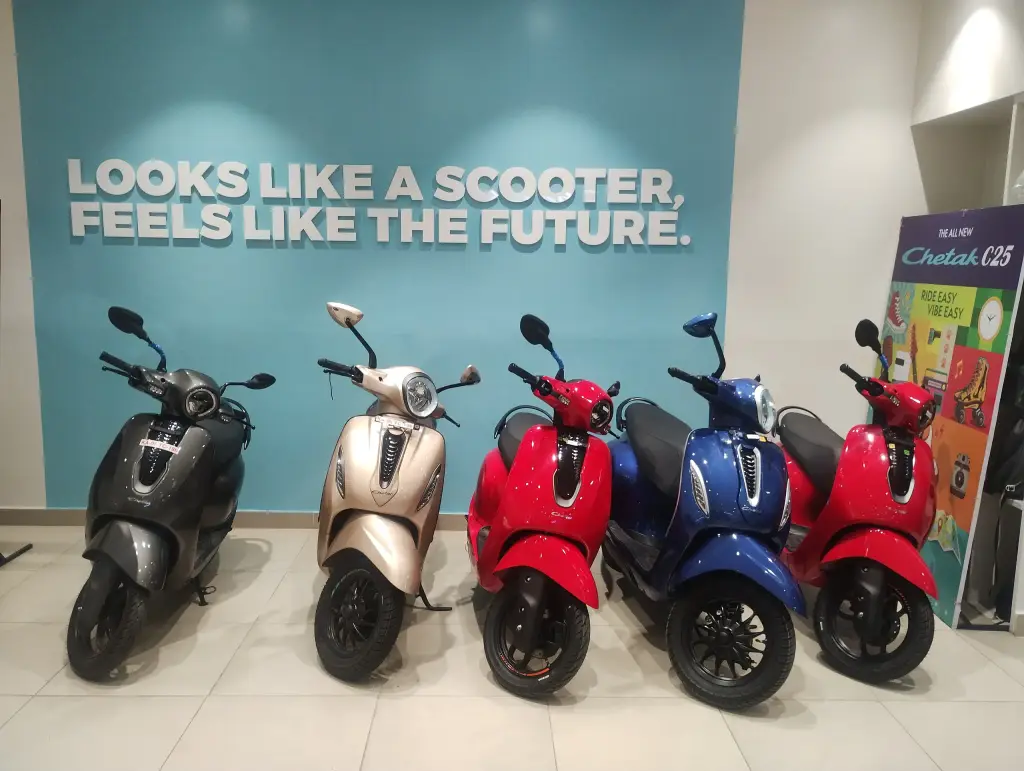
The Bajaj Chetak is a motor scooter produced by Bajaj Auto in India. Past versions were petrol-powered, either two- or four-stroke; the modern Chetak is electric and uses a 4.2 kW BLDC motor with a 2.89 kWh lithium-ion battery pack, for a range of about 90 km. Named after the horse of the warrior Maharana Pratap, it was for decades the family scooter of urban India.
Bajaj Chetak at a glance
| Maker | Bajaj Auto, India |
|---|---|
| Origin | licensed Vespa Sprint design |
| Petrol production | 1970s–2005 |
| Four-stroke model | Chetak 4S, 2002 |
| Electric model | Chetak Electric, unveiled 16 October 2019 |
| Electric motor | 4.2 kW BLDC |
| Battery | 2.89 kWh lithium-ion |
| Range | about 90 km |
| Production plant | Chakan, Pune |
| Tagline | Hamara Bajaj |
Based on one source: the English Wikipedia article on the Chetak.
History of the Bajaj Chetak
Vespa roots
The Chetak began as an unofficial continuation of Bajaj’s licensed production of the Italian Vespa Sprint. Bajaj had built the Vespa 150 under licence from Piaggio since the 1960s. When the licence was not renewed in 1971, following changes in foreign ownership rules that favoured Indian control, Bajaj lost the Vespa name but not the tooling or the knowledge. It continued to make scooters on the same design, most notably the Chetak.
Hamara Bajaj
The Chetak became an affordable and popular means of transport for India’s urban upper-middle class, marketed under the tagline Hamara Bajaj, meaning our Bajaj. Demand was so strong that buyers waited years for delivery; at one point the waiting period was ten years. The scooter was considered durable, though it had a known quirk: after stopping, it had to be tilted to the right to feed fuel mixture into the carburettor.
Engineering
Like the Vespa Sprint, the Chetak used a swingarm rear suspension formed by the integrated engine and gearbox unit, and a single-sided trailing-link front suspension. Because both hubs were single-sided, the wheels could be swapped front to rear. The engine and gearbox sat offset on the right-hand side of the rear wheel. Around 1980 the licensed design was replaced by an all-new in-house design that kept the general appearance, the most obvious differences being the nosecone and the indicators. In 2002 the Chetak 4S brought a four-stroke engine designed and built by Bajaj to improve emissions and fuel economy.
The end of petrol production
The Chetak’s main rival was the LML NV, a licensed copy of the Vespa PX 150. As motorcycles and cars took over, the scooter lost ground, and Bajaj stopped making scooters altogether in 2005, though sales of existing stocks continued into 2006.
Chetak Electric
On 16 October 2019 Bajaj unveiled an electric Chetak with an all-metal body and retro styling. Production began on 25 September 2019 at the Chakan plant, and sales started in Pune and Bangalore in January 2020 through selected KTM dealerships. The original Urbane variant had a rear drum brake and was later discontinued. By 2023 the scooter was sold in 100 cities through more than 40 experience centres.
Design and features
- Vespa-derived layout: offset engine and gearbox, single-sided suspension and interchangeable wheels.
- All-metal body: the classic Chetak and the electric version both use steel panels.
- Retro styling: the electric model deliberately echoes the petrol scooter’s shape.
- Electric drivetrain: 4.2 kW BLDC motor and 2.89 kWh battery, about 90 km of range.
- Long waiting lists: demand once stretched delivery times to a decade.
Bajaj Chetak versions
- Vespa-derived Chetak: the original two-stroke scooter of the 1970s and 1980s.
- 1980 redesign: in-house body with a new nosecone and indicators.
- Chetak 4S (2002): four-stroke engine for cleaner emissions and better economy.
- Chetak Electric (2019): 4.2 kW BLDC motor, 2.89 kWh battery.
- Chetak Urbane: early electric variant with a rear drum brake, later discontinued.
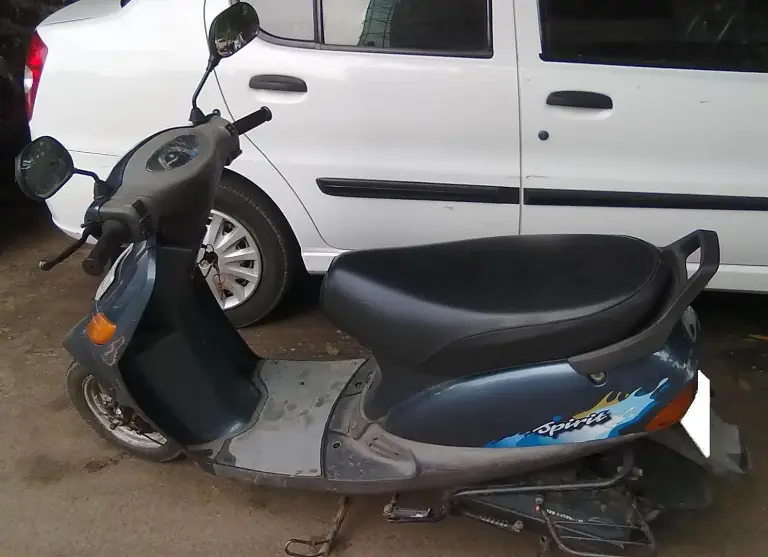
Other Bajaj scooters in the collection include the Spirit and the Legend. The full range is in the Bajaj collection.
Video: Motor Bajaj Chetak 150cc
Video on YouTube.
Sources
- Bajaj Chetak, English Wikipedia: history, engineering, electric model