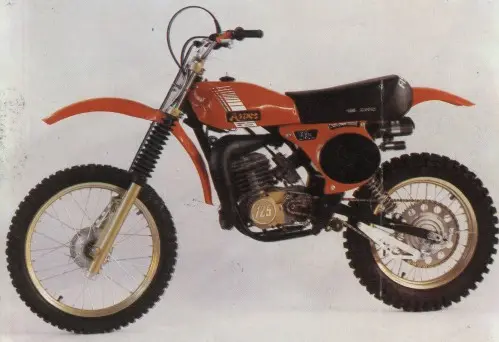
The Aspes 50 stands for the small-capacity side of a firm that built motorcycles and mopeds in Gallarate, in northern Italy, from 1961 to 1982. Fifty-centimetre machines were where Aspes began and where it returned at the very end of its story.
Aspes 50 at a glance
| Maker | Aspes, Gallarate, Italy |
|---|---|
| Founded | late 1950s by Teodosio Sorrentino |
| Name | shortened from Aspesi, the surname of the founder’s wife |
| First products | bicycles, then mopeds from 1961 |
| Early mopeds | Falco, then Sport (1964) and Sprint (1966) |
| Early two-strokes | Minarelli P4 engines |
| Cross moped | Navaho, shown at the Milan show in 1971 |
| Automatic moped | Sioux, single-speed, 1977 |
| Company ended | 1982, absorbed by Unimoto |
| Revival | Menzaghi Motors of Varese, 2009 |
| Late flagship | Sirio Hybrid 50 scooter |
| Last products | none after 2011 |
Based on one source, the Italian Wikipedia article on Aspes. There is no separate page on the Aspes 50; this article covers the small-capacity mopeds of the firm.
History of the Aspes 50
From bicycles to mopeds
Aspes was founded in Gallarate at the end of the 1950s by Teodosio Sorrentino. The name is an abbreviation of Aspesi, the surname of his wife. The firm began by making bicycles, and from 1961 it added classic utility mopeds such as the Falco — the machines that made up the small-capacity end of the range.
The youth market
The range was quickly widened for young buyers with the Sport of 1964 and the Sprint of 1966, both driven by a Minarelli P4 two-stroke engine. In 1967, using the touring model S as a base, Aspes built the Cross T (Cross Teodosio), its first attempt at the off-road market that was so popular with young riders of the time. The Cross T was a modest success and led the firm to go further with the Cross Special ’68 and ’69 and the cheaper Junior Cross ’70, which used the same chassis with simpler components.
Navaho and Sioux
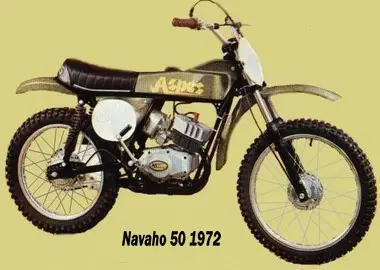
At the Milan show of 1971 Aspes presented the Navaho, a cross moped that sold well among the youngest riders thanks to its angular, simple bodywork in glassfibre, painted in bright metallic colours. The late 1970s brought the opposite approach: in 1977, looking for a commercial success to pull the firm out of crisis, Aspes put on sale a single-speed automatic moped of traditional style, the Sioux. Neither the Sioux nor the later 125cc Yuma TSB found much of a response, and in 1982 Unimoto of Cesena absorbed the Gallarate company, using the Aspes brand until 1984 before closing in 1986.
The 2009 revival
The brand did not stay buried. It passed through several owners and on 9 December 2008 was sold to Menzaghi Motors of Varese, which in 2009 put motorcycles badged Aspes on the market. This was a purchase of the name rather than a return of the old factory. The flagship was the Sirio Hybrid 50, a scooter with a combined four-stroke engine and electric motor, lithium iron phosphate batteries recharged while running, a Honda-derived power unit developed in the United States and Chinese production by Mainbon of Shanghai as the Hybrid-50QT-6B. No Aspes products are recorded after 2011.
Design and features
- Small-capacity start: Aspes began with bicycles and moved into utility mopeds in 1961, with the Falco as the first of the type.
- Minarelli power: the Sport and Sprint of the mid-1960s used Minarelli P4 two-stroke engines bought from outside.
- Cross styling: the Navaho of 1971 brought angular glassfibre bodywork and bright metallic paint to the moped class.
- Automatic simplicity: the Sioux of 1977 was a single-speed automatic aimed at traditional buyers.
- Hybrid finale: the 2009 Sirio Hybrid 50 combined a four-stroke engine with an electric motor and LiFePO4 batteries.
Aspes 50 versions
- Falco (from 1961): the classic utility moped that opened the range.
- Sport (1964) and Sprint (1966): youth models with Minarelli P4 two-stroke engines.
- Navaho (1971): cross moped with glassfibre bodywork in metallic colours.
- Sioux (1977): single-speed automatic moped of traditional design.
- Sirio Hybrid 50 (2009): scooter with combined petrol and electric propulsion, built in China.
The larger machines of the same firm are described in the Aspes 125 article, and the rest of the marque is in the Aspes collection.
Video: Aspes 50
Video on YouTube.
Sources
- Aspes, Italian Wikipedia: company history, mopeds, Navaho, Sioux, Sirio Hybrid 50