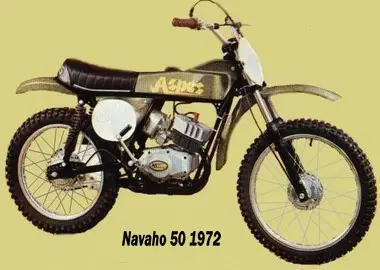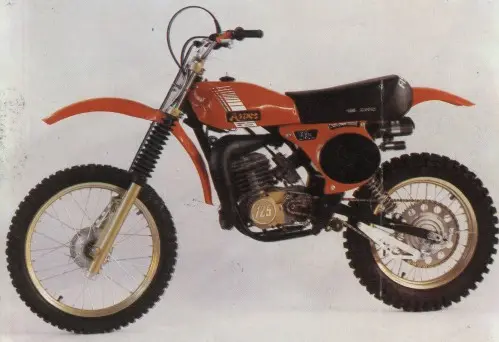
The Aspes 125 was the heart of the Gallarate firm’s range in the 1970s. Having bought engines from Maico and Minarelli, Aspes designed its own 125cc two-stroke, founded the ASCO workshop to build it, and turned the Apache, Hopi and Juma into competitive cross and road machines.
Aspes 125 at a glance
| Maker | Aspes, Gallarate, Italy |
|---|---|
| Active | 1961–1982 |
| First 125 | Apache 125, 1970 |
| Apache engine | Maico disc-valve, 18 CV |
| Apache chassis | Ceriani competition forks, steel frame |
| Own engine | from 1971, designed by Gianfranco Maestroni |
| Engine workshop | ASCO, with Vito Consiglio of Travacò Siccomario |
| Hopi 125 | 1972, successor to the Apache |
| Juma | shown 1973, on sale 1974 |
| Juma top speed | 135 km/h, the fastest 125 on sale |
| Hopi gearbox | six speeds from 1977 |
| One-make trophy | Criterium Monomarca Aspes Yuma, 1977–1979 |
Based on one source, the Italian Wikipedia article on Aspes. There is no separate page on the Aspes 125; this article covers the firm’s 125cc models.
History of the Aspes 125
The Apache 125
In 1970 Aspes presented the Apache 125, the model with which the firm began naming its machines after Native American tribes. The Apache used competition Ceriani forks, a swinging arm on flexible bushes and a sturdy drawn-steel frame, with a Maico disc-valve engine of 18 CV. It was competitive enough to be bought by private racers. That same period brought Piermario Sorrentino, eldest son of the founder and a keen speed-racing enthusiast, into the company, and at his insistence Aspes began modernising its road mopeds with the Super Sport and started work on a competition machine for the Italian Juniores championship.
An engine of its own
At the Milan show of 1971 Aspes displayed a 125 Juniores racing prototype fitted with its first engine of its own design, the work of the technician Gianfranco Maestroni, who had been brought over from Yamaha Italia. Some prototypes of the new engine were also fitted to Apache frames, and after long development Aspes decided to produce its 125cc engines in house. It set up the associated company ASCO (Aspesi Consiglio), which took in the mechanical workshop of Vito Consiglio at Travacò Siccomario, who led the development and industrialisation of the engine.
Hopi and Juma
The Hopi 125 reached the market in 1972 as the successor to the Apache. Unlike most makers of the period, Aspes chose not to use a Sachs engine and built its own. The Hopi did reasonably well in cross, though in regularity its engine proved difficult to use. In 1973, at the Milan show, the company presented the Juma, a road-going 125 with an engine derived from the Hopi’s. It went into production in 1974 and sold well in France, where under the importer BPS it was unbeatable in production-class racing; with a top speed of 135 km/h it was the fastest 125 on sale.
The Yuma years and the end
Existing models were restyled and developed further, and from 1977 the Hopi gained a six-speed gearbox. In the same year Aspes started the Criterium Monomarca Aspes Yuma, the first one-make trophy in Italy, which ran until 1979 and helped young riders such as Loris Reggiani, Fausto Gresini, Maurizio Vitali and Davide Tardozzi to emerge. The late 1970s nevertheless brought decline: the Hopi sold poorly, and the Yuma was the fastest in its class but also the most expensive. A later, less highly tuned Yuma TSB found little response, and in 1982 Unimoto absorbed the Gallarate company, keeping the Aspes brand until 1984.
Design and features
- Own 125cc engine: designed by Gianfranco Maestroni, formerly of Yamaha Italia, and built by the associated ASCO workshop.
- Racing chassis: the Apache 125 used competition Ceriani forks, a bush-mounted swinging arm and a drawn-steel frame.
- Maico power first: the Apache’s disc-valve Maico engine produced 18 CV and was used by private racers.
- French success: the Juma, sold through the importer BPS, was unbeatable in production racing in France.
- Talent factory: the one-make Yuma trophy of 1977–1979 launched riders who went on to grand prix racing.
Aspes 125 versions
- Apache 125 (1970): the first of the tribally named models, with a Maico engine and Ceriani forks.
- 125 Juniores prototype (1971): racing machine with the first Aspes-designed engine.
- Hopi 125 (1972): Apache successor with an in-house engine, six speeds from 1977.
- Juma (1973–1974): road 125 derived from the Hopi, 135 km/h and a strong seller in France.
- Yuma: road model that gave its name to the one-make trophy of 1977–1979.
- Yuma TSB: a softer version of the Yuma, with little commercial success.
The mopeds of the same firm are covered in the Aspes 50 article, and more machines are in the Aspes collection.
Video: Aspes 125 RgcR 1978
Video on YouTube.
Sources
- Aspes, Italian Wikipedia: Apache, Hopi, Juma, engines, racing, ASCO