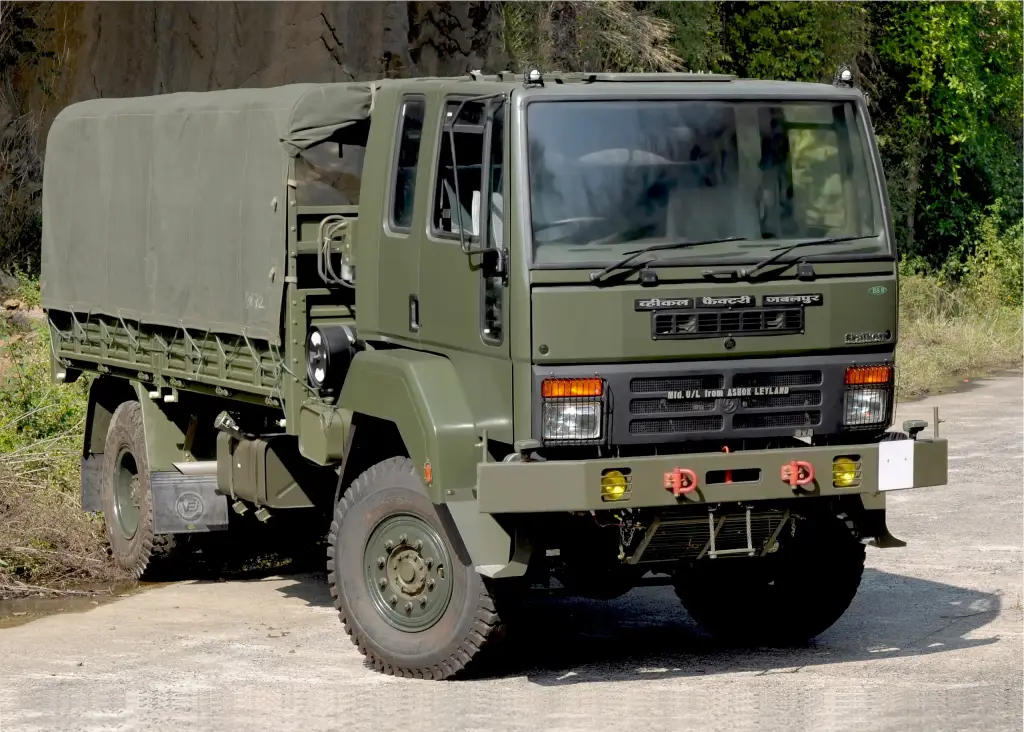
The Ashok Leyland Stallion is the standard medium-duty logistics truck of the Indian Armed Forces. Built in 4×4 and 6×6 form by Vehicle Factory Jabalpur, it carries troops and cargo from desert bases to high-altitude posts, and more than 60,000 are in Indian Army use.
Ashok Leyland Stallion at a glance
| Type | medium-duty military truck, 4×4 and 6×6 |
|---|---|
| Produced by | Vehicle Factory Jabalpur, Armoured Vehicles Nigam Limited |
| Licence granted | 10 August 1998, for the Stallion Mk III |
| Main operator | Indian Army, more than 60,000; several thousand with the ITBP |
| Replaced | Shaktiman trucks |
| Operating altitude | up to 5,500 m (18,000 ft) |
| Temperature range | −35 to 55 °C |
| Drive side and gearbox | right- or left-hand drive; manual or automatic |
| Cab | armoured or non-armoured |
| Bodies | troop carrier, cargo platform with steel drop sides and tarpaulin |
| Special versions | Super Stallion, Stallion Kavach, Field Artillery Tractor |
| Exports | marketed in Africa and the Middle East from 2005 |
Based on one source, the English Wikipedia article on the Stallion.
History of the Ashok Leyland Stallion
The Stallion is built not by Ashok Leyland itself but by Vehicle Factory Jabalpur, a state ordnance factory now part of Armoured Vehicles Nigam Limited. On 10 August 1998 the factory was granted a licence by Ashok Leyland to produce the Stallion Mk III, and the truck has since become the logistical backbone of the Indian Armed Forces: the Indian Army runs more than 60,000 of them and the Indo-Tibetan Border Police several thousand more. In service the Stallion took over from the Shaktiman, the earlier workhorse of the armed forces, which has been phased out.
Ashok Leyland began marketing the Stallion abroad in February 2005, targeting Africa and the Middle East. In August 2006 a report from the Parliament of the United Kingdom stated that Stallions had been sold to the Sudanese government and supplied to GIAD Automotive Industry Co in kit form; the report raised concerns about British involvement in the sale, since some British nationals sat on Ashok Leyland’s board without holding a Trade and Brokerage Licence.
Design and features
- Rough-terrain mobility: the 4×4 and 6×6 versions work from coastal bases to snow-covered mountain posts, at altitudes up to 5,500 m and in temperatures from −35 to 55 °C.
- Built for simple maintenance: the truck was engineered to be repaired in areas without supporting infrastructure.
- Flexible bodies: the standard troop-carrying platform has steel drop sides, a one-piece drop tailgate and a removable tarpaulin on bows; a torsion-free body was optional.
- Factory choice: every base variant can be ordered left- or right-hand drive, with manual or automatic transmission, and with an armoured or ordinary cab.
- Kit supply: Ashok Leyland Defence sells Stallion kits to makers of armoured vehicles and mine-protected vehicles.
Ashok Leyland Stallion versions
- Troop carrier and cargo: the standard platform body, also offered with an armoured cab or with a crane.
- Special bodies: fuel and water bowsers, recovery vehicle, ISO container carrier with twist locks, fire fighting truck and tipper.
- Super Stallion: an upgraded version, rated at 10 tonnes as a 6×6 and 12 tonnes as an 8×8; its chassis carries the upgraded BM-21 Grad multiple rocket launcher mounted by Larsen & Toubro for the Indian Army.
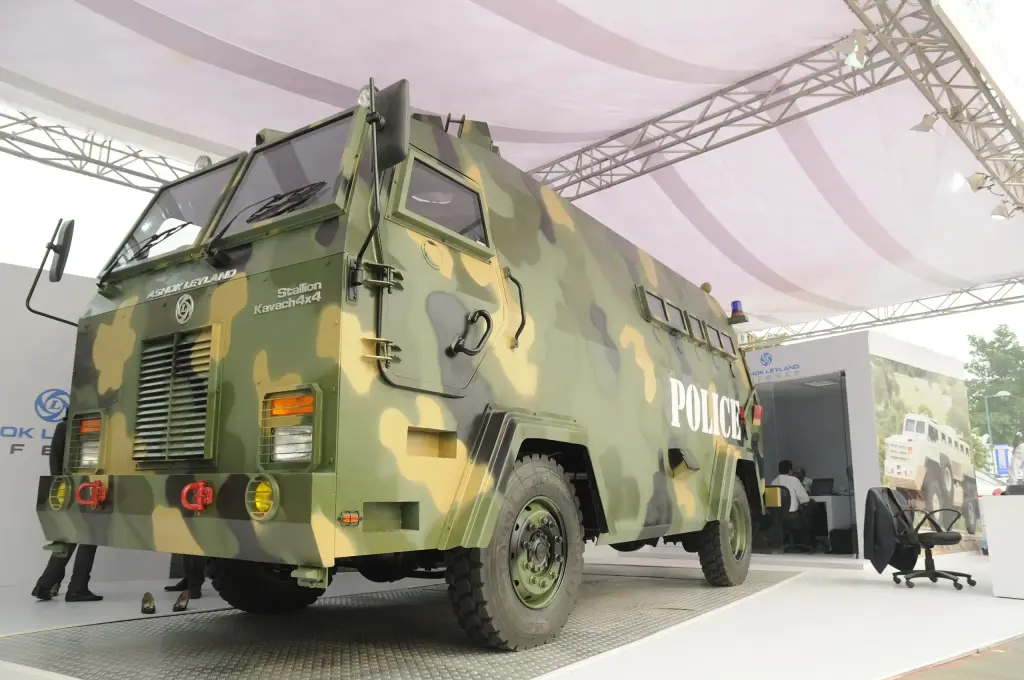
- Stallion Kavach: an armoured personnel carrier developed from the 4×4 Stallion.
- Field Artillery Tractor: a 4×4 and 6×6 variant for towing heavy artillery guns.
- Panhard TC54: a Stallion with an Austrian Steyr diesel engine and a Czech transmission, developed in 2008 for a Saudi-Chinese 155 mm towed artillery programme.
The Stallion is one of two military vehicles in this collection, alongside the Viking bus chassis. More Ashok Leyland vehicles are in the Ashok Leyland collection.
Video: Stallion-Defence
Video on YouTube.
Sources
- Ashok Leyland Stallion, English Wikipedia: production licence, design, variants, operators