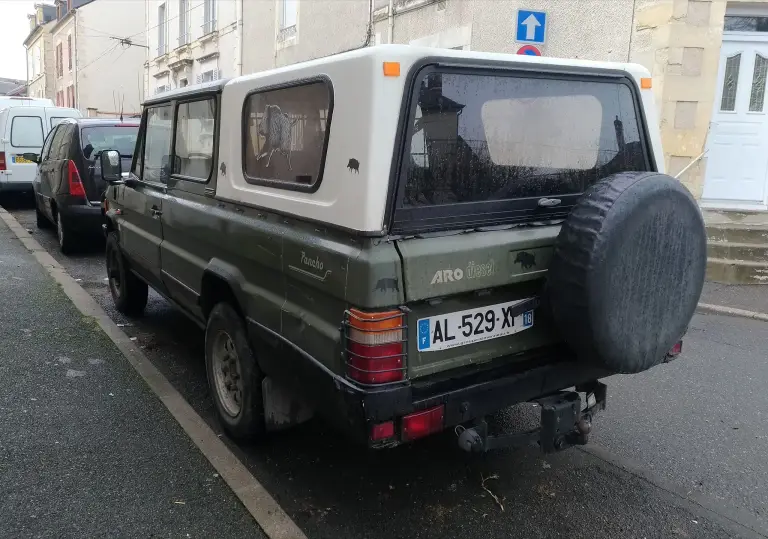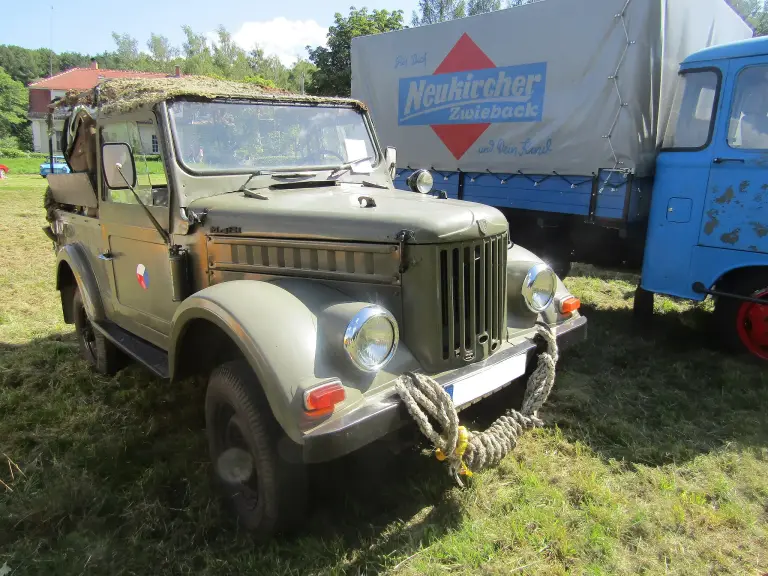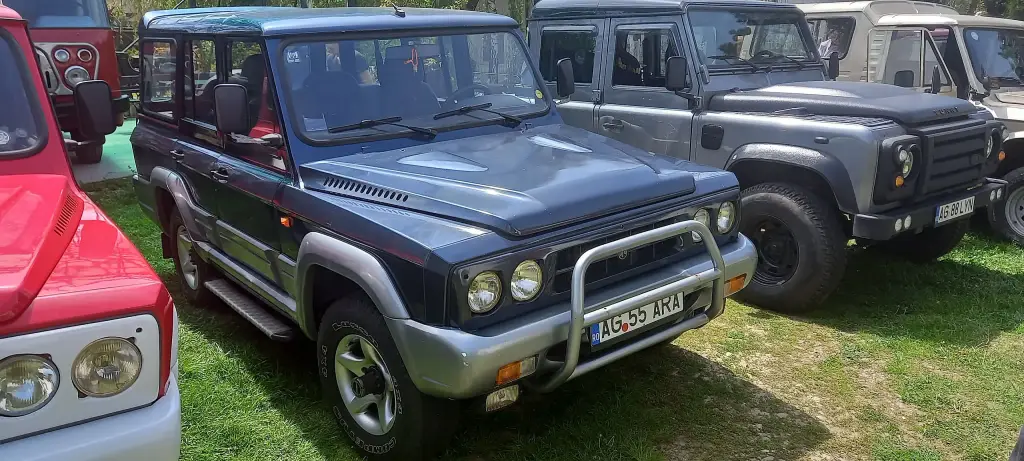
The ARO 24 Series was a family of four-wheel-drive off-road vehicles made by ARO in Câmpulung, Romania. It appeared in 1969, went into mass production in 1972 and stayed on the line until the company closed, spanning soft-tops, five-door estates, pick-ups, ambulances and military versions.
ARO 24 Series at a glance
| Maker | ARO (Întreprinderea de Automobile ARO), Câmpulung |
|---|---|
| Production | 1969–2006; mass production from 1972 |
| First model | ARO 240, a two-door soft-top |
| Body styles | two-, three-, four- and five-door estates and soft-tops, pick-ups, ambulances, transport versions |
| Drive | 4×2 and 4×4 |
| Engines | petrol and diesel, including Romanian diesel, Toyota and Romanian-built turbo-diesel units |
| Wheelbase | 2,350 mm; 2,600 mm on the 263, 264 and 266 |
| Military version | ARO Dragon, also in armoured form |
| Built abroad | Portaro 4×4 in Portugal, Hisparo 4×4 in Spain |
| US plan | Cross Lander 244X, cancelled in 2005 |
History of the ARO 24 Series
Origins and the ARO 240
The ARO 24 Series was developed by Întreprinderea de Automobile ARO in Câmpulung and shown for the first time at the EREN national exhibition in Bucharest in 1969; the first example carried chassis number 00001. The Romanian account says the design took six years and that the production model was officially named ARO 240. Mass production is dated from 1972, although evidence points to test cars from 1969. The 240 was a two-door soft-top with independent front suspension, a four-speed gearbox and a transfer case; its new 2,500 cc engine produced 75 hp, and the earliest cars still used the engine of the ARO M461.
The range grows, 1975–1977
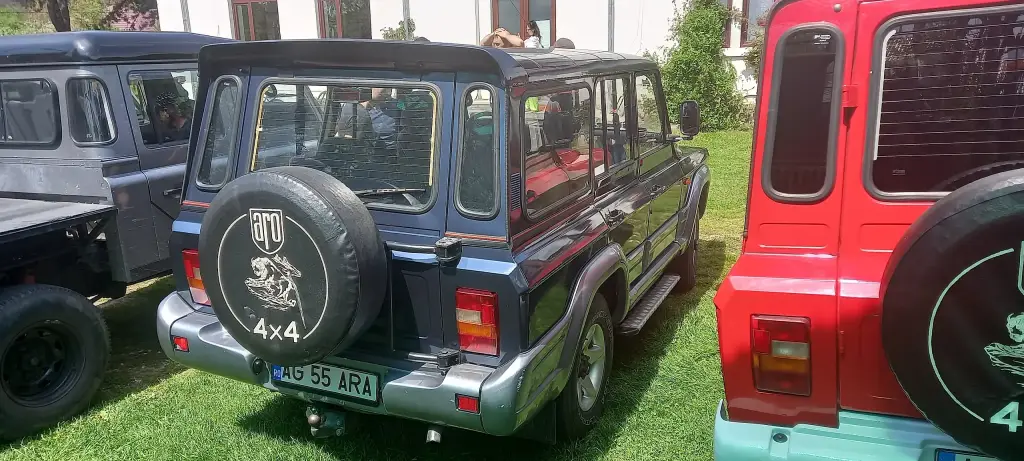
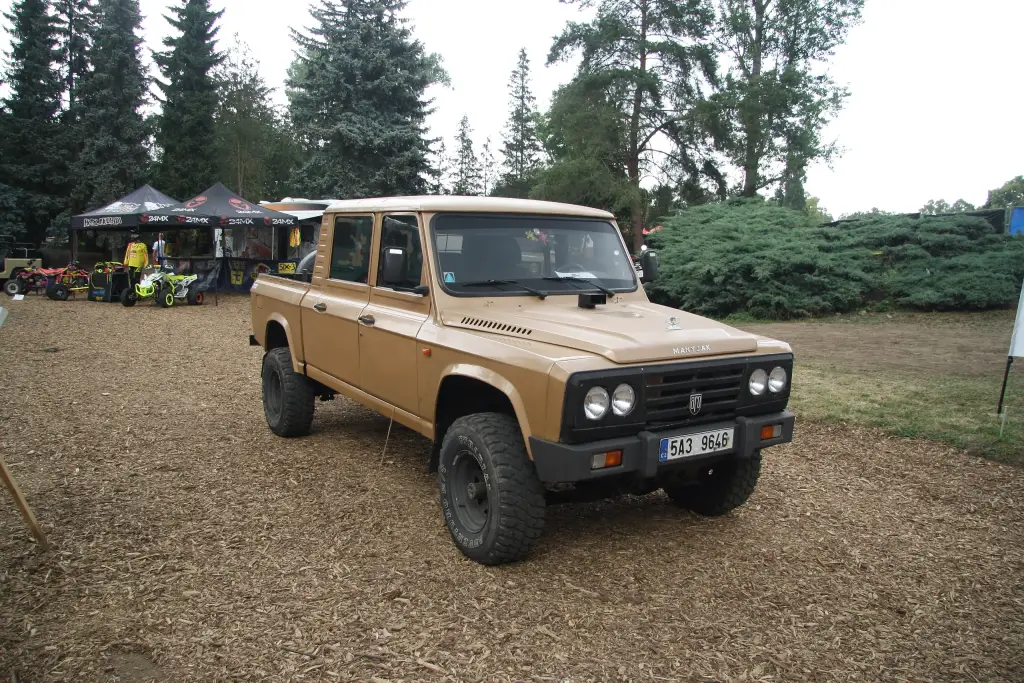
In 1975 came the 241, a four-door soft-top, and the 243, a three-door with a fully enclosed rear body and eight seats or a partition and load space. The 242 pick-up, derived from the 240 and 243, also arrived in 1975. In 1976–77 ARO added the five-door 244 and the 320 pick-up, the latter built by ROCAR on a lengthened ARO 24 chassis. The five-door 246 with seven seats completed the estate line. The light commercial family grew to include the 320 single-cab, 324 double-cab, 328 Maxi and 330 extended single-cab pick-ups.
Revisions and facelifts
The first generation, built from 1972 to 1976, had Dacia 1300 headlights and round tail lights similar to the ARO M461. From 1977 round headlights were used as on the IMS and the rear lights were restyled. In 1984 a new plastic grille was adopted: two round headlights on most 243s, four round ones mainly on the 244, and two rectangular Dacia 1300-type lights on the 241, 242, 243 and 244. The same year brought a new dashboard and instruments, including the instrument panel of the Dacia 1310. In 1985 a new grille and smaller round headlights arrived, with double headlights used mostly on the 244. The 1995 revision restyled the double-headlight front and adopted Oltcit Club rear lamps; the last facelift of 1998 introduced Toyota-type ornaments.
Engines and export
The range was offered with many petrol and diesel engines and in both 4×2 and 4×4 form. Notable steps were the introduction of Romanian diesel engines, units supplied by Toyota and Romanian-built turbo diesels. The ARO 24 was exported to socialist and capitalist markets alike, took part in the Paris–Dakar rally and reached Africa, India, the United States and South America. In Portugal the vehicles were assembled in Setúbal and sold as the Portaro 4×4; in Spain they were called Hisparo 4×4, with a reshaped body and better equipment. A plan to market the 244 in the United States as the Cross Lander 244X in 2005 was cancelled.
Special bodies, military versions and the end
ARO built an extensive variety of special bodies, among them the 263 (eight seats, three doors, on a 2,600 mm wheelbase), the 264 (five seats, four doors) and the 266 (seven seats, five doors), all with the wheelbase stretched from 2,350 mm to 2,600 mm. There were ambulances such as the 323 Sanitară with a raised roof behind the B-pillar and the 35S on a 3,500 mm wheelbase, plus the 338 TC and the 429 TC/TP transport versions. For the Romanian military ARO designed the Dragon, with a simplified flat-panelled body and an armoured variant; a civilian Dragon Civil was also offered. Production ended when ARO was shut down: English Wikipedia dates this to 2006, Romanian Wikipedia to 2005.
Design and features
- Body-on-frame 4×4: a separate chassis, a transfer case and independent front suspension, a novelty among off-roaders of the period.
- One family, many bodies: soft-tops, three-, four- and five-door estates, pick-ups, ambulances and transport versions shared the same basic design.
- Long-wheelbase variants: the 263, 264 and 266 stretched the wheelbase from 2,350 mm to 2,600 mm for more room.
- Mixed engine supply: Romanian petrol and diesel units, Toyota engines and Romanian-built turbo diesels were all fitted over the years.
ARO 24 Series versions
- ARO 240: two-door soft-top cabriolet, the first of the series.
- ARO 241 and 243: four-door soft-top and three-door eight-seater.
- ARO 244 and 246: five-door estates with five and seven seats.
- ARO 242, 320, 324, 328 and 330: single- and double-cab pick-ups, including the 328 Maxi and the long 330.
- ARO Dragon: military version with a flat-panelled body and an armoured variant.
The smaller ARO 10 was the little brother of this series, and the earlier ARO M461 was the model the 24 replaced. More vehicles are in the ARO collection.
Sources
- ARO 24 Series, English Wikipedia: production dates, versions, export, revisions
- ARO 24, Romanian Wikipedia: history, launch, models, facelifts