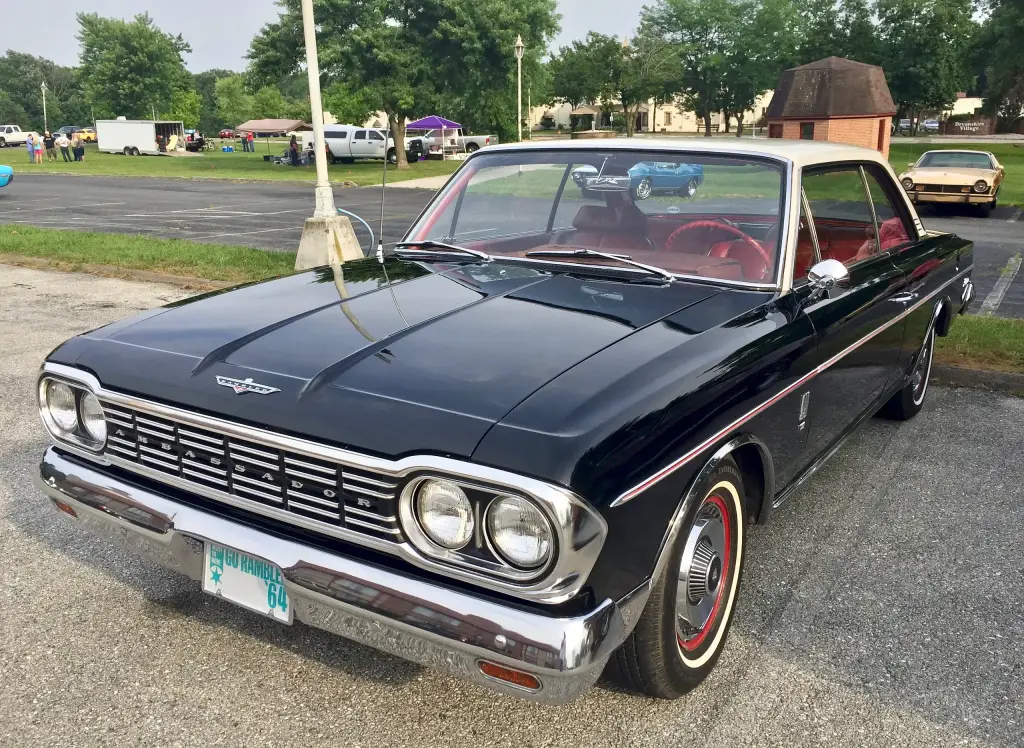

The AMC Ambassador was the top line of American Motors from the 1957 through the 1974 model year. The name had belonged to Nash since 1927, passed through the Rambler range after the merger that created AMC, and ended up on the company’s own flagship. Over eight generations the Ambassador was built as a sedan, hardtop, station wagon or convertible.
AMC Ambassador at a glance
| Maker | American Motors Corporation, Kenosha, Wisconsin |
|---|---|
| Production | 1957–1974 model years, eight generations |
| Class | full-size 1957–1961, mid-size 1962–1966, full-size 1967–1974 |
| Body styles | two- and four-door sedans, two- and four-door hardtops, four-door station wagons, two-door convertibles |
| Position | flagship line, with more standard equipment and higher levels of trim |
| Nameplate | a Nash trim level from 1927, a separate Nash model by 1932; Ambassador V-8, then Rambler Ambassador, then AMC Ambassador |
| Assembly | Lake Front plant, Kenosha, Wisconsin, until 1974; Brampton, Ontario, 1963–1966 |
| Overseas assembly | AMI in Australia 1961–1963, IKA in Argentina 1965–1972, ECASA in Costa Rica 1965–1970, Planta REO in Mexico for the first generation |
| Construction | unit body, which Nash called Unitized Body |
| Headlamps | the first American car with standard stacked quad headlamps |
This page is based on one source, the English Wikipedia article on the AMC Ambassador.
History of the AMC Ambassador
Origins with Nash Motors
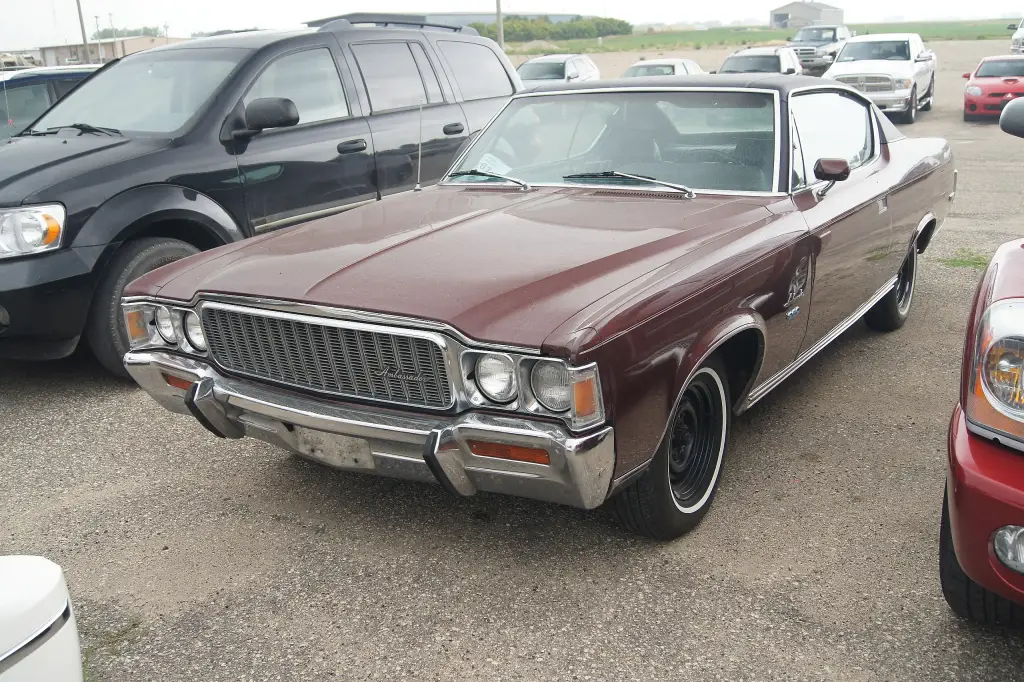

The Ambassador name was first used by Nash in the 1927 model year, not for a separate model but as a high trim designation on a specially appointed four-door, five-passenger sedan. By 1932 it had become a model range of its own and the top of the Nash line. Pre-war Nash Ambassadors were known for lavish equipment, robust construction and high quality, and earned the nickname “the Kenosha Duesenberg” after the Wisconsin city where they were built; their competition included Packard, Lincoln and Duesenberg, and the cars are Approved Classics of the Classic Car Club of America. The Ambassador was also a showcase for Nash engineering: it used unit body construction, which the company marketed as Unitized Body, and after the war it carried the aerodynamic Airflyte styling. The Nash Ambassador was the first car with standard stacked quad headlamps, a layout that broke some state laws at the time but was later widely copied.
Reorientation under American Motors
Nash-Kelvinator and Hudson Motors merged in 1954 to form American Motors. The death of George W. Mason that October brought George Romney to the presidency, and Romney concentrated the company on compact Rambler models instead of direct competition with General Motors, Ford and Chrysler. The Nash Ambassador was still sold through the Nash dealer network for a transition period up to 1957, largely carried over in 1954 with its Airflyte body; that year’s car was the first American automobile with a fully integrated front-end heating, ventilating and air-conditioning system. As the new company settled, the nameplate moved into the Rambler range, first as the Ambassador V-8 by Rambler and then as the Rambler Ambassador, and finally became the AMC Ambassador.
An eight-generation flagship
Across its eight generations the Ambassador changed class twice: it was a full-size car from 1957 to 1961, a mid-size car from 1962 to 1966, and a full-size car again from 1967 to 1974. Buyers could choose two- and four-door sedans, two- and four-door hardtops, four-door station wagons and two-door convertibles. The cars were built at AMC’s Lake Front plant in Kenosha, Wisconsin, until 1974 and at Brampton Assembly in Ontario between 1963 and 1966. Australian Motor Industries assembled right-hand-drive Ambassadors from knock-down kits from 1961 to 1963; the fifth-generation cars were manufactured by Industrias Kaiser Argentina in Córdoba from 1965 to 1972 and assembled by ECASA in Costa Rica from 1965 to 1970; the first generation was put together in Mexico by Planta REO. Fifth- and seventh-generation Ambassadors were also converted into custom stretch limousines in Argentina and the United States. When production ended in 1974 the nameplate had been in use since 1927, making it the longest continuously used car nameplate until then.
Design and features
- Flagship status: the Ambassador sat at the top of the range, with more standard equipment and higher levels of trim than the rest of the line.
- Longest-running nameplate: in use from 1927 until 1974, it was the longest continuously used car name ever until then.
- Unitized Body: Nash’s unit body construction was among the first popular uses of the layout in American cars.
- Stacked quad headlamps: the Nash Ambassador was the first car to have them as standard equipment.
- Wide choice of bodies: sedans, hardtops, a four-door station wagon and a two-door convertible were all part of the line.
AMC Ambassador versions
- Two- and four-door sedans: the volume body styles of the range.
- Two- and four-door hardtops: pillarless versions offered alongside the sedans.
- Four-door station wagon: the load-carrying Ambassador.
- Two-door convertible: the open version of the flagship.
- Rambler and AMC naming: the same line was sold as the Ambassador V-8 by Rambler, then as the Rambler Ambassador, and finally as the AMC Ambassador.
- Stretch limousines: fifth- and seventh-generation cars were converted into custom limousines in Argentina and the United States.
The Ambassador began as the Nash Ambassador and continued in the Rambler range as the Rambler Ambassador. More cars are in the Ambassador collection.
Video: 1966 AMC Ambassador DPL TV Ad
Video on YouTube.
Sources
- AMC Ambassador, English Wikipedia: history, generations, body styles, assembly