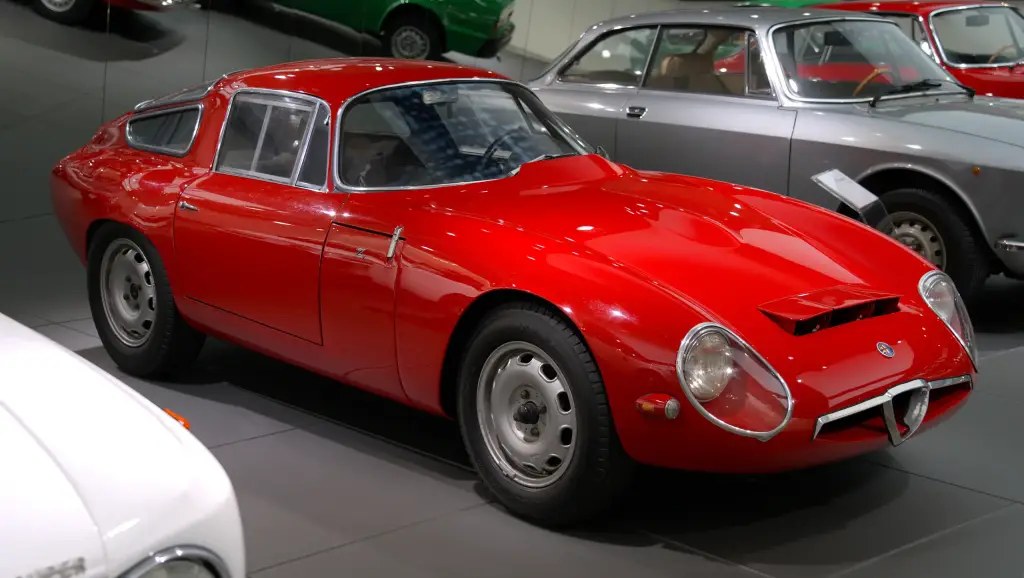
The Alfa Romeo Giulia TZ, also called the TZ1 or Tubolare Zagato, is a sports and racing coupé built by Alfa Romeo from 1963 that replaced the Giulietta SZ. A lightweight car with a tubular space frame and an aluminium Zagato body, it weighed only 650 kg, and 112 units were built between 1963 and 1965.
Alfa Romeo Giulia TZ1 at a glance
| Presented | 1962 Turin Auto Show |
|---|---|
| Production | 112 units, 1963–1965 |
| Frame | tubular spaceframe by SAI Ambrosini |
| Body | light all-aluminium, by Zagato, with a Kamm tail (coda tronca) |
| Engine | 1,570 cc straight-four DOHC (78 mm × 82 mm) |
| Power | 112 PS at 6,500 rpm (road trim); up to 160 PS (race trim) |
| Brakes and suspension | disc brakes, independent suspension |
| Weight | 650 kg (1,433 lb) |
| Top speed | 216 km/h (134 mph) |
This page is based on English Wikipedia only, so the figures could not be cross-checked against a second source.
History of the Alfa Romeo Giulia TZ1
The original TZ, now sometimes called TZ1 to tell it from the later TZ2, was presented at the 1962 Turin Auto Show. It used a 1,570 cc twin-cam engine and other components shared with the Alfa Romeo Giulia and carried a 105-series chassis number, but it was a purpose-built sports racing car. The tubular frame was built in the province of Perugia by SAI Ambrosini, the body was made by Zagato, and final assembly was done by Delta of Udine, with Carlo Chiti first a consultant and then project leader. The firm soon became Auto-Delta.
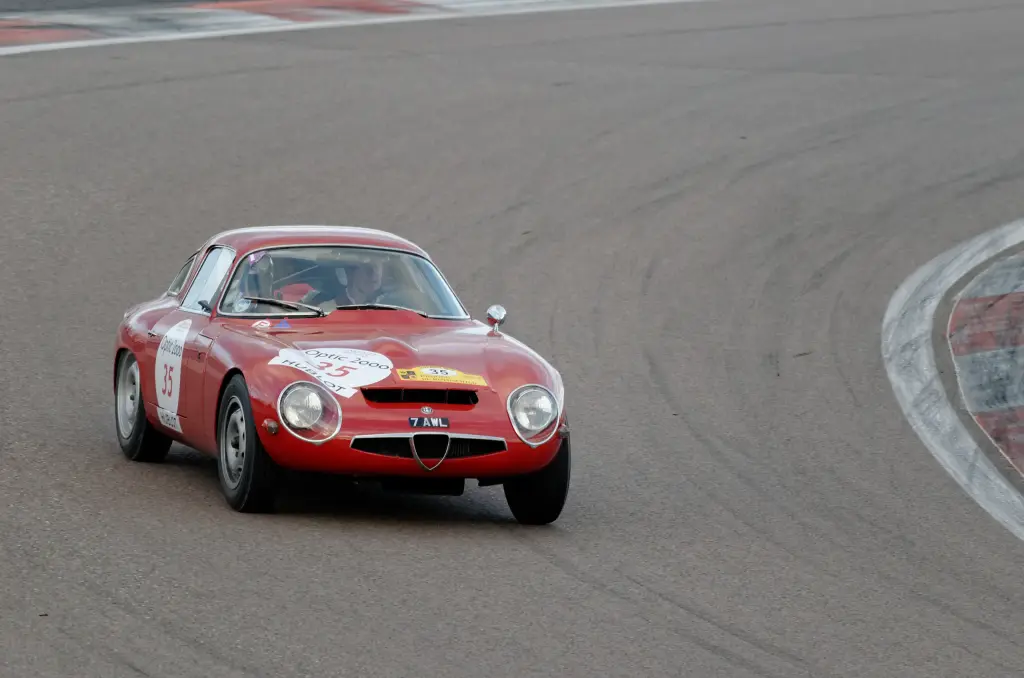
The car debuted at the 1963 FISA Monza Cup, where TZs took the first four places in the prototype category. At the start of 1964 it was homologated as a Gran Turismo car (100 units were needed) and went on to take class wins in Europe and North America. Because only a limited number were built, TZ cars are highly collectable today, with listed prices of around 150,000–200,000 US dollars.
Design and features
- Kamm tail: the “coda tronca” rear, based on the research of Dr. Wunibald Kamm, cuts lift and adds little drag; Zagato had proved it on earlier Sprint Zagato racers.
- Engine: the Giulia alloy block with wet steel liners, installed at an angle to improve airflow, with the twin-spark head also used in the GTA.
- Chassis: a tubular spaceframe with disc brakes and independent suspension.
Alfa Romeo Giulia TZ1 versions
- TZ (TZ1), 1963–1965: 112 cars, road and race versions.
- TZ2 (1964): the fibreglass-bodied racing version, only 12 built.
- TZ3 (2010–2011): modern tribute cars built by Zagato for Alfa Romeo’s centenary.
More Alfa Romeo sports cars of the 1960s are in our Alfa Romeo collection, for example the Giulia TZ2, the TZ3 and the Giulia GTA.
Alfa Romeo Giulia TZ1 questions and answers
What does TZ mean?
Tubolare Zagato: a tubular frame with a Zagato body.
How many Giulia TZ were built?
112 units between 1963 and 1965.
What engine does the TZ have?
A 1,570 cc twin-cam four-cylinder, 112 PS in road trim and up to 160 PS in race trim.
How fast is it?
A top speed of 216 km/h (134 mph) at a weight of only 650 kg.
What did the TZ replace?
The Giulietta SZ.
Sources
- Alfa Romeo Giulia TZ, English Wikipedia: design, engine, history