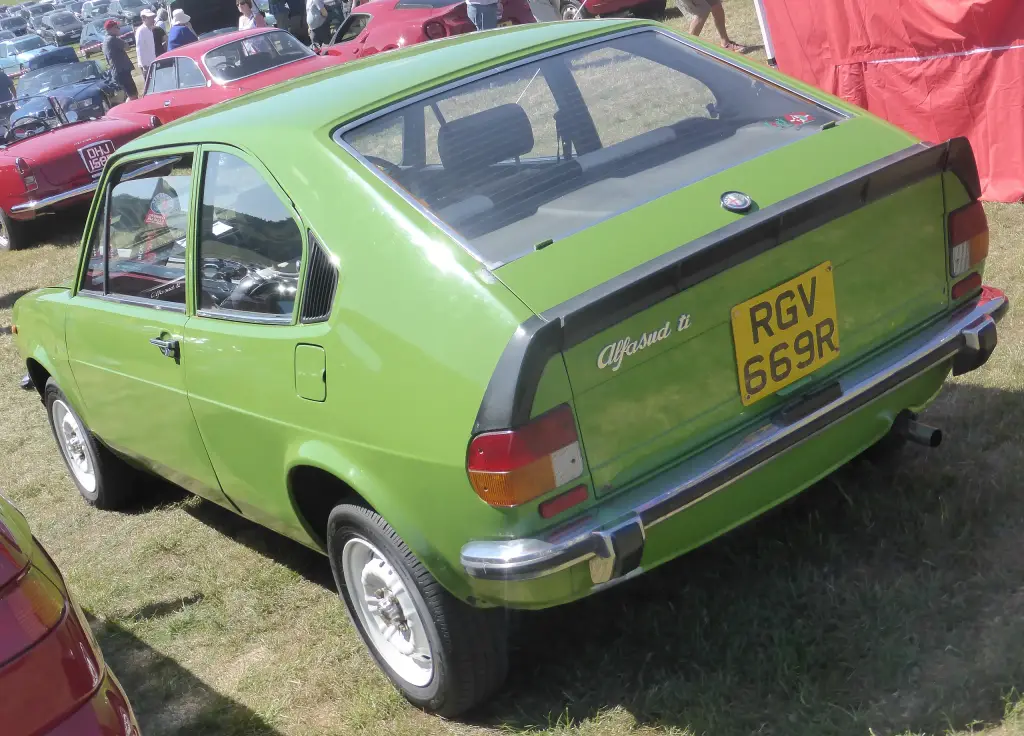
The Alfa Romeo Alfasud (Type 901, 902 and 904) is a small front-wheel-drive family car made by Alfa Romeo from 1971 to 1989. It was known for its boxer engine, low centre of gravity, class-leading handling and styling by Giorgetto Giugiaro of ItalDesign, and also for its susceptibility to rust.
Alfa Romeo Alfasud at a glance
| Production | 1971–1989 (saloon 1972–1983, Sprint coupé 1976–1989) |
|---|---|
| Units built | 893,719 saloons (1972–1983) and 121,434 Sprint coupés (1976–1989) |
| Types | 901, 902 and 904 |
| Plant | Alfa Romeo Pomigliano d’Arco, southern Italy |
| Engineer | Rudolf Hruska; styling by Giorgetto Giugiaro (ItalDesign) |
| Launch engine | 1,186 cc water-cooled boxer, one belt-driven overhead camshaft per cylinder head |
| Drive | front-wheel drive |
| Suspension | front MacPherson struts; rear beam axle with Watt’s linkage |
| Facelifts | 1977 and 1980 |
This page is based on English Wikipedia only, so the figures could not be cross-checked against a second source.
History of the Alfa Romeo Alfasud
Alfa Romeo had explored a smaller front-wheel-drive car in the 1950s, but firm plans for a new model below the existing range were laid down only in 1967. The car was to be built at a new state-sponsored factory at Pomigliano d’Arco in southern Italy, which gave the car its name: Alfa Sud means “Alfa South”. On 18 January 1968 a new company was registered in Naples, with 90 % of the capital subscribed by Alfa Romeo and 10 % by Finmeccanica.
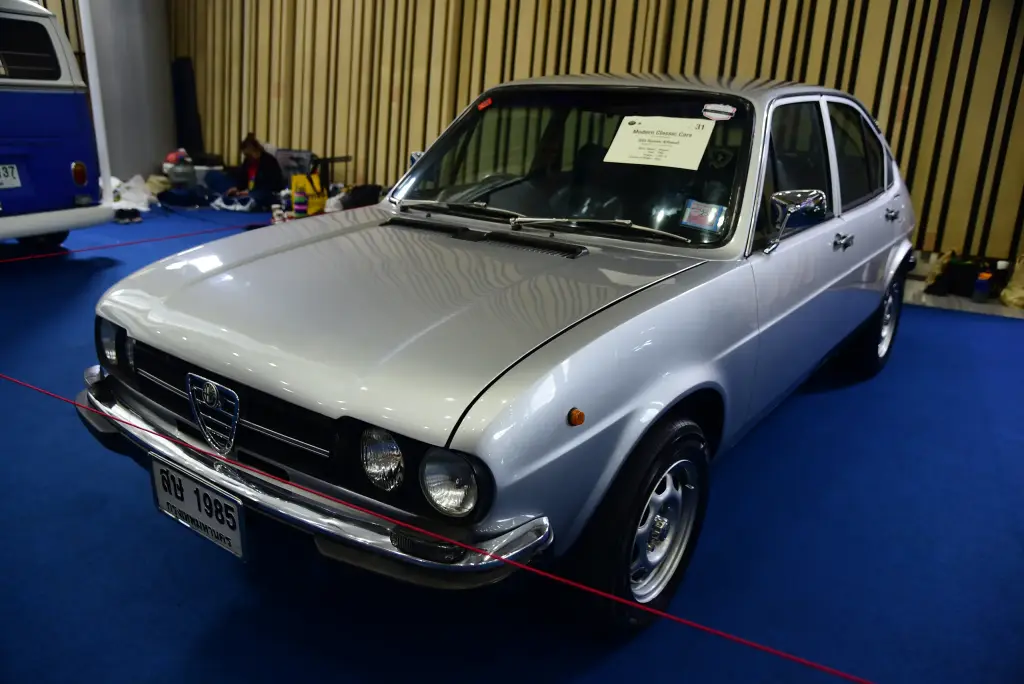
The Alfasud debuted at the Turin Motor Show in 1971. Over its life it grew from a four-door saloon to a family of bodies: a two-door saloon (only in “ti” trim), the Giardinetta wagon (1975), the Sprint coupé (1976), a three-door hatchback (1981) and a five-door hatchback (1982).
Design and features
- Engine: a flat-four boxer with a belt-driven overhead camshaft on each cylinder head.
- Chassis: a low centre of gravity and an aerodynamic profile gave class-leading handling.
- Weak point: a conspicuous susceptibility to rust.
Alfa Romeo Alfasud versions
- Saloon (1971–1983): four-door, with a two-door “ti” version.
- Giardinetta (1975): a three-door wagon.
- Alfasud Sprint (1976–1989): the two-door coupé.
- Hatchbacks (1981 and 1982): three- and five-door liftbacks.
More Alfa Romeo cars of the era are in our Alfa Romeo collection, for example the Alfa Romeo 33, the Arna and the Alfa Romeo Sprint.
Alfa Romeo Alfasud questions and answers
Why is it called Alfasud?
Because it was built at a new factory in southern Italy: Alfa Sud means “Alfa South”.
Who designed the Alfasud?
Engineering by Rudolf Hruska and styling by Giorgetto Giugiaro of ItalDesign.
What engine does it have?
A water-cooled flat-four boxer, 1,186 cc at launch.
How many were built?
893,719 saloons between 1972 and 1983, plus 121,434 Sprint coupés between 1976 and 1989.
Which car replaced it?
The Alfa Romeo 33 evolved from it, using its floorpan, chassis and drivetrain.
Sources
- Alfa Romeo Alfasud, English Wikipedia: history, production, body styles