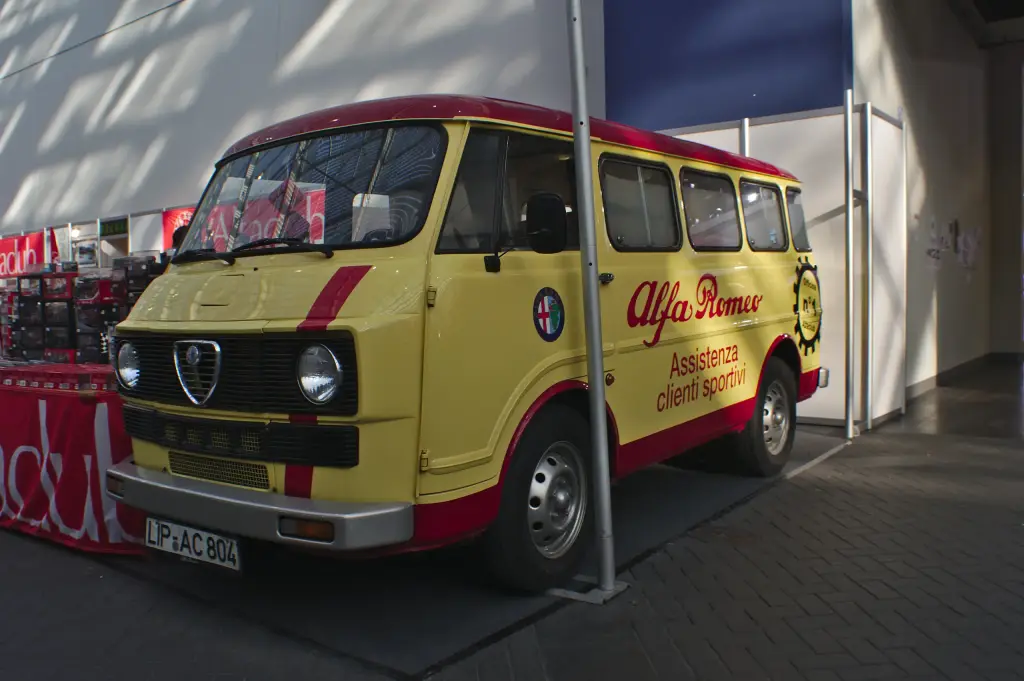
The Alfa Romeo Romeo is a light commercial cab-over van and pickup truck introduced by Alfa Romeo in 1954 as the Autotutto (“all purpose”). The van line was built until 1983, when it was replaced by relabelled Fiat and Iveco commercials; in Spain it was rebodied and stayed in production into the early 2000s.
Alfa Romeo Romeo and F12 vans at a glance
| Production | 1954–1983 (Romeo 1954–1966; F12/A12 from 1967) |
|---|---|
| Units | about 23,000 Romeos between 1954 and 1966 |
| Introduced | 1954 Turin Motor Show as the T10 Autotutto (panel van and minibus) |
| Romeo petrol engine | 1,290 cc Twin Cam four, detuned to 37 hp, top speed 97 km/h |
| Romeo diesel option | two-cylinder supercharged two-stroke, 30 hp, 75 km/h |
| Romeo 2 (1957) | also built under licence in Spain by FADISA with a 1.6 L Perkins 4.99 diesel |
| Romeo 3 (1966) | hydraulic clutch, adjustable driver’s seat; replaced after about six months |
| F12 and A12 (1967) | Giulia-engined, 1,290 cc Twin Cam of 52 hp, four-speed, front-wheel drive |
| Diesel (1973) | 1,760 cc Perkins 4.108, 50 hp |
This page is based on English Wikipedia only, so the figures could not be cross-checked against a second source.
History of the Alfa Romeo Romeo and F12 vans
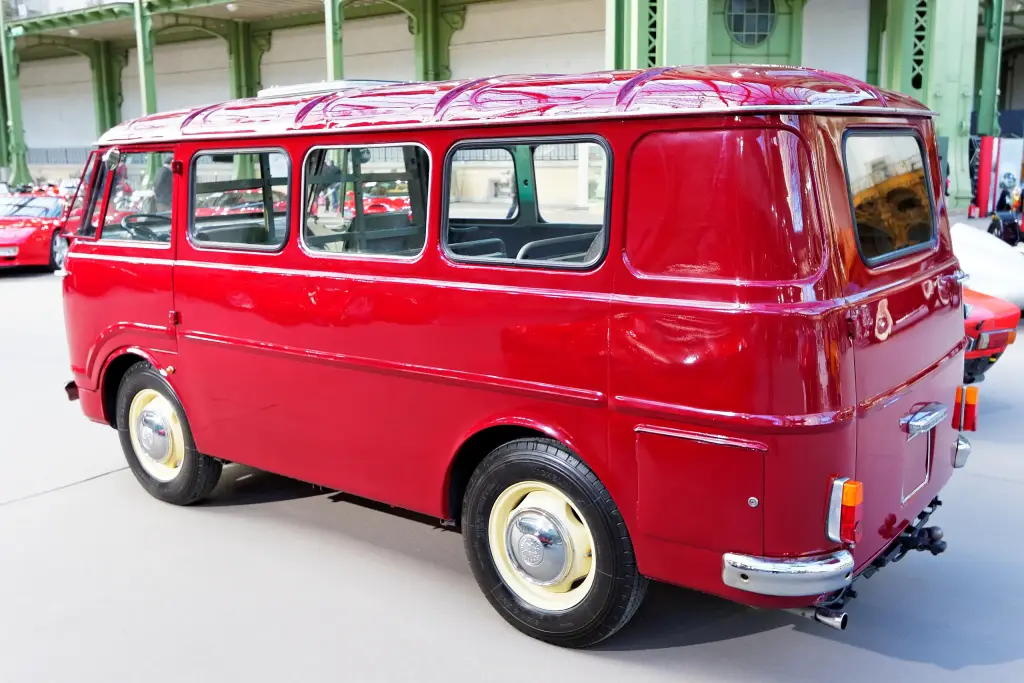
The first Alfa Romeo T10 “Autotutto” was unveiled at the 1954 Turin Motor Show in panel van and minibus versions. Later Alfa Romeo introduced many body versions: van, high-roof van, “Promiscuo” (a van with additional side windows and rear seating), minibus, school bus, ambulance, pickup, drop-side truck and double-cab truck, and coachbuilders made their own versions. The updated Romeo 2 appeared in 1957 and the final Romeo 3 in 1966, which had a short production run of about six months before being replaced by the F12 and A12 models. In all some 23,000 Romeos were produced between 1954 and 1966.
In 1967 the Autotutto was replaced by the Giulia-engined Alfa Romeo F12 and A12 vans, with a wider chrome-and-mesh grille and the Twin Cam engine uprated to 52 hp. In 1973 a Perkins diesel was added. The line ended in 1983 when relabelled Fiat and Iveco commercials took over; in Spain, where it was also built, the vehicle was rebodied and kept in production into the early 2000s, first as an Ebro or Avia and finally as the Nissan Trade.
Design and features
- Engine: the 1,290 cc Alfa Romeo Twin Cam, the same engine later used on the Giulietta Berlina.
- Layout: a front-engined cab-over van; the F12 and A12 had a four-speed gearbox and front-wheel drive.
- Bodies: van, minibus, school bus, ambulance, pickups and trucks.
Alfa Romeo Romeo and F12 vans versions
- Autotutto / Romeo (1954–1957): the first series.
- Romeo 2 (1957): built in Italy and in Spain (FADISA).
- Romeo 3 (1966): the final Romeo.
- F12 and A12 (1967–1983), F11 and A11: Giulia-engined vans, later with Perkins diesel.
More Alfa Romeo vehicles are in our Alfa Romeo collection, for example the Alfa Romeo Giulietta whose engine it shared. Our older “Romeo 2” and “F 12” pages are covered here.
Alfa Romeo Romeo and F12 vans questions and answers
What is the Alfa Romeo Romeo?
A light commercial cab-over van and pickup introduced in 1954 as the Autotutto.
What replaced the Romeo?
The Giulia-engined Alfa Romeo F12 and A12 vans in 1967.
How many Romeos were made?
About 23,000 between 1954 and 1966.
Was it built outside Italy?
Yes, in Spain by FADISA, where it lived on as an Ebro, Avia and finally the Nissan Trade.
What engines did it have?
A 1,290 cc Twin Cam petrol engine and Perkins diesels.
Sources
- Alfa Romeo Romeo, English Wikipedia: models, engines, production