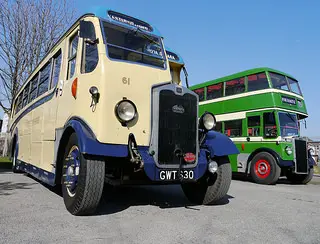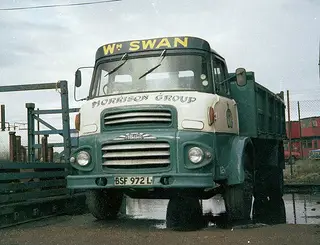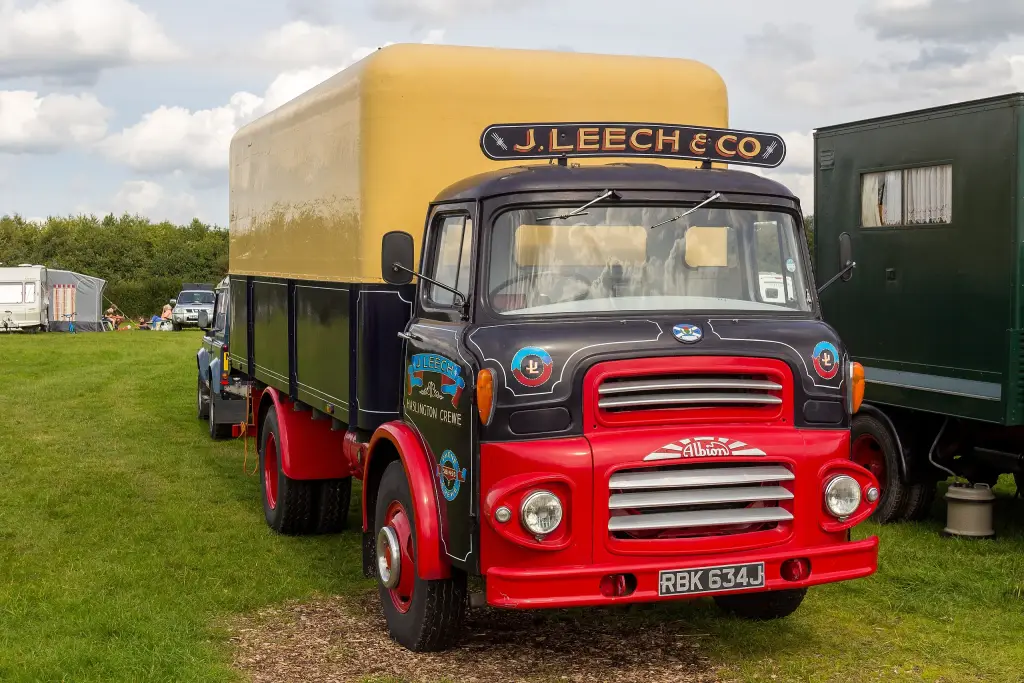
The Albion Chieftain was one of the lorries offered by Albion Motors of Scotstoun, Glasgow, and it appears in the company’s model list from 1948. Its six-speed gearbox had an overdrive sixth gear, and the rear axle was of the worm-and-wheel type. The Chieftain remained in the range through the Leyland takeover until the Albion name was dropped in 1972.
Albion Chieftain at a glance
| Maker | Albion Motors Ltd, Scotstoun, Glasgow |
|---|---|
| Type | Lorry (commercial truck) |
| In the range | from 1948 |
| Gearbox | six-speed, sixth gear an overdrive |
| Rear axle | worm and wheel |
| Factory | Scotstoun works, Glasgow |
| Brand | Albion until 1972, then Leyland |
| Range neighbours | Clydesdale, Reiver, Claymore (1954–1966), Clansman |
| Albion name dropped | 1972 |
| Vehicle production at Scotstoun | until 1980 |
There is no dedicated Wikipedia article for the Chieftain; this page is based on the Albion Motors company article only (based on one source).
History of the Albion Chieftain
A Scottish commercial vehicle maker
Albion Motors was founded in 1899 in Glasgow as the Albion Motor Car Company, by Thomas Blackwood Murray and Norman Osborne Fulton, who had both previously worked at Arrol-Johnston. The firm began on the first floor of a building in Finnieston Street with only seven employees and moved to its Scotstoun works in 1903. In April 1931 it was renamed Albion Motors Ltd, and its vehicles carried the sunrise badge. Although the first ten years were dominated by motor cars, in 1909 the company decided to concentrate on commercial vehicles, and lorries and buses became its main business.
The Chieftain in the post-war range
The Chieftain was listed in the Albion lorry range from 1948, alongside models such as the Claymore of 1954–1966, the Clydesdale and the Reiver, a six-wheeler. Albion gave it a six-speed gearbox in which the sixth ratio was an overdrive, a layout suited to long-distance running, and a worm-and-wheel rear axle. Along with the Claymore, it was one of the named models that made up the company’s post-war lorry line-up for British hauliers.
Leyland and the end of the Albion name
Albion was bought by Leyland Motors in 1951 and became part of the British Leyland Motor Corporation in 1968. Production of the Chieftain, Clydesdale and Reiver trucks and of the Viking bus models continued after the merger, and in 1969 the company took over the neighbouring Coventry Ordnance Works on South Street for truck component manufacture. British Leyland eliminated the Albion name in 1972, and the products continued to be built at the same factory under the Leyland brand. Vehicle production at the former Albion works in Scotstoun went on until 1980, when it moved to the British Leyland plant at Bathgate.
Design and features
- Overdrive top gear: a six-speed gearbox whose sixth ratio was an overdrive, with a worm-and-wheel rear axle behind it.
- Named model range: the Chieftain sat among Albion’s named post-war lorries, the Claymore, Clydesdale, Reiver and Clansman.
- Scotstoun build: assembled at the Glasgow works that had been Albion’s home since 1903.
- Long model life: kept in the catalogue through the Leyland takeover and until 1972.
Albion Chieftain versions
- Chieftain (from 1948): the original Albion-badged lorry.
- Albion-badged production: built and sold under the sunrise badge until 1972.
- Leyland-badged continuation: from 1972 the same products were sold under the Leyland brand from the same factory.
The Chieftain was one of a family of named Albion lorries that included the Clydesdale; the company also built the Valkyrie bus. More vehicles are in the Albion collection.
Video: 1954 Albion Chieftain restoration: first run of the engine
Video on YouTube.
Sources
- Albion Motors, English Wikipedia: company history, lorry range, gearbox and axle, Leyland takeover