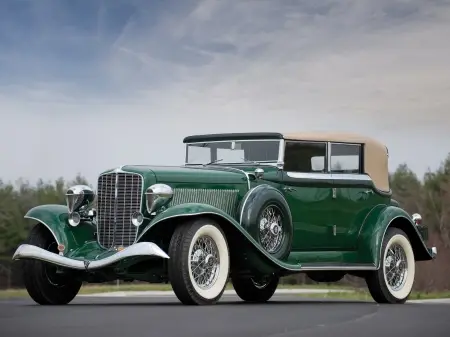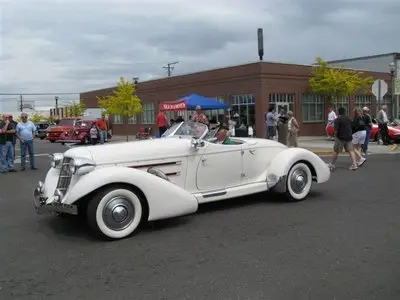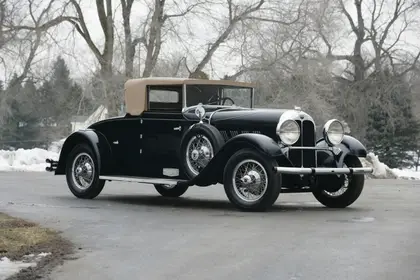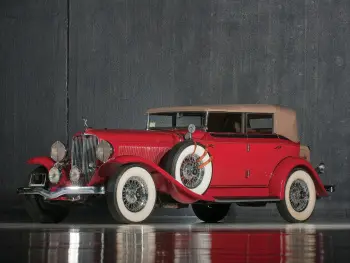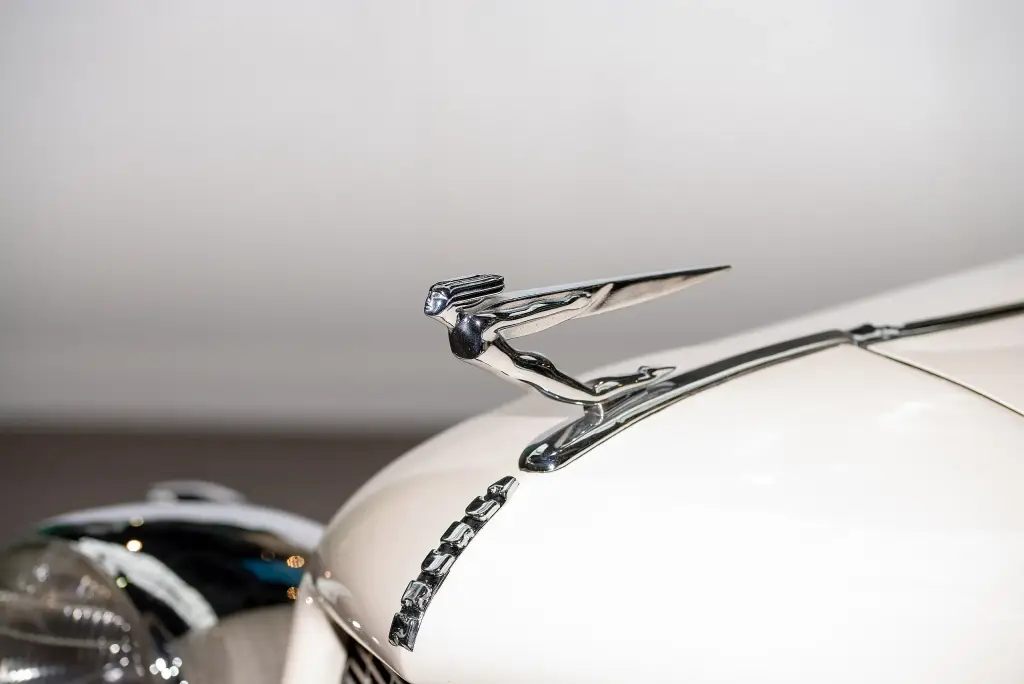
The Auburn Speedster is an American car made by the Auburn Automobile Company of Auburn, Indiana, and built in Union City, Indiana. A total of 887 cars were built between 1928 and 1936, in three series: the 1928–1930 eights, the 1931–1934 cars including the V12, and the dramatic 1935–36 supercharged eight. The first two series were styled by Alan Leamy, the 851 of 1935 by Gordon Buehrig, who also designed the Cord Model 810.
Auburn Speedster at a glance
| Maker | Auburn Automobile Company, Auburn, Indiana |
|---|---|
| Built | 1928 to 1936, 887 cars |
| First series (1928–1930) | straight eights, Speedster 115, 120 and 125 |
| Second series (1931–1934) | Speedster 160 with a 6.4 L V12, about 25 built |
| Third series (1935–1936) | Speedster 851 and 852, supercharged straight eight |
| 851 engine | 4,585 cc flathead eight, 150 bhp at 4,000 rpm |
| 851 gearbox | 3-speed synchromesh with a 3:1 / 4.5:1 dual-ratio axle |
| 851 length and weight | 4,930 mm, 1,700 kg |
| 851 top speed | 100 mph (160 km/h) |
| Supercharged boat-tails | 143 built (851/852SC) |
| Speedster 120 | 100 built, perhaps 8 known to survive |
| End of production | 1937, when Auburn ceased car production |
English Wikipedia is the only source used here (the German page is about a later replica maker). Its figures are those printed on the page.
History of the Auburn Speedster
An image leader
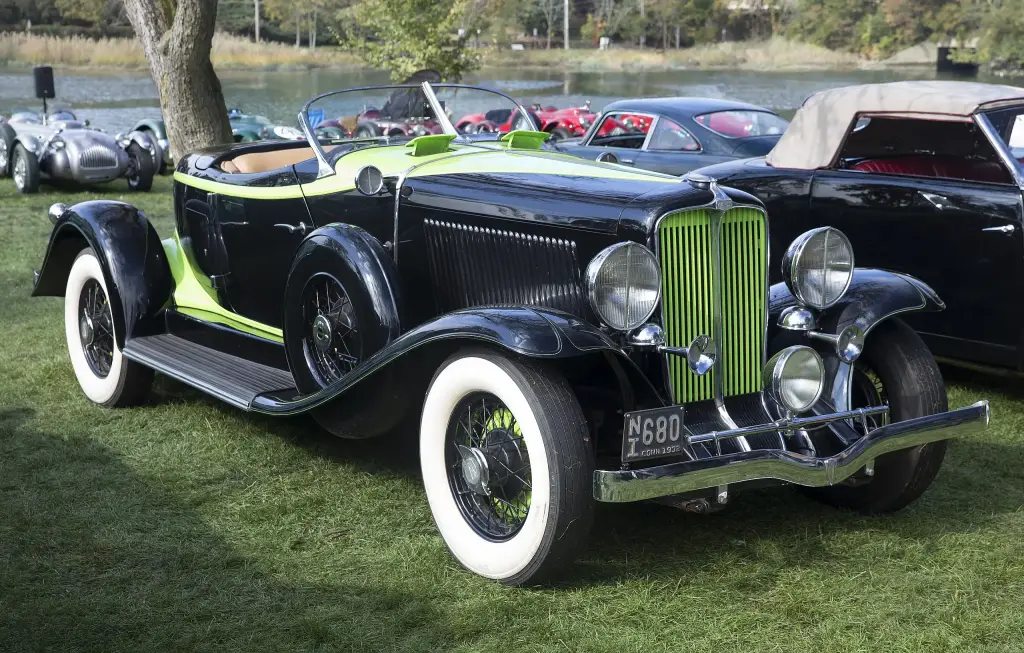
In 1924 Auburn output was down to six cars a day. Errett Lobban Cord, a successful salesman, took over the distressed company and brought in James Crawford to develop a new range. Others had already built boat-tail cars (Peerless, Packard, Hudson), but Auburn wanted an image leader in the class. The Speedster had a fixed windscreen but no side windows, no interior door release, an optional roof and a cockpit for two in an aerodynamic body.
First series, 1928 to 1930
The first Auburn eight appeared in 1925 as the Eight-In-Line, and in 1926 it received a 4.8-litre Lycoming side-valve engine of 68 bhp and the name 8-88. By 1930 the power had risen to 115 bhp, hence the Speedster 115. The car had semi-elliptic springs all round and mechanical brakes after experiments with hydraulics, and the open two-seater body styled by Count Alexis de Sakhnoffsky had a boat-tail and a vee windscreen. The Speedster 120, with the “big eight” of 120 hp, was built in 1928 and 1929 on a longer chassis; 100 were built and perhaps eight survive. In 1930 the Speedster 125, advertised as a “racing car with comfort of a closed car”, reached over 100 mph.
The V12 and the 851
In 1931 Auburn introduced a 6.4-litre V12 designed by George Kublin and built by Lycoming. In the Depression it was expensive, and only about 25 Speedster 160s were built, but the engine design was used as the basis of the LaFrance engine, used for decades in fire trucks. The Speedster 851, the last production model, was introduced in 1934 for the 1935 model year with bodywork by Gordon Buehrig: sandwiched front and rear fenders, a backswept radiator and external side-threaded exhaust pipes made it the iconic Auburn “Hollywood car”. The 852 of 1936 was identical but for the badge on the grille, and 143 supercharged 851/852SC boat-tail speedsters were made. Its Columbia dual-ratio axle, with an epicyclic gear train, gave a fast 4.5:1 final drive or a leisurely 3:1 selected by a lever on the steering wheel and a dip of the clutch.
Design and features
- Boat-tail: a pointed rear deck that later inspired the 1963–67 Corvette Stingray and the 1971–73 Buick Riviera.
- Engine: the 851 used a Schweitzer-Cummins centrifugal supercharger on a flathead eight.
- On screen: Marlene Dietrich drove an 851SC in the 1936 film Desire.
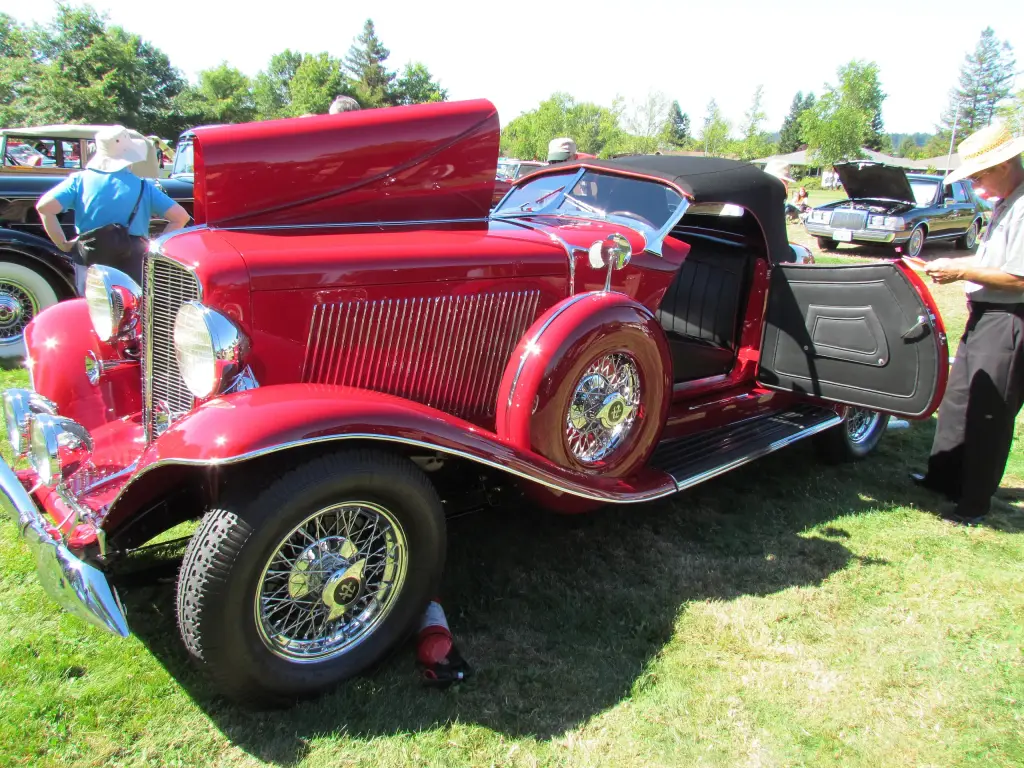
Auburn Speedster versions
- Speedster 115, 120, 125 (1928–1930): Lycoming straight eights.
- Speedster 160 (1931–1934): 6.4 L V12, about 25 built.
- Speedster 851 and 852 (1935–1936): supercharged eight by Gordon Buehrig.
More Auburn cars are in our Auburn collection, and the boat-tail shape also appears on the Buick Riviera.
Sources
- Auburn Speedster, English Wikipedia: history, series, specifications