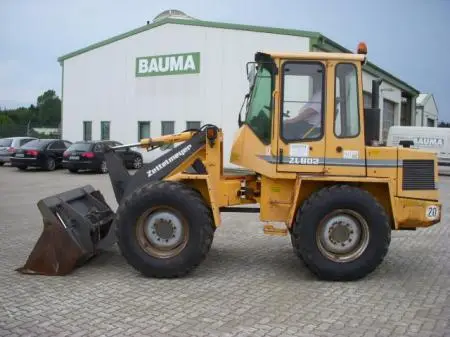
The Zettelmeyer ZL is a wheel loader from Zettelmeyer Baumaschinen, the construction-machinery maker of Konz on the Moselle. The firm built steam rollers, diesel tractors and loaders for almost a century before Volvo bought it in 1994, and the ZL belongs to the wheel-loader line that by 1968 was the broadest offered by any German manufacturer.
Zettelmeyer ZL at a glance
| Maker | Zettelmeyer Baumaschinen GmbH, Konz, Germany |
|---|---|
| Founded | 1897 by Hubert Zettelmeyer |
| First product | steam roller for road building |
| Diesel tractors | from the early 1930s; the 500th built in 1936 |
| First lift loader | 1953, lift height 2.80 m |
| Wheel loaders | widest programme of any German maker by 1968 |
| Road-building branch | closed in 1971 |
| Owner from 1975 | IBH |
| Owner from 1994 | Volvo |
| Works | Konz; from 1975 moved from the town centre to Könen |
There is no Wikipedia article on the ZL model itself; this page is based on the German Wikipedia article on the Zettelmeyer works, which describes the company and its wheel-loader programme. Based on one source.
History of the Zettelmeyer ZL
From a steam roller to a machinery works
Hubert Zettelmeyer founded the company in Konz in 1897 after buying a steam roller for road building, which he drove himself until 1899 before turning to running the business. In 1901–02 the family bought its first plot at Granastraße 68 and built a house and offices there, and in 1902 the first repair workshop followed. For a time the firm acted as agent for Clayton & Shuttleworth of Lincoln, selling their steam rollers, portable steam engines and threshing machines. Because spare parts were hard to obtain, the workshop was greatly enlarged in 1905 in preparation for building a roller of its own; a design office was added in 1909 and in 1910 the first Zettelmeyer steam roller left the works. By 1914 twenty roller trains with about 45 men were working for the company, fourteen of the rollers built in-house, and in 1913 the workforce was about 110.
During the First World War the trains were placed under the imperial army and used across the western front; after the war all 24 roller trains returned to Konz intact. In 1925 the business continued as Zettelmeyer AG and opened branches across Germany, and until 1929 it built complete roller trains with living, coal and water wagons. The motor roller then ended further development of the steam roller.
Diesel tractors and the war
Hubert Zettelmeyer died on 19 June 1930 at the age of 64 and his son Peter took over the firm. In the early 1930s Zettelmeyer began building diesel tractors, and the success was immediate: within a year the tractor business accounted for 52 per cent of total turnover. The 500th diesel tractor left the works in 1936, by which time the workforce had grown to more than 840.
The Second World War brought this success to an abrupt end. Large parts of the factory were destroyed by bombing in May 1944, the Allies having taken Zettelmeyer for an armaments plant. The site was rebuilt between 1946 and 1950, regular production resumed in 1950, and in 1951 the works newspaper Die Dampfwalze appeared for the first time.
Lift loaders and the wheel-loader range
In 1953 Zettelmeyer presented its first Hubloader at the Hannover industrial fair. Its lift height of 2.80 m was remarkable for the period, and the mechanical gearbox was developed by the company itself. In 1955 Peter Zettelmeyer received the Bundesverdienstkreuz; the firm worked with Philipp Holzmann, Siemens Bau and Hochtief on the Riveristalsperre dam near Trier, introduced a suggestion scheme that paid for adopted ideas, raised productivity by 130 per cent and began exporting on a large scale. The last section of the new factory halls was finished in 1956, and machines were exported for the first time to Brazil, Colombia, Mexico, Indonesia and India.
By 1957 the workforce had reached 1,600 and the production of diesel tractors ended; the spare-parts warehouse, final assembly and test department moved to Konz-Karthaus. Despite the recession of the late 1960s, in 1968 Zettelmeyer could offer the widest wheel-loader programme of any German manufacturer. This is the line the ZL comes from. The road-building division, unprofitable, was closed in 1971.
Change of owners
In 1975 the company, increasingly in financial difficulty, was sold to IBH. The move of the works from Konz town centre to the Könen district was prepared, a large number of machines was delivered to Iraq and a branch was set up there. In 1994 Volvo bought the company, and the Zettelmeyer name passed into the Swedish group.
Design and features
- Lift-loader lineage: Zettelmeyer’s first Hubloader of 1953 had a 2.80 m lift height and an in-house mechanical gearbox.
- Wheel-loader programme: by 1968 the Konz works offered the widest range of wheel loaders of any German maker.
- Own engineering: transmissions and lifting gear were developed in-house, a tradition going back to the design office of 1909.
- Export record: from the mid-1950s machines went abroad in quantity, reaching Brazil, Colombia, Mexico, Indonesia and India by 1956.
- Long-lived site: the works at Konz remained an important regional employer for nearly a century.
Zettelmeyer ZL versions
- Steam rollers (from 1910): the founding product, built as complete roller trains until 1929.
- Diesel tractors (from the early 1930s): the 500th was built in 1936; production ended in 1957.
- Hubloader (1953): the first lift loader, shown at the Hannover industrial fair.
- Wheel loaders (1960s): the broad Radlader range that the ZL belongs to.
- Road-building equipment: made until the division was closed in 1971.
The ZL is one of the machines of the Konz works; more of the marque’s history and pictures are in the Zettelmeyer collection.
Video: Zettelmeyer ZL 2001 Radlader
Video on YouTube.
Sources
- Zettelmeyer, German Wikipedia: company history, products, owners