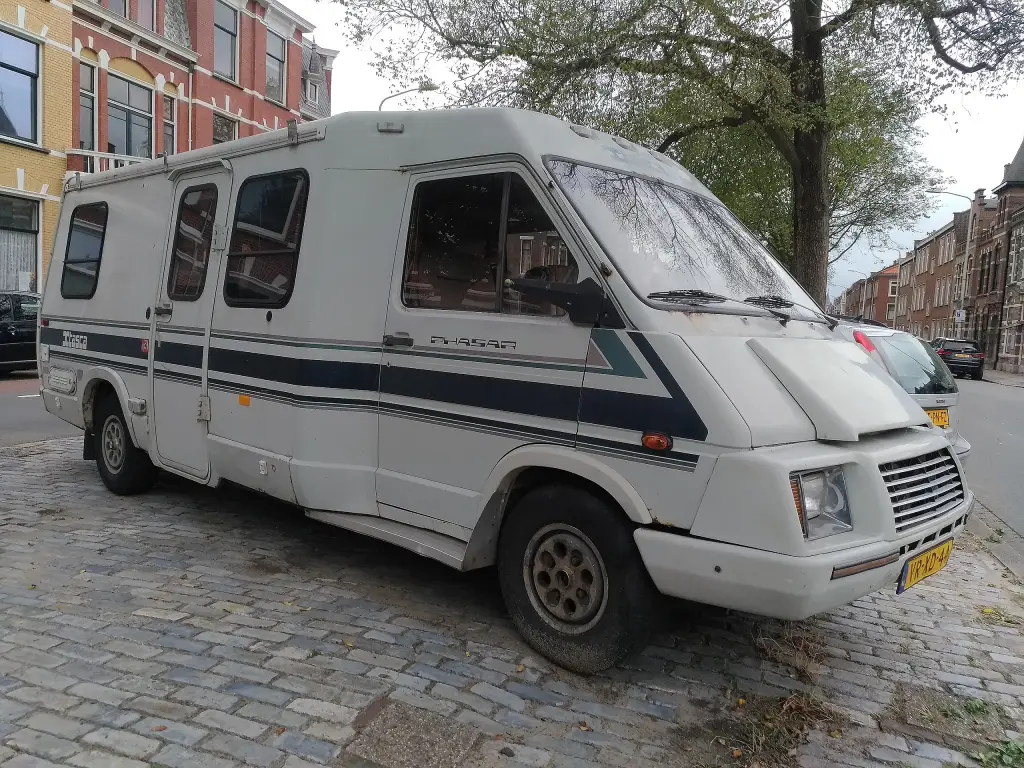

The Winnebago LeSharo was a compact, low-profile motorhome assembled by Winnebago Industries from 1983 to 1992 on the chassis of the Renault Trafic van. Sold alongside the upmarket Itasca Phasar, it was conceived after the fuel crises of the 1970s to offer 16 to 23 mpg at a time when American motorhomes returned 4 to 10. About 21,000 examples were built in Forest City, Iowa, before the Renault supply agreement ended.
Winnebago LeSharo at a glance
| Maker | Winnebago Industries, Forest City, Iowa |
|---|---|
| Also sold as | Itasca Phasar |
| Production | 1983–1992 |
| Class | Class B low-profile motorhome |
| Chassis | Renault Trafic cutaway van |
| Engines | 2.1-litre diesel four; 2.2-litre petrol four |
| Power | 57–103 hp |
| Transmission | 4- or 5-speed manual; 3-speed automatic |
| Fuel economy | 16–23 mpg |
| Height | 97 in (1983); 99 in (1987) |
| GVWR | 5,830 lb (1983); 6,677 lb (1987) |
| Built | about 21,000 |
The article relies on the English and French Wikipedia pages on the LeSharo; the video shows an owner’s example converted to a Chrysler V6, a modification not covered by the sources.
History of the Winnebago LeSharo
A compact motorhome for the fuel crisis
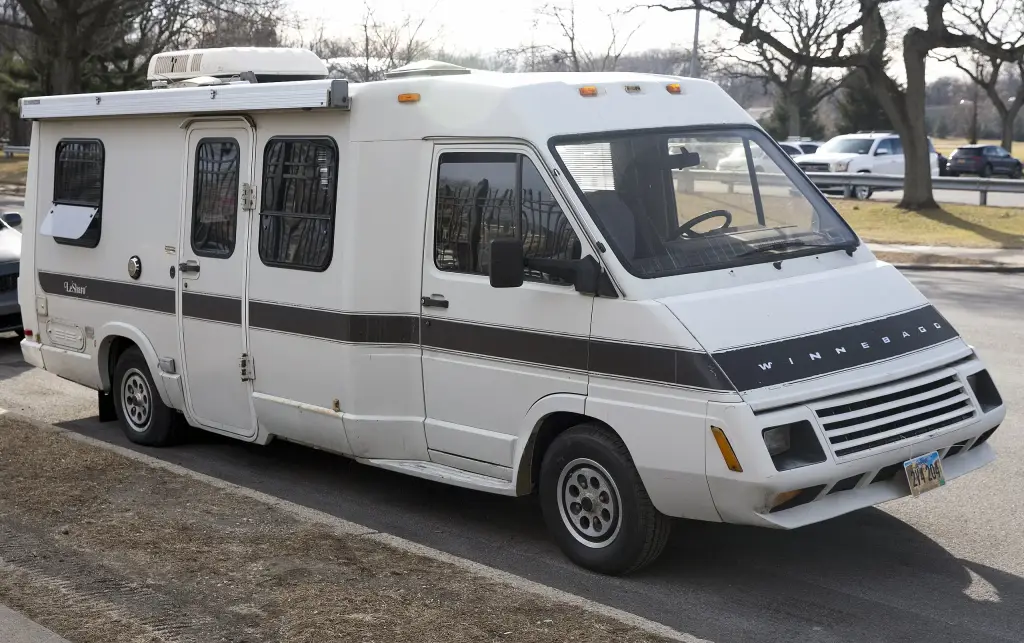
The fuel crises of 1973 and 1979 hit American recreational-vehicle manufacturing hard. Motorhomes built on one-ton van chassis returned only 4 to 10 mpg, and larger vehicles did worse. Winnebago looked for a European light commercial vehicle, preferably with front-wheel drive to maximise living space, as GMC had done with its Motorhome, and reached an agreement with Renault to use the Trafic chassis. The 1983 LeSharo was introduced in August 1982 as Winnebago’s first compact RV; it weighed roughly half as much as a Minnie Winnie on a one-ton cutaway chassis. Renault supplied the Trafic as a chassis cab without rear lighting, and the 20 cm wider rear axle of the Renault Master B80 was adopted to carry the larger body. To play down the Renault origins, the front fascia below the hood was restyled and used headlamps from the Buick Skylark; the side mirrors were repositioned for the wider body.

Engines and equipment
At launch the LeSharo used a 57 hp 2.1-litre naturally aspirated diesel four with a four-speed manual gearbox. A turbocharger raised output to 75 hp in 1984, and the engine was later shared with the Jeep Cherokee and Jeep Comanche, Renault then being the parent company of AMC and Jeep. For 1985 a 2.2-litre petrol engine of 100 hp arrived from the Renault 18i and Fuego, paired with a three-speed automatic; it was 25 per cent more powerful but added over 400 pounds of curb weight. The diesels were dropped for 1986. That year also brought a heavy-duty rear axle, standard for the rest of production, and, to meet US emissions rules, a catalytic converter from Tenneco Walker’s European division and a carbon canister from GM.
The model range
The LeSharo was launched as part of a four-vehicle range. The low-roof LeSharo and the premium Itasca Phasar were recreational vehicles that seated and slept four. A high-roof version was sold as the Winnebago Centauri, a seven-seat conversion van, although it was not produced between 1986 and 1989. Essentially a shell version of the Centauri, the two-seat Winnebago Utility Van was made from 1983 to 1992.
Second generation, 1987–1992
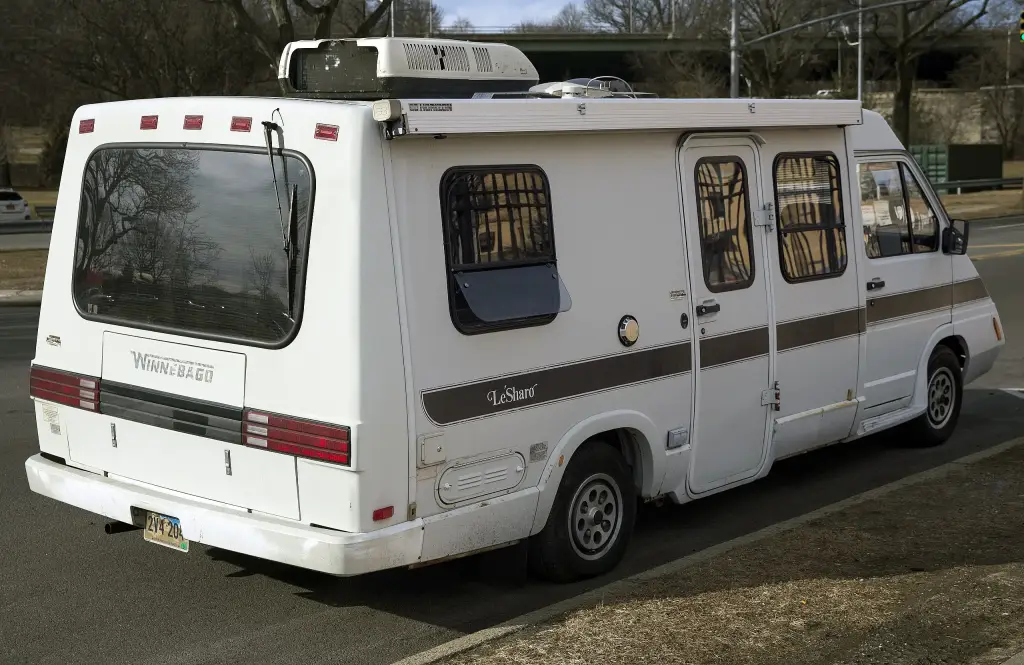
In 1987 the LeSharo, Phasar and Utility Van received their first body redesign. Height grew from 97 to 99 inches, the front became sleeker and the headlamps were recessed and no longer sourced from GM; at the rear a larger window was fitted and the spare tire was enclosed in the bodywork. Gross vehicle weight rose from 5,830 to 6,677 pounds. A five-speed manual became optional with the 2.2-litre engine in 1988. The Utility Van ended in 1989, when the dormant Centauri passenger van returned; output of the 2.2-litre engine changed slightly to 103 hp as Renault switched from Bosch fuel injection to a Bendix-based Renix unit. By 1990 the five-speed was discontinued and all vehicles were built with an automatic. Winnebago ended its chassis agreement with Renault after the 1992 model year, retiring the LeSharo and Phasar, and Renault stopped importing the Trafic to North America.
Successor: the Rialta
Winnebago revived the idea for 1995 with the Rialta, built on a longer-wheelbase version of the Volkswagen EuroVan (T4) chassis. It started with a 110 hp 2.5-litre five, and a 2.8-litre VR6 of 140 hp, later 201 hp, followed for 1996. Volkswagen stopped importing the T4 after 2003, but Winnebago kept assembling Rialtas until 2005, when its stock of chassis cabs ran out. In 1999 the parts and product-support rights for the LeSharo and its variants were sold to a specialist company.
Design and features
- Renault Trafic chassis: front-wheel drive and a low floor made the most of the living space.
- Economy: 16–23 mpg and about half the weight of a Class C motorhome on an American chassis.
- Engine choice: naturally aspirated and turbocharged diesels, then a 2.2-litre petrol with automatic.
- Four-model range: LeSharo, Itasca Phasar, Centauri conversion van and Utility Van.
- 1987 redesign: more aerodynamic bodywork, a taller roof and a higher gross weight.

Winnebago LeSharo versions
- LeSharo (1983–1992): the standard low-roof four-berth motorhome.
- Itasca Phasar: the premium version sold through Winnebago’s Itasca division.
- Centauri: a high-roof seven-seat conversion van, absent from the range in 1986–1989.
- Utility Van (1983–1992): a two-seat shell version of the Centauri.
- Rialta (1995–2005): the Volkswagen-based successor to the concept.
The LeSharo was Winnebago’s first compact motorhome and the forerunner of the Rialta. More vehicles from the maker are in the Winnebago collection.
Video: A 1986 Winnebago LeSharo with a Chrysler V6 conversion
Video on YouTube.
Sources
- Winnebago LeSharo, English Wikipedia: history, engines, model range, production
- Winnebago LeSharo, French Wikipedia: dimensions, weight, production total