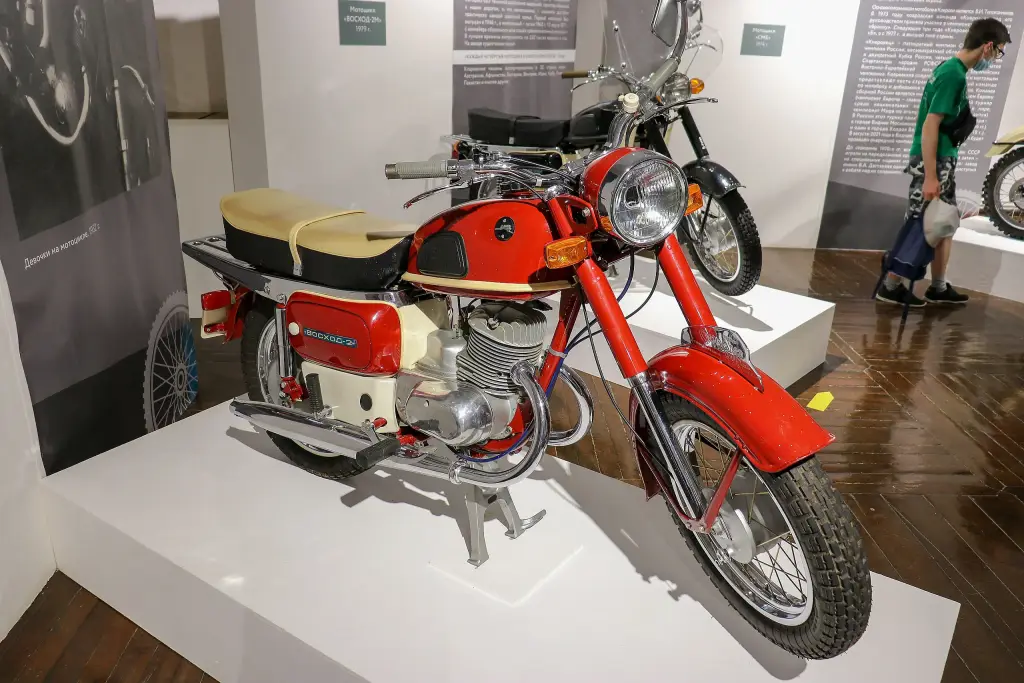

The Voskhod 175 was a family of Soviet 175 cc two-stroke road motorcycles built by the Degtyaryov Plant (ZiD) in Kovrov from 1965 to 1993. It continued the Kovrovets K-175 line and took its name from the Voskhod spacecraft. Over almost three decades the model grew from a 10 hp commuter into a 14 hp machine with electronic ignition and 12-volt electrics.
Voskhod 175 at a glance
| Maker | Degtyaryov Plant (ZiD), Kovrov, USSR |
|---|---|
| Production | 1965–1993 |
| Predecessor | Kovrovets K-175 (1957–1965) |
| Engine | single-cylinder two-stroke, air-cooled, 175 cm³ |
| Bore × stroke | 61.72 × 58 mm |
| Power | 10 hp (1965) to 14 hp (Voskhod-2M) |
| Gearbox | four-speed |
| Top speed | 95–105 km/h |
| Dry weight | 110–125 kg |
| Name | after the Voskhod spacecraft |
Based on one source: the Russian Wikipedia article on the Voskhod. English Wikipedia has no page for the model.
History of the Voskhod 175
The first Voskhod, 1965–1971
The Voskhod appeared in 1965 as the further development of the Kovrovets K-175 series, which had been built from 1957 to 1965. Its single-cylinder two-stroke engine of 175 cm³ used two-channel loop scavenging under the Schnürle patent and drove through a four-speed gearbox. Compared with the K-175V the power rose to 10 hp at 5,200–5,400 rpm and the torque to 14 N·m at 5,100 rpm. Ignition was by contact breaker and the generator was the G-411 type. The bike received a differently shaped fuel tank, a luggage rack and knee shields. Top speed was 95 km/h and dry weight 110 kg.

Voskhod-2 and Voskhod-2M, 1972–1979
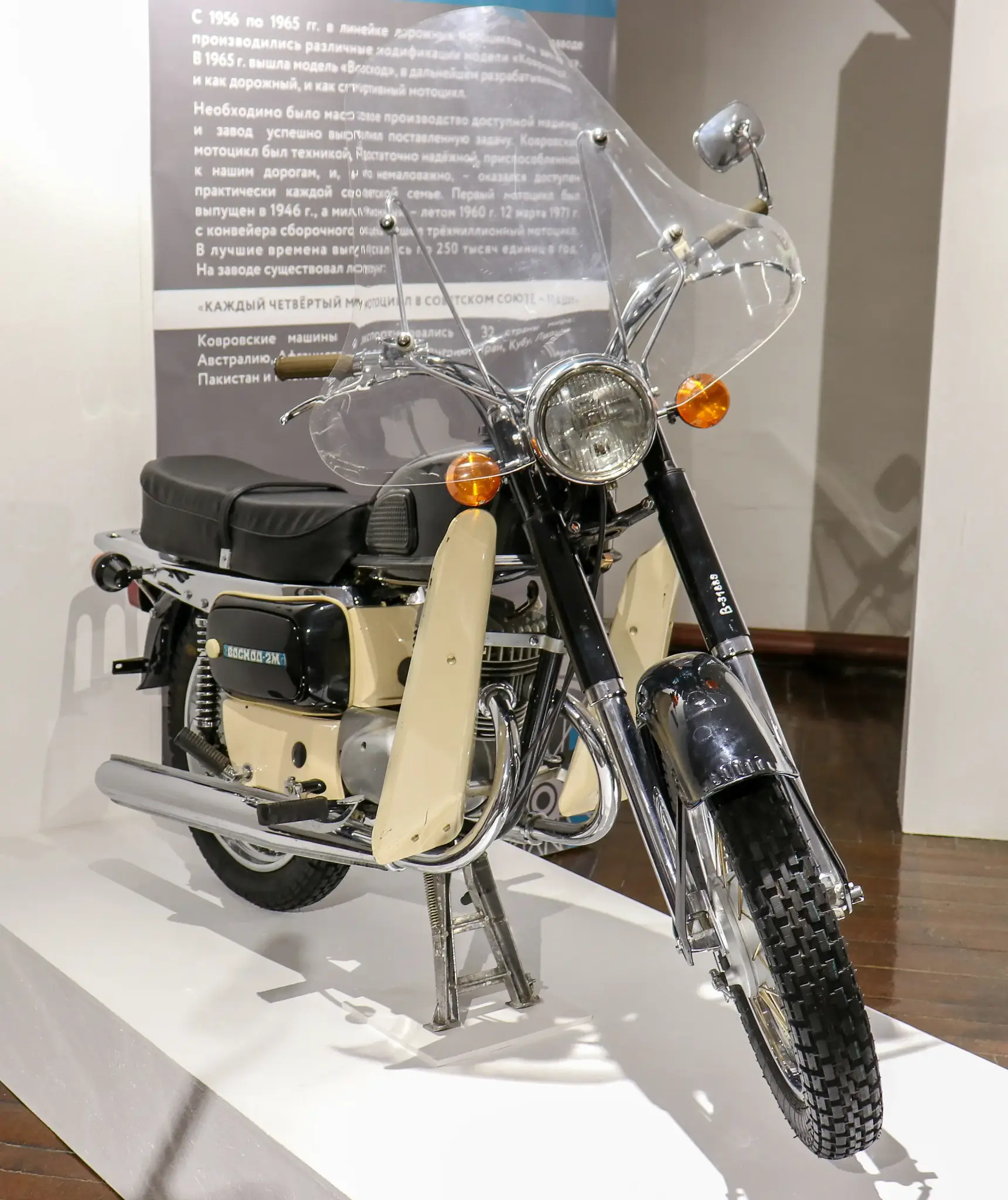
The Voskhod-2 of 1972–1977 was a thorough update aimed at reliability and appearance, modernised again in 1976. It was recognisable by round rather than rectangular indicator lamps, and it brought a new tail light, new mufflers and new instruments. The big change was contactless electronic ignition with the G-427 generator. The gearbox teeth were strengthened and better clutch plates raised the clutch reserve factor to 1.47. Power was 10.5 hp at 5,400 rpm, torque 15 N·m at 5,200 rpm, top speed 95 km/h and dry weight 125 kg. The Voskhod-2M of 1976–1979 kept the 173.7 cm³ displacement but lifted output to 14 hp at 5,500–5,800 rpm and torque to 16 N·m by reshaping the ports in the crankcase and cylinder and fitting a new cylinder head with a compression ratio of 9.2. It used a K-62V carburettor, lost the decompressor and moved the spark plug to the centre of the combustion chamber. Ignition was the G-427 generator with a KET-1 unit. The engine was designed for AI-93 petrol but could run on A-76. The fork tubes were made larger in diameter and travel grew by 20 mm to 160 mm. Top speed was 105 km/h and dry weight 121 kg.
Voskhod-3 and Voskhod-3M, 1979–1993
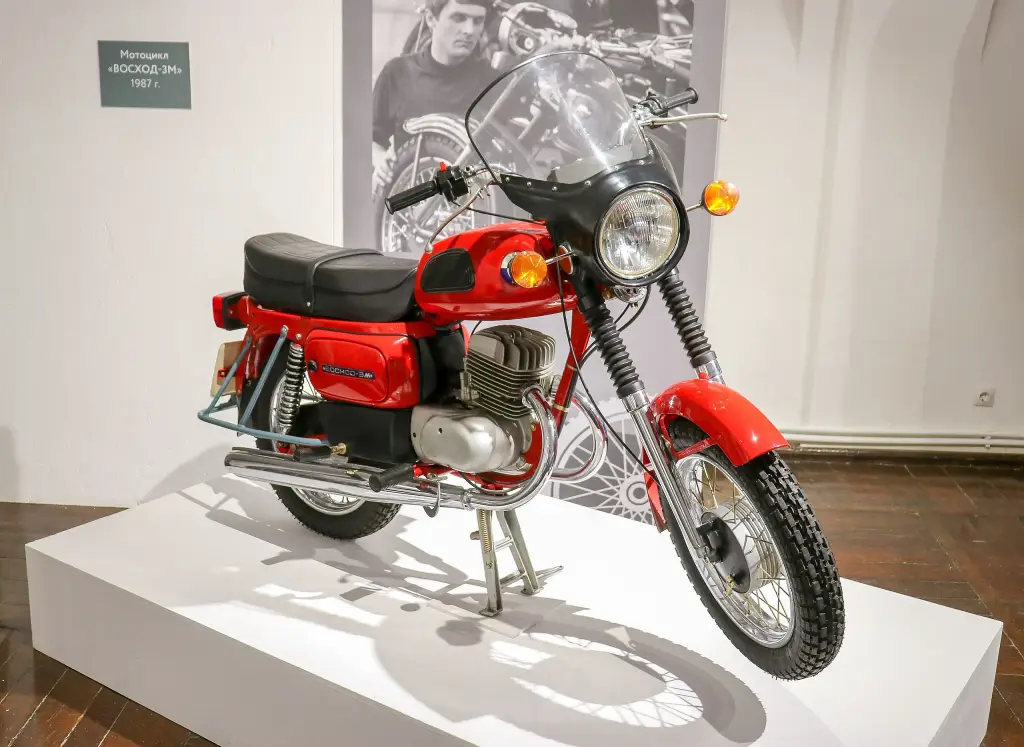
The Voskhod-3 of 1979–1983 carried a tank holding two litres more, rear shock absorbers with adjustment and greater energy capacity, set at 12 degrees from the vertical and giving 105 mm of wheel travel, with open springs. The drum brakes grew from 125 to 160 mm and gained lining wear indicators, the wheels received stronger spokes, and the bike got a driven-sprocket damper, a new swingarm, a new rear brake mechanism and a new front mudguard. Top speed was 105 km/h, acceleration to 100 km/h took 24 seconds, and dry weight was 125 kg (130 kg ready to ride). The Voskhod-3M of 1983–1993 was a substantial modernisation: a larger cooling jacket, an external instrument panel instead of the speedometer and warning lamps inside the headlamp shell, and a new tank of the same volume. From 1988 the plate under the seat was shortened and painted in the body colour, and the aluminium instrument panel gave way to plastic. Some engines were fitted with Czechoslovak carburettors. The 3M had 12-volt electrics, an FG-137B headlamp with a European-beam lens, a new tail light with side reflectors and a plastic instrument block above the headlamp with the ignition lock, speedometer and warning lamps for the indicators and main beam. It also had an anti-theft lock, rubber gaiters on the front dampers, brake lining wear indicators on both wheels, a new profiled front mudguard, a folding kickstart pedal, folding rider footrests and two mirrors. The factory warranty was 20 months. Top speed was 105 km/h and dry weight 122 kg. Voskhod-3M Lux versions had better paint and plating work and rubber dust covers on the fork seals instead of gaiters, with a chrome fixed fork tube and an “L” after the badge lettering. A tricycle, the Voskhod-3M Krokha, was built on the same model with a 200 kg payload, 80 km/h top speed and a rear axle borrowed from the Ant scooter.
Design and features
- Schnürle loop scavenging: two-channel loop scavenging from the first 1965 model.
- Electronic ignition: the G-427 contactless system on the Voskhod-2 and the KET-1 unit on the 2M.
- Larger brakes: drum brakes grew from 125 to 160 mm on the Voskhod-3, with lining wear indicators.
- 12-volt electrics: the Voskhod-3M moved to 12 volts and an external instrument panel above the headlamp.

Voskhod 175 versions
- Voskhod (1965–1971): the original 10 hp model with contact ignition.
- Voskhod-2 (1972–1977): round indicator lamps, new instruments and electronic ignition.
- Voskhod-2M (1976–1979): 14 hp engine with a new head and K-62V carburettor.
- Voskhod-3 (1979–1983): larger tank, 160 mm brakes and adjustable rear shocks.
- Voskhod-3M (1983–1993): 12-volt electrics, external instrument panel and anti-theft lock; Lux versions with better finish.
- Voskhod-3M Krokha: a tricycle with a 200 kg payload built on the 3M.
All Voskhod models are collected in the Voskhod category.
Sources
- Восход (мотоцикл), Russian Wikipedia: models, engines, equipment, production years