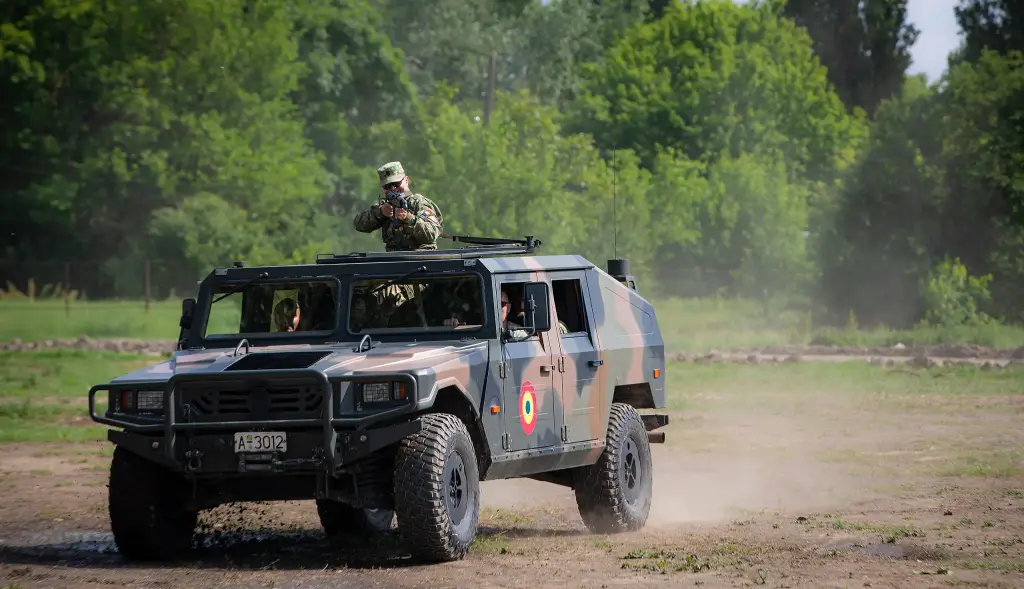

The URO VAMTAC (Vehículo de Alta Movilidad Táctico, “High Mobility Tactical Vehicle”) is a Spanish four-wheel-drive military vehicle manufactured by UROVESA in Santiago de Compostela. Built to requirements close to those of the American Humvee, it has become the standard light vehicle of the Spanish armed forces and is used by more than 20 countries.
URO VAMTAC at a glance
| Maker | UROVESA (URO, Vehículos Especiales S.A.), Santiago de Compostela |
|---|---|
| Production | from 1998 |
| Class | four-wheel-drive military tactical vehicle |
| Main models | I3, S3, ST5 |
| Engine | Steyr Motors M16 six-cylinder turbocharged diesel |
| Power | 135 kW (181 hp); 166 PS in the I3, 188 PS in the S3 |
| Transmission | five-speed automatic |
| Length / width / height | 4.845 m / 2.175 m / 1.9 m |
| Curb weight | 3,000–3,500 kg |
| Payload | 1,500–2,000 kg |
| Range | over 600 km |
| Gradients | 70% climb, 50% side slope |
History of the URO VAMTAC
Origins and the Spanish contract
The Spanish army began considering its own multirole vehicle to replace its Land Rovers soon after the HMMWV entered production in 1984, and the American design was a natural candidate. The VAMTAC concept did not take shape until 1995, when a competition was held for a next-generation tactical vehicle. UROVESA chose to design a vehicle that could exceed the American specification. After testing by the Spanish Ministry of Defence the company received a five-year contract, and the URO VAMTAC was produced from 1998 to 2003.
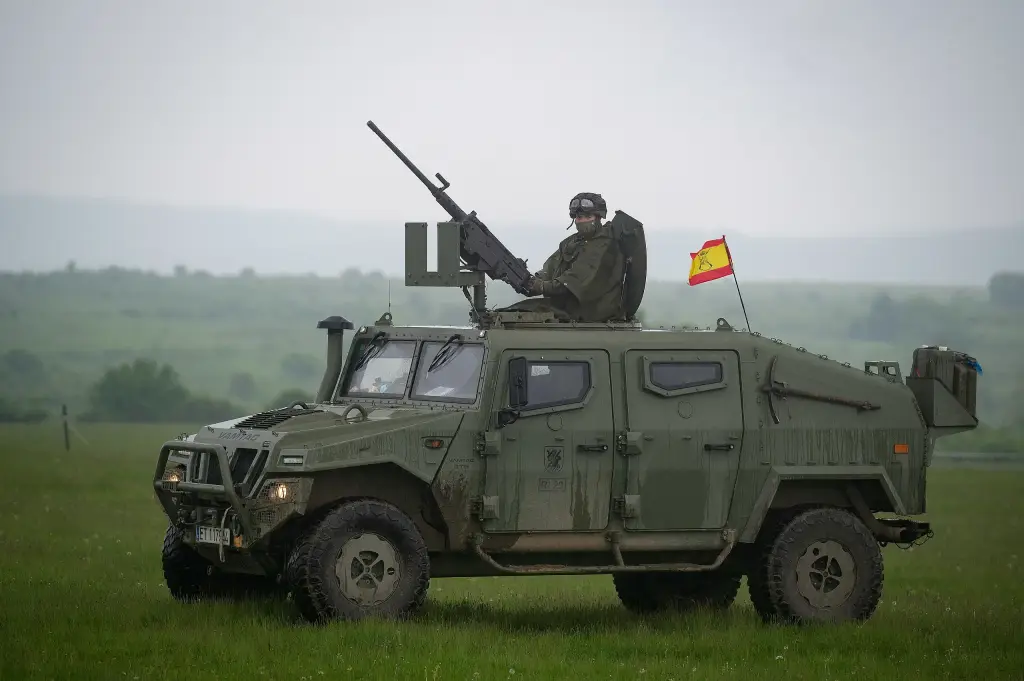

Second contract and the I3 and S3
In October 2005, after a three-month trial, the Ministry of Defence awarded a new five-year contract. The two models previously known as T3 and T5 were re-designated I3 and S3. About 1,200 vehicles were delivered under the first contract, roughly 60 percent of them T5 (later S3), and around 900 more under the second, all of the S3 type, bringing the Spanish total to some 2,100.
Service and later development
In April 2013 the VAMTAC was selected as the vehicle for all branches of the Spanish armed forces, with 772 to be acquired over five years, replacing the HMMWVs of the Spanish Marines. The type has served in Afghanistan, Congo and Lebanon, and the Spanish National Police has used it as well. In 2020 a further purchase of up to 663 vehicles was announced. A 2017 estimate put about 4,500 vehicles in service in more than 20 countries and some 50 configurations.
Design and features
- Four-wheel drive: permanent all-wheel traction with high ground clearance for very rough terrain at full load.
- Three body families: command and control with a four-door cab, chassis-cab and pick-up, the last two with a choice of two-door, four-door or short rear-door cabs.
- Weapon mounts: the rear compartment can take machine guns, grenade launchers, anti-tank missiles, 81 mm mortars, M40 recoilless rifles and light air-defence missiles.
- Armour kits: about a quarter of the first-contract Spanish vehicles received ballistic protection, and the later armoured S3 adds a modular survival cell with mine and IED protection.
- Mobility: a range of more than 600 km and the ability to climb 70% gradients and cross 50% side slopes.

URO VAMTAC versions
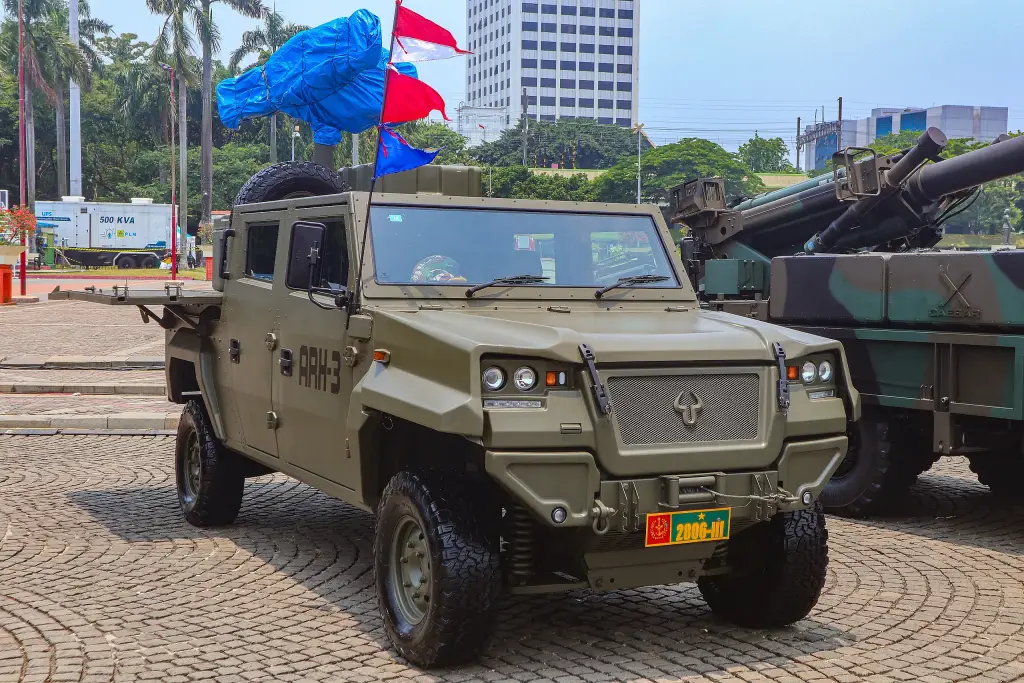
- Rebeco (1998–2003): the first series version.
- I3 (2004–2010): originally the T3, with a 166 PS engine.
- S3 (2004–2010): originally the T5, with a 188 PS engine; also built as the S3 Armoured.
- ST5 (from 2013): the current model, with greater payload and more scope for equipment and armour.
- ST5 BN3 (from 2015): STANAG level 3 armour.
- SK95 and LTV: a light artillery tractor on the ST5 chassis (from 2018) and a Light Tactical Vehicle.
More military and civilian vehicles are in the URO collection.
Video: VAMTAC PERFORMANCE
Video on YouTube.
Sources
- URO VAMTAC, English Wikipedia: development, contracts, dimensions, versions
- URO VAMTAC, Spanish Wikipedia: Spanish orders, armoured S3, operators