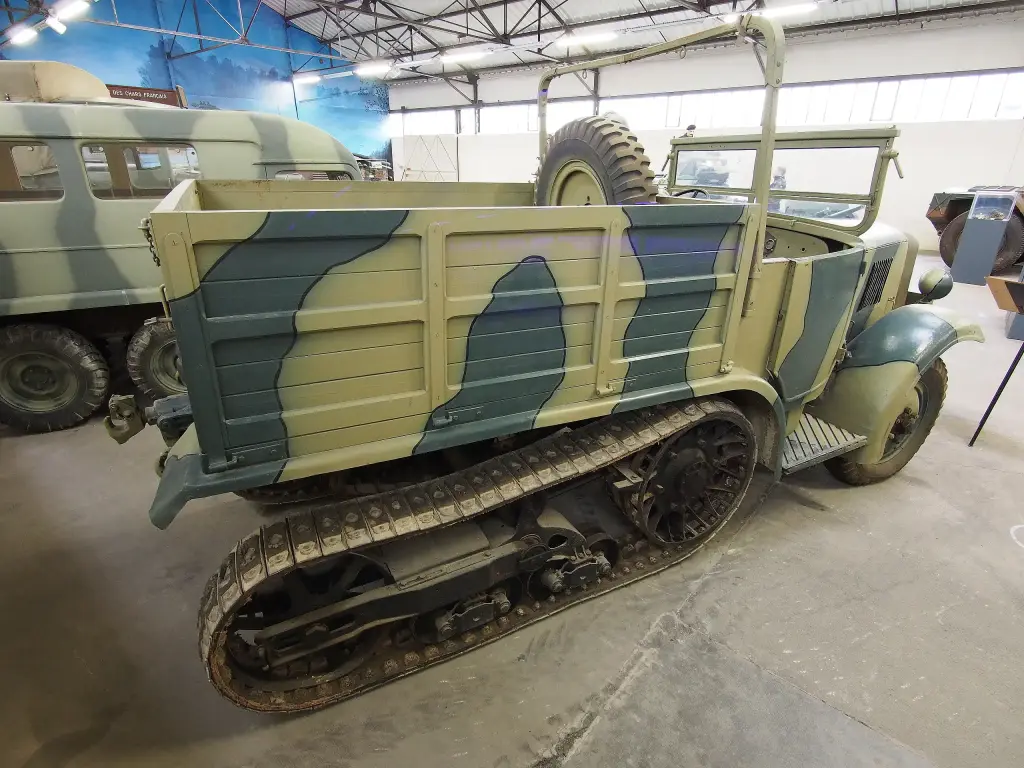
The Unic P107 was a French half-track of the late 1930s, developed by Citroën from the Kégresse patents and taken into production by Unic after Citroën’s bankruptcy. It was the standard prime mover of the French field artillery in 1940 and, in captured form, served the Wehrmacht throughout the Second World War.
Unic P107 at a glance
| Maker | Unic, Puteaux, under Citroën Kégresse licence |
|---|---|
| Production | 1937–1940 |
| Predecessor | Citroën-Kégresse P17 |
| Designed | 1935 by Citroën; production taken over by Unic |
| Engine | Citroën P39, 3,454 cc four-cylinder, 60 hp |
| Transmission | four-speed gearbox with a two-speed reduction unit |
| Maximum speed | 46 km/h |
| Running gear | Kégresse half-track, front drive pulley |
| French versions | artillery tractor, engineer platform, telephone vehicle |
| Built | 3,276 according to French Wikipedia; 1,274 before the war plus 1,896 by June 1940 in the English article |
| Users | France, Germany (captured vehicles), Poland (order of 1939) |
The two Wikipedia articles give different production totals (3,276 in French, 1,274 plus 1,896 in English); both figures are shown in the table.
History of the Unic P107
In the 1920s and 1930s Citroën built a long line of half-tracks using the Kégresse patent. In 1934 the company introduced the P107 as the successor to the Citroën-Kégresse P17, with a more powerful engine. Before series production could begin Citroën went bankrupt; its new owner, Michelin, chose to concentrate on the civilian market. Unic then bought a licence for the Kégresse patent and took over production of the P107. From 1937 the vehicles built by Unic received their own designations, including P 107 B, P 107 BU and P 107 U1.
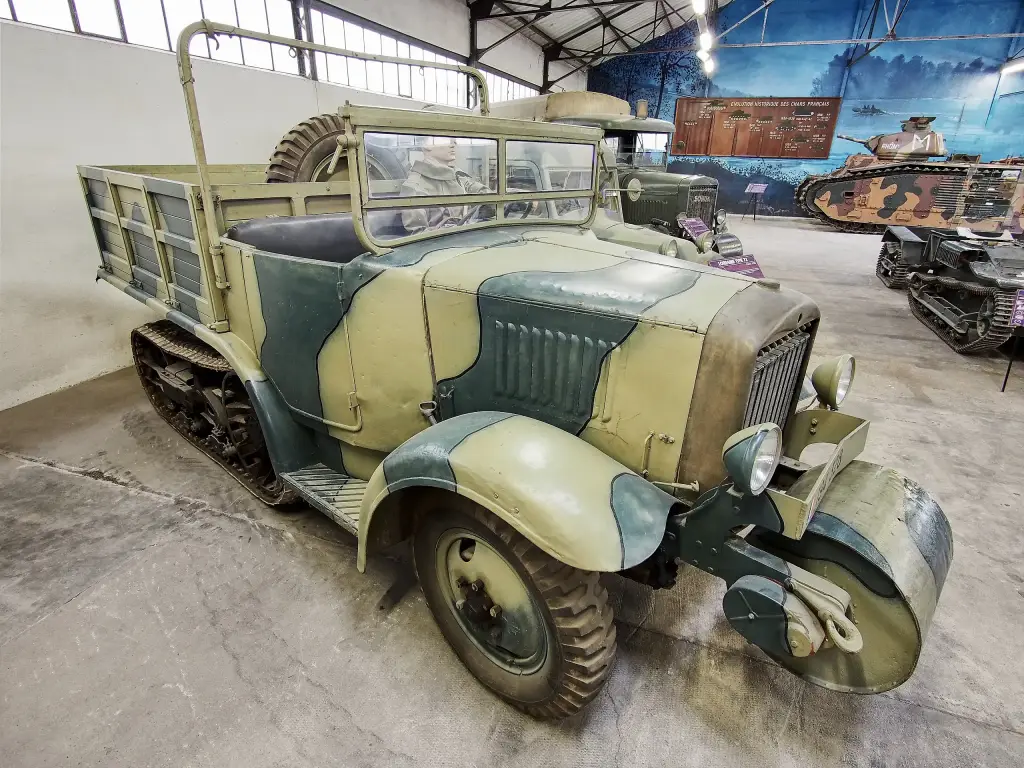
The French army adopted the type in 1936 as the replacement for the P17. The first order had been placed in 1935. Two main versions entered military service: a light prime mover for the 75 mm gun, the short 105 mm Bourges and the short 105 mm Schneider, and a platform cargo vehicle for engineer units. A third version was delivered to transmission units. The French Wikipedia article gives a production total of 3,276 vehicles between 1937 and 1940; the English article counts 1,274 delivered before the war and another 1,896 up to June 1940.
The P107 was powered by the Citroën P39, a four-cylinder engine of 3,454 cc developing 60 hp, coupled to a four-speed gearbox and a two-speed reduction unit at the gearbox output. Maximum speed was 46 km/h. The drive was of the positive type, with the driving pulley at the front of the track system. Of the engineer version, 60 vehicles were built; some were converted into telephone vehicles with a cable layer installed at the rear.
Poland ordered 60 P107s on 27 August 1939, but on 22 September, while the vehicles were on their way, the order was cancelled and they were recalled to France. After the fall of France the Germans used captured half-tracks extensively under the designation leichter Zugkraftwagen 37 U304(f), mainly to tow anti-tank guns. With German half-tracks in short supply, Major Alfred Becker of the 21. Panzerdivision, stationed near Caen in 1944, had captured Unic vehicles converted into light armoured personnel carriers.
Design and features
- Kégresse running gear: a flexible track with a front driving pulley, developed from Citroën’s pre-war half-track system.
- Artillery tractor: designed to move the 75 mm and short 105 mm guns of the French field artillery.
- Engineer equipment: a platform cargo body and a telephone version with a cable layer.
- German conversions: mortar carrier, command vehicle, ambulance, 37 mm self-propelled anti-tank gun and 2 cm anti-aircraft mount.
Unic P107 versions
- P 107 B, P 107 BU, P 107 U1: Unic designations used from 1937.
- Artillery tractor: the main French version, for 75 mm and short 105 mm guns.
- Engineer platform: cargo body for engineer units, 60 built.
- Telephone vehicle: engineer chassis with a cable layer at the rear.
- Leichter Zugkraftwagen 37 U304(f): German designation for captured vehicles used as gun tractors.
- Leichter Schützenpanzerwagen U304(f): Becker’s armoured personnel carrier conversion, with mortar, command, ambulance, anti-tank and anti-aircraft variants.
The P107 was the best-known military vehicle of Unic; the same factory later built the post-war Izoard trucks, and the Saverne shows how Unic names were used on later Fiat-based models.
Video: Souchez 2005 – Unic P107
Video by Manu-Military on YouTube.
Sources
- P107, English Wikipedia: origins, French versions, production, German use
- Citroën/Unic P107, French Wikipedia: engine, transmission, speed, production total
- Unic (entreprise), French Wikipedia: company background, licence and production