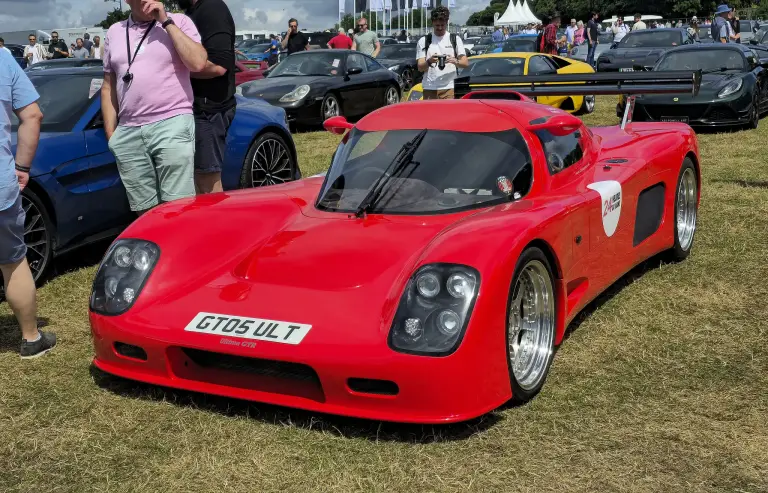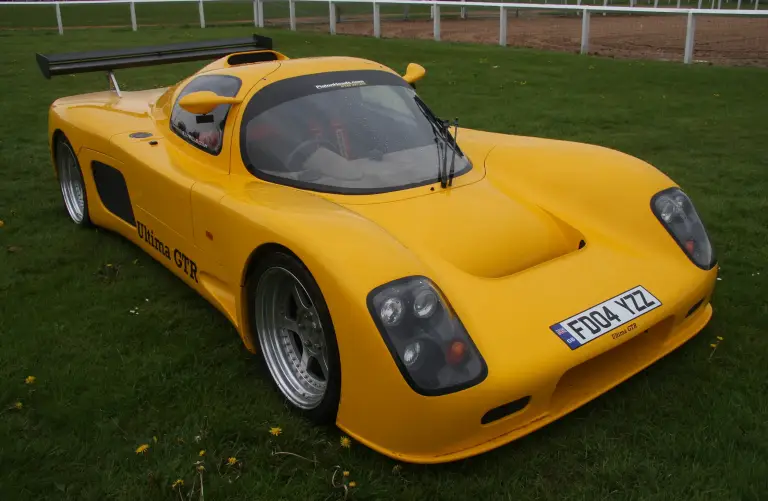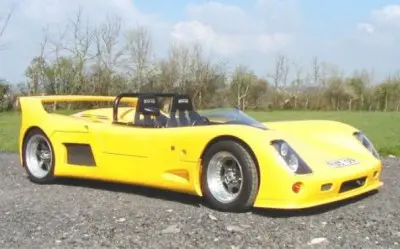
The Ultima Spyder was the roadster version of the Ultima Sport, a kit car built by Ultima Sports Ltd in England. Introduced in 1993 and sold until 1998, it combined the Sport’s tubular steel space frame and glass-reinforced plastic body with a cut-down windscreen and minimal weather protection.
Ultima Spyder at a glance
| Maker | Ultima Sports Ltd, England |
|---|---|
| Production | 1993–1998 (Sport and Spyder 1992–1998) |
| Layout | mid-engined, rear-wheel drive |
| Chassis | tubular steel space frame |
| Body | GRP, can-am style |
| Windscreen | cut down, minimal protection from the elements |
| Launch engine | 3.5-litre Rover V8 |
| From 1994 | Chevrolet small-block V8 |
| Later turnkey engines | 5.7-litre Chevrolet V8 with 345, 430 or 500 hp |
| Rover V8 output | 230 bhp |
| Renault PRV V6 turbo | 311 bhp, up to 400 bhp with more boost |
| Weight | 850 kg with the standard aluminium body |
| Turnkey cars | first completed in 1993 |
| Succeeded by | Ultima GTR and Ultima Can-Am |
The article is based on one source, the English Wikipedia page on the Ultima Sport; the Spyder redirects to that page, and this article covers the roadster version.
History of the Ultima Spyder
The Ultima Spyder belongs to the Sport generation. The company had built the Mk1 in 1983, the Mk2 in 1984 and the Mk3 in 1989; in 1992 Ted Marlow and Richard Marlow bought the rights to the car and started building a revised model called the Ultima Sport. The Sport, sometimes called the Mk4 in company literature, used a developed version of the Mk3 bodywork with larger headlamp openings holding three lights instead of one. Two earlier Mk3 cars had been used by McLaren when testing the F1: one, chassis number 12 and known as “Albert”, for the gearbox and central seating position, and another, number 13 and known as “Edward”, for the BMW V12 engine and its ancillaries.
The Spyder was new rather than a converted coupe. This roadster variant had a cut-down windscreen and offered minimal protection from the elements. It was introduced in 1993 and first intended as a lower-cost model: Ultima expected buyers to choose the Rover V8 with a Renault transaxle, but customer demand meant that Chevrolet small-block V8s were typically fitted instead. For buyers of fully built-up cars the engine choice was restricted to the 5.7-litre Chevrolet, in three states of tune with 345, 430 or 500 hp. The chassis itself was designed to take as much as 1,000 bhp, although no version left the factory with that much power.
Engines changed quickly in the early years. The Spyder was launched in 1993 as a softer version of the Sport with a 3.5-litre Rover V8, and from 1994 it was fitted with the Chevrolet small-block V8. In 1995 Ultima built a prototype Sport made entirely of carbon fibre, which brought the weight down to 600 kg against 850 kg for the standard aluminium-bodied car; it would have been far too expensive to produce, and carbon fibre was shelved until the Ultima RS. A new engine mount system for rotary engines appeared for 1995 but was unpopular, with fewer than 30 cars made with it. There was no official four-cylinder option, although a Sport prototype used a turbocharged Ford-Cosworth YB from a Darrian T90. The Sport and Spyder were built from 1992 to 1998, and their body styles were significantly altered for the succeeding Ultima GTR and Ultima Can-Am roadster.
Design and features
- Open body: a cut-down windscreen and minimal weather protection, in the can-am style of the period.
- Space frame chassis: a tubular steel frame designed to take engines from four to eight cylinders, or rotaries.
- Engine choice for kit builders: Rover V8, Chevrolet small-block V8, Renault PRV V6 turbo, or no engine at all for customers ordering a bare shell.
- Light weight: 850 kg with the standard aluminium body and a Rover V8; a carbon-fibre prototype reached 600 kg.
- Factory turnkey cars: Ultima began assembling complete cars during this generation, the first being finished in 1993.
Ultima Spyder versions
- Spyder with Rover V8 (1993): the launch version, with a 3.5-litre Rover V8 of 230 bhp.
- Spyder with Chevrolet V8 (from 1994): the small-block engine that most customers chose.
- Turnkey Spyder: factory-built with the 5.7-litre Chevrolet in 345, 430 or 500 hp form.
- Renault PRV V6 turbo: 311 bhp as standard, up to about 400 bhp with higher boost.
- Rotary-engined cars: fewer than 30 built with the 1995 rotary engine mounts.
- Carbon-fibre prototype (1995): a 600 kg Sport that was never put into production.
The Spyder was followed by the Ultima GTR and the GTR-based Can-Am roadster. More cars are in the Ultima collection.
Video: Ultima Spyder spin at Silverstone trackday
Video on YouTube.
Sources
- Ultima Sport, English Wikipedia: history, Spyder, engines, weights