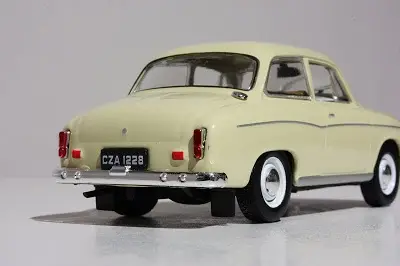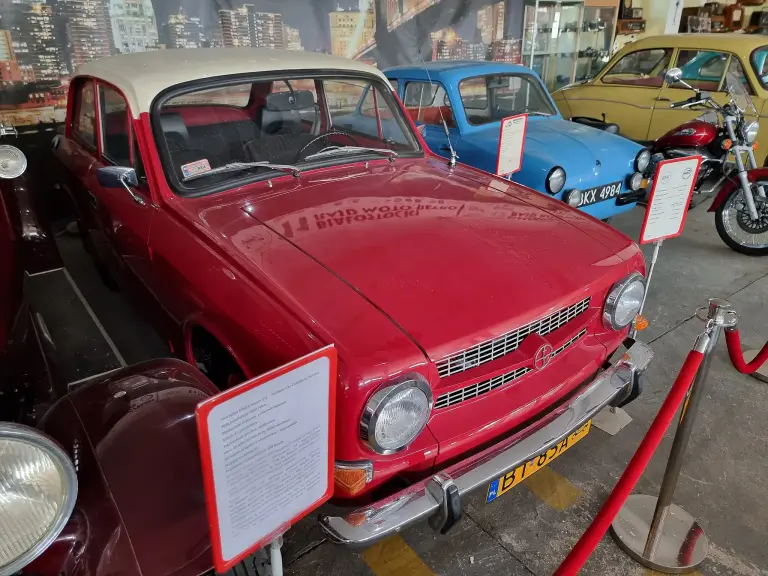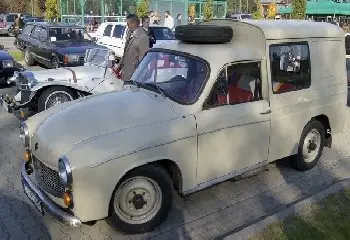
The Syrena Bosto was the panel-van member of the Polish Syrena family, built by FSM in Bielsko-Biała from 1972 until 30 April 1983. Its name is an acronym of Bielski Osobowo-Towarowy, “Passenger-Cargo [car] of Bielsko”, and about 135,000 were built.
FSO Syrena Bosto at a glance
| Maker | FSM (Fabryka Samochodów Małolitrażowych), Bielsko-Biała |
|---|---|
| Production | 1972 – 30 April 1983 |
| Based on | Syrena 104, later the 105 |
| Name | Bielski Osobowo-Towarowy, “Passenger-Cargo [car] of Bielsko” |
| First shown | December 1971, at the new FSM factory in Bielsko-Biała |
| Bosto 104B | in production from 1972 |
| 104B bodies | four-seater van with 200 kg of freight, or two-seater cab with 350 kg |
| Bosto 105B | replaced the 104B in 1976 |
| 105B changes | uprated springs from the FSO Warszawa, larger fuel tank from the FSO 125p, handbrake between the seats |
| Engine | three-cylinder two-stroke, longitudinally ahead of the front axle, front-wheel drive |
| Built | approximately 135,000 |
| Sister model | Syrena R-20 pick-up |
The Bosto has no Wikipedia article of its own; it is covered in a section of the English and Polish articles on the FSO Syrena, which this page follows.
History of the FSO Syrena Bosto
A van from the Syrena
The Bosto and its pick-up sister, the R-20, were first introduced to the 104 models of the Syrena. The first Bosto was revealed in December 1971 at the newly built FSM factory in Bielsko-Biała in southern Poland, and the last one left the line on 30 April 1983. In all, approximately 135,000 Bostos were built.
104B and 105B
The Bosto 104B began official production in 1972. It was offered as a four-seater van able to carry 200 kg of freight, or as a two-seater cab with a 350 kg load rating. The second edition, the Bosto 105B, replaced the 104B in 1976. Stylistically the two were essentially the same vehicle, and the differences were in construction: uprated semi-elliptical springs from the FSO Warszawa, a larger fuel tank borrowed from the FSO 125p, and the handbrake moved to the standard position between the front seats.
The mechanical layout
As in the Syrena saloon, the three-cylinder two-stroke engine was mounted longitudinally in front of the front axle and drove the front wheels through a gearbox with driveshafts coming sideways out of it. That layout, unusual for a van of the period, was carried over unchanged from the passenger car.
Design and features
- Cargo body: a panel van on the Syrena 104 and later 105 chassis.
- Two payload options: a four-seater van with 200 kg of freight or a two-seater cab rated at 350 kg.
- Two editions: the 104B from 1972 and the revised 105B from 1976.
- Saloon mechanicals: the three-cylinder two-stroke engine and front-wheel drive of the Syrena.
FSO Syrena Bosto versions
- Bosto 104B (1972–76): the first production edition, on the 104 base.
- Bosto 105B (1976–83): revised springs, larger fuel tank and repositioned handbrake.
- Syrena R-20: the pick-up version built alongside the van.
The van was derived from the Syrena 104 and later the Syrena 105. Its pick-up sister is described in the article on the Syrena R-20; more cars are in the Syrena collection.
Video: Daniec Syrena Bosto 1
Video on YouTube.
Sources
- FSO Syrena, English Wikipedia: Bosto history, editions, payloads, production total and mechanical layout
- FSO Syrena, Polish Wikipedia: the Syrena family and production in Bielsko-Biała