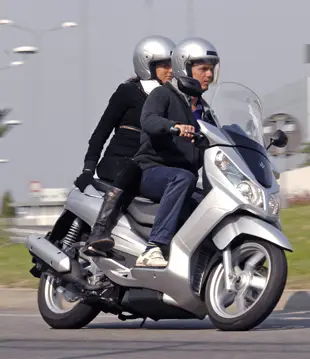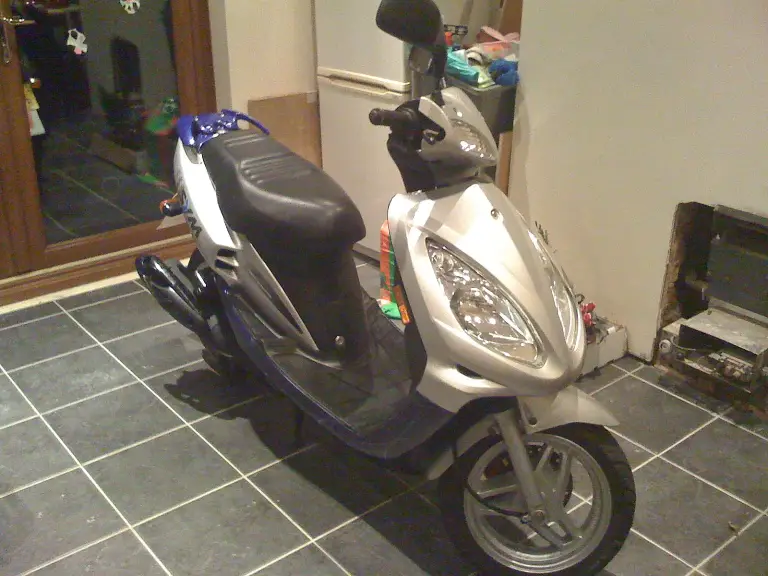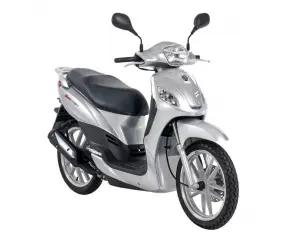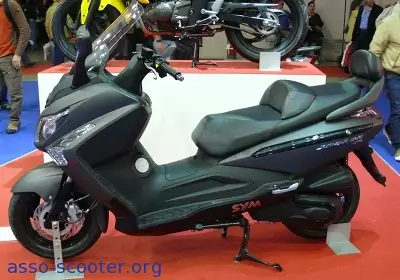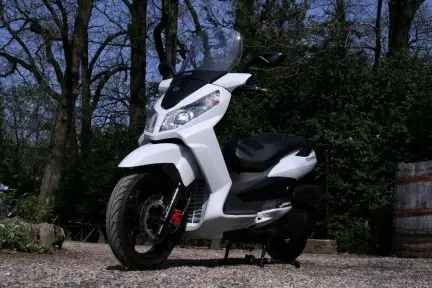
The SYM Joyride is the Taiwanese company’s first compact scooter designed and developed in house for global sale. Shown on the home market in 1999 and sold abroad as the SYM RV from 2000, it has since passed through the Joyride Evo of 2009, the Joyride S of 2016 and a completely new Joyride 300 in 2022.
SYM Joyride at a glance
| Maker | SYM (Sanyang Motor), Taiwan |
|---|---|
| Shown at home | 1999, as the SYM RV |
| European name | Joyride, from 2001 |
| Engines over time | 125 and 150 cc single-cylinder four-strokes; 172 cc (badged 200) from 2002; 278 cc in the 300 |
| First series | 2000–2016 in Asia, Evo from 2009 |
| Evo | 2009, new front shield, 13-inch front wheel |
| S | 2016, LED daytime running lights, ABS on the 200 |
| 300 | 2022, new frame, 16-inch front wheel |
| Length | 2.01 m (first series), 2.11 m (Evo), 2.215 m (300) |
| Seat height | 730 mm, 760 mm on the Evo, 778 mm on the 300 |
| Built under licence | Hyosung Grantus in South Korea |
There is no English Wikipedia article on the Joyride; the page is based on the Italian article on the model and on the English article on the manufacturer.
History of the SYM Joyride
The Joyride was presented on the home market in 1999 and sold from 2000 as the SYM RV. It was the first compact scooter in the 125–150 cc class developed inside the company and intended for export around the world. At 2.01 metres long it had 12-inch wheels, a flat floor and a wide seat for two 730 mm from the ground. The Joyride name was used in Europe and South America, where the model found a modest following, and its styling took cues from the Jet, which was already well regarded in Europe: a large headlight on the front shield with air intakes above it, LCD instrumentation and a backrest for the passenger.
The first range used 125 and 150 cc four-strokes, both Euro 1. The 125 was liquid-cooled and made 11.3 hp, the 150 air-cooled and 13.1 hp, for claimed top speeds of 102 and 110 km/h. From 2001 the Joyride was also sold in Europe as the Laverda Phoenix under a badge-engineering agreement with Laverda, then part of the Aprilia group; the Phoenix differed only in its badges. In August 2002 a 200 version was announced with an engine of exactly 172 cc, derived from the 150 by enlarging the bore to 61 mm: Euro 1, 16.3 hp and 115 km/h, also offered with Laverda badges. The engines were re-homologated to Euro 2 in 2003 and Euro 3 in 2006; the Laverda went in 2005 and the 150 in 2006, when the 125 and 200 gained a 200 mm rear disc and the 200 also gained combined braking.
Joyride Evo (2009)
SYM presented the second series, the Joyride Evo, in 2008 and sold it from 2009, while the classic Joyride continued in Asia until 2016; the production licence then went to Hyosung, which built it in South Korea as the Hyosung Grantus. The Evo was a restyle by Andreani Design with a new front shield, twin headlights and a black V-shaped grille, indicators moved to the outer ends of the lights, and an optional passenger backrest. The mechanics carried over, but the front wheel grew to 13 inches and the rear suspension became a pair of shock absorbers. Length rose to 2.11 metres, the wheelbase to 1,430 mm and the seat to 760 mm, with a weight of 153 kg and 270 mm front and 200 mm rear discs. The 125 made 11.7 hp at 8,500 rpm and 9.9 Nm, the 200 15 hp at 8,000 rpm and 13.24 Nm, both Euro 4.
Joyride S (2016)
The Joyride S was presented at EICMA 2015 and sold from 2016. Changes were small: a new front mask and headlights with LED daytime running lights, the same Euro 4 125 and 200, ABS added on the 200, and black wheels. Output rose to 13.9 hp at 9,000 rpm for the 125 and 17 hp at 8,250 rpm for the 200, with a 273 mm front disc and combined braking on the 125. In November 2019 the engines were homologated to Euro 5, ABS came to the 125 as well and the front disc changed to 240 mm.
Joyride 300 (2022)
The new generation was presented at EICMA 2021 and went on sale in 2022. It is not a restyle but an all-new model, offered only with the 278.3 cc single shared with the Joymax Z+ 300 and sitting beside the Joyride S, which stayed in production. It has a new frame, a 16-inch front wheel (110/70-16, with a 140/70-14 at the rear), a flat floor and a rear rack. At 2.215 metres long it has a 778 mm seat, a 260 mm front and 240 mm rear disc and ABS as standard, with a 30 mm telescopic fork and twin rear shocks. The liquid-cooled four-stroke makes 26 hp at 8,000 rpm and 26 Nm at 6,000 rpm; the styling follows the family look introduced by the Maxsym TL, with LED lights, a colour digital dashboard, keyless starting and a USB 2.0 socket.
Design and features
- In-house design: the first SYM scooter developed at home for sale worldwide.
- Flat floor: kept through every generation, from the 2000 RV to the 2022 Joyride 300.
- Badge-engineered twin: sold in Europe as the Laverda Phoenix, and later built by Hyosung as the Grantus.
- Growing wheels: 12 inches at first, 13 on the Evo, 16 at the front of the 300.
SYM Joyride versions
- Joyride / SYM RV (2000–2016): the original series, 125, 150 and 172 cc.
- Laverda Phoenix (2001–2005): the same scooter with Laverda badges.
- Joyride Evo (2009): restyled by Andreani Design, 13-inch front wheel.
- Joyride S (2016): LED daytime lights and ABS on the 200.
- Joyride 300 (2022): all-new model with a 278 cc engine and 16-inch front wheel.
The Joyride sits below the flagship Maxsym in the range, and its styling owed a debt to the smaller Jet. More scooters are in the SYM collection.
Video: SYM Joyride EVO 2013 top speed acceleration
Video by Peter Trnovsky on YouTube.
Sources
- SYM Joyride, Italian Wikipedia: all generations, engines, dimensions
- Sanyang Motor, English Wikipedia: company history, model list