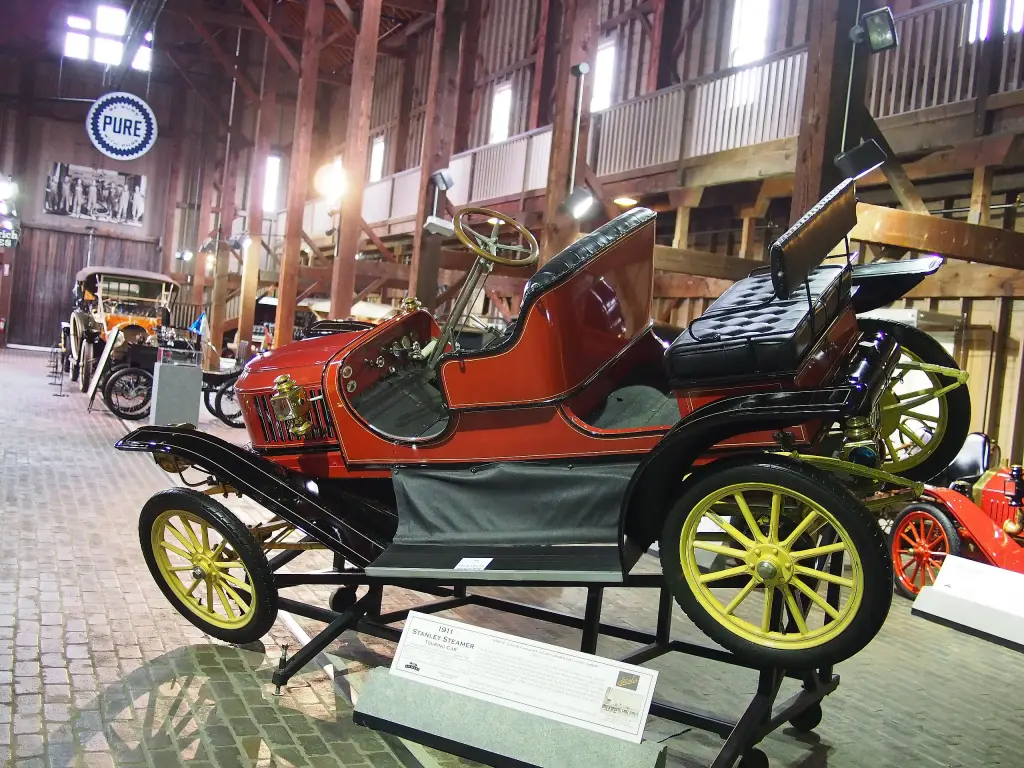

The Stanley Steamer was the popular name for the steam cars built by the Stanley Motor Carriage Company, an American manufacturer that operated from 1902 to 1924. The twin brothers Francis E. and Freelan O. Stanley had built their first car in 1897 and sold more than 200 cars in 1898 and 1899, more than any other American maker. Their cars were quick and simple to drive for their time, but they could not compete with the rapidly improving internal combustion engine.
Stanley Steamer at a glance
| Maker | Stanley Motor Carriage Company, United States |
|---|---|
| Production | 1902–1924; first Stanley car built in 1897 |
| Founders | Francis E. Stanley and Freelan O. Stanley |
| Engine | two-cylinder double-acting steam engine, 10 or 20 hp |
| Boiler | vertical fire-tube, fired by gasoline and later kerosene |
| Drive | chain to a rear differential; later geared directly to the rear axle |
| Body | wooden bodies early on, aluminium coachwork later |
| Land speed record | 127 mph (204 km/h) over a mile in 1906, in 28.2 seconds |
| Peak production | 519 cars in 1917 |
| Last model | 740D sedan, $3,950 in 1924 |
There is no Wikipedia article on an individual Stanley Steamer model: this page is based on the English Wikipedia article on the Stanley Motor Carriage Company, which describes the cars as a group (one source).
History of the Stanley Steamer
The Stanley twins
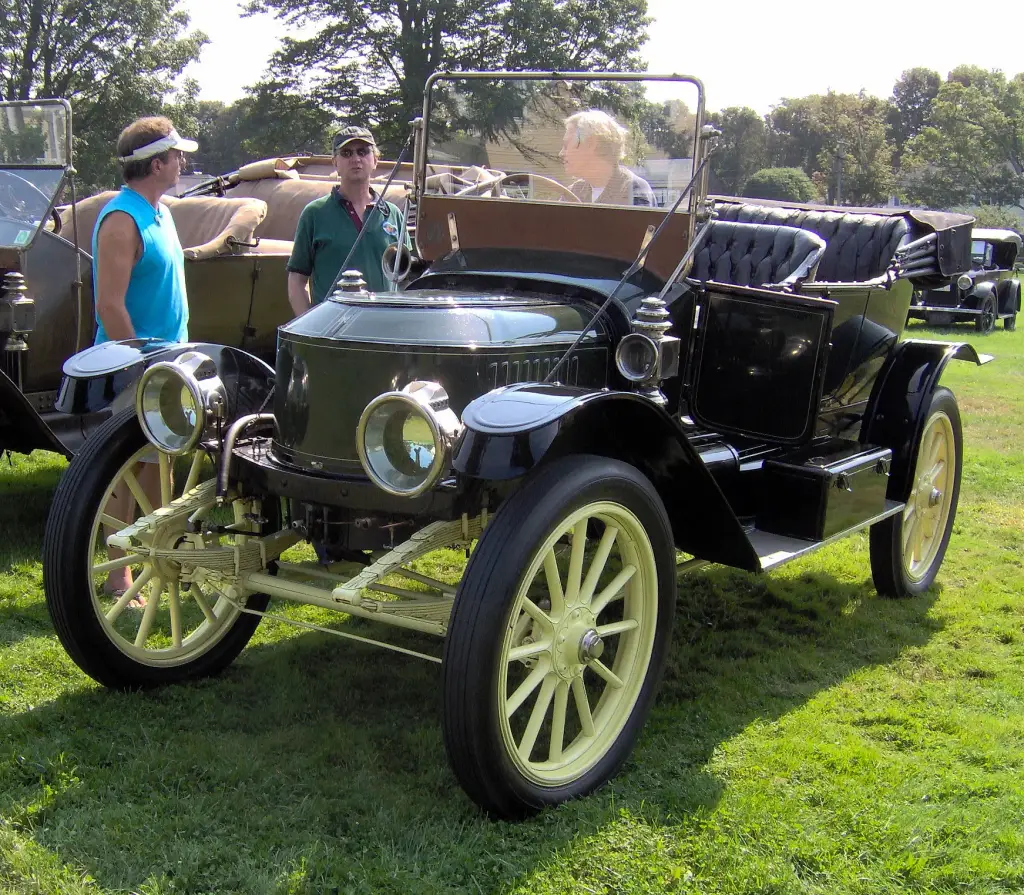

Francis E. Stanley (1849–1918) and Freelan O. Stanley (1849–1940) were twins who founded the company after selling their photographic dry plate business to Eastman Kodak. They made their first car in 1897. During 1898 and 1899 they produced and sold over 200 cars, more than any other American maker. In 1899 Freelan and his wife Flora drove one of their cars to the top of Mount Washington in New Hampshire, 6,288 ft (1,916 m) high, the first car to climb the 7.6-mile carriage road; the ascent took more than two hours.
From Locomobile to the Stanley company
The Stanleys sold the rights to their early design to Locomobile, and in 1902 they formed their own Stanley Motor Carriage Company. To overcome patent difficulties with the design they had sold, they developed a new model with twin-cylinder engines geared directly to the rear axle. Later cars had aluminium coachwork that resembled the internal combustion cars of the time, but they kept steam-car features by having no transmission, clutch or driveshaft, and a fully sprung tubular steel frame. When the boiler was moved to the front of the car, owners dubbed the result the “coffin nose”.
How a Stanley worked
Early Stanley cars had light wooden bodies mounted on wooden “perch poles” with full-elliptic leaf springs. Steam was generated in a vertical fire-tube boiler mounted beneath the seat above a vaporising gasoline, later kerosene, burner. The boiler was reinforced with several layers of piano wire wound around it, which gave a strong but relatively lightweight shell. Early models used copper fire-tubes expanded into the crown sheets; later, condensers caused oil-fouling in the expansion joints and welded steel fire-tubes had to be used. The boilers were safe in practice: they had safety valves, and even if these failed a joint would rupture and relieve the pressure before the shell itself could burst. No Stanley boiler explosion is documented. The engine had two simple-expansion double-acting cylinders side by side with slide valves, and drive went through the crankshaft and a chain to a rear-mounted differential.
Records and decline
A Stanley Steamer set the world record for the fastest mile in an automobile in 1906, covering it in 28.2 seconds at 127 mph (204 km/h). No automobile broke that record until 1911, and the record for steam-powered cars stood until 2009. Production rose to 519 cars in 1917, and the car was nicknamed “The Flying Teapot”. But during the mid to late 1910s the improved fuel efficiency and power of internal combustion engines, together with electric starters instead of cranks, made the more expensive steam car steadily less popular. Francis died in 1918, and Freelan sold his interests to Prescott Warren. No model with more than 20 hp was produced after 1918, and a 1924 Stanley 740D sedan cost $3,950 against less than $500 for a Ford Model T. The company closed in 1924.
Design and features
- No gearbox: the steam engine drove the rear wheels without a transmission, clutch or driveshaft.
- Fire-tube boiler: a vertical boiler under the seat, later moved to the front and known as the “coffin nose”.
- Piano-wire reinforcement: layers of wire wound around the boiler gave strength with little weight.
- Condensers from 1915: added to improve the range between water stops.
- Safety record: safety valves and joint design meant no documented Stanley boiler explosion.
Stanley Steamer versions
- Early wooden-body cars (1897–1902): light bodies on wooden perch poles with full-elliptic springs.
- Twin-cylinder models: engines of 10 hp (7.5 kW) and 20 hp (15 kW), geared directly to the rear axle.
- Coffin-nose models: later cars with the boiler moved to the front and aluminium coachwork.
- Condenser models from 1915: fitted with condensers to recover water and extend range.
- 740D (1924): the final sedan, priced at $3,950.
The Stanley Steamer belongs with the other early American makes in the Stanley collection, where photographs and notes on the cars are gathered.
Sources
- Stanley Motor Carriage Company, English Wikipedia: history, design, records, production