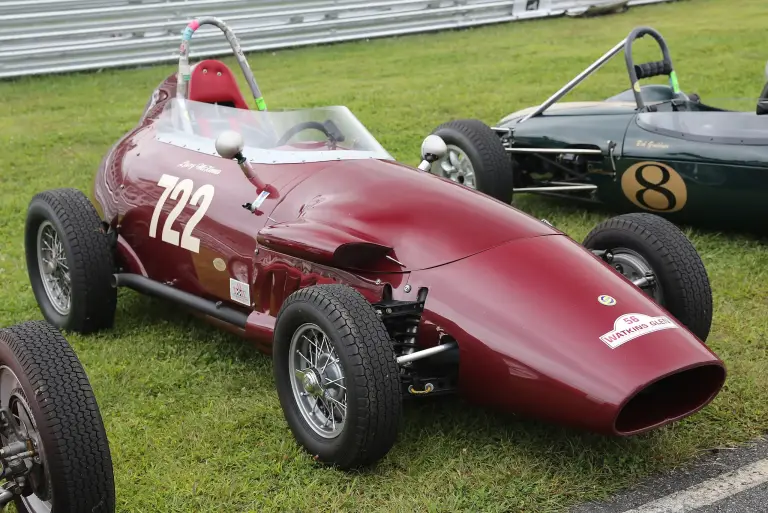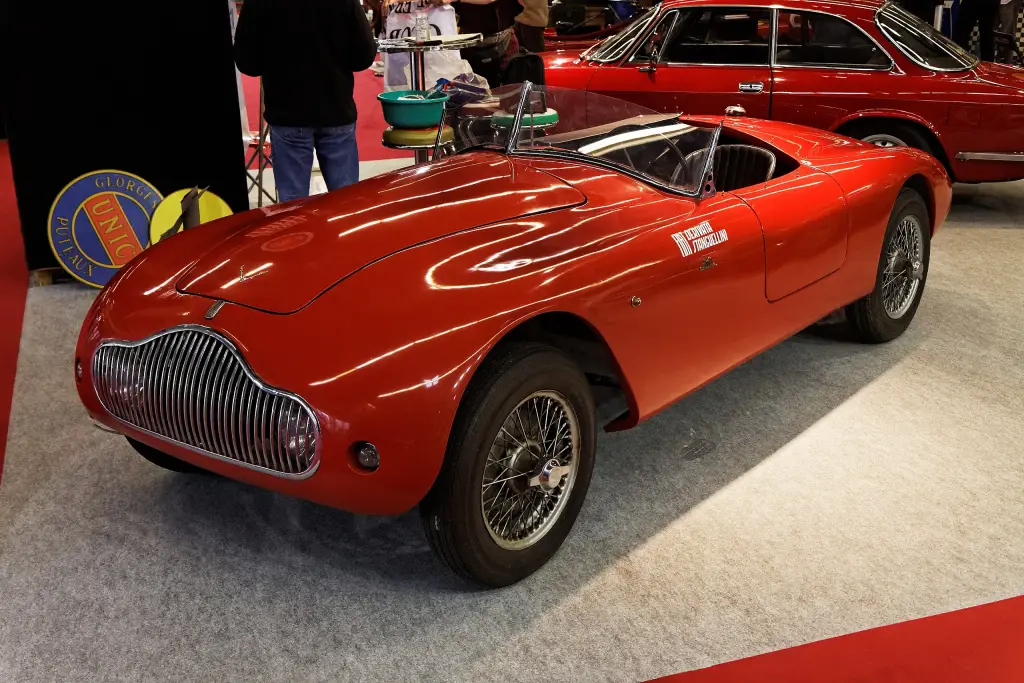
The Stanguellini 1100 was the 1,100 cc side of Vittorio Stanguellini’s Modena workshop, which from 1936 built its own cars on Fiat and Maserati chassis and concentrated on the 750 and 1100 cc racing classes. Using Fiat 1100 blocks with aluminium twin-cam cylinder heads of its own design, Stanguellini extracted about 90 bhp and a top speed of some 190 km/h from the larger engine.
Stanguellini 1100 at a glance
| Maker | Stanguellini, Modena |
|---|---|
| Basis | Fiat 1100 mechanicals |
| Class | sports and racing cars, 750 and 1100 cc classes |
| Cylinder head | aluminium twin overhead camshaft, made by Stanguellini |
| Carburettors | dual side-draught Weber |
| Power | about 90 bhp (70 kW) at 7000 rpm |
| Top speed | about 190 km/h (120 mph) |
| Bodywork | usually by Carrozzeria Reggiano |
| Road version | 1947 Bertone four-seat berlinetta on a tubular chassis |
| Racing highlights | Mille Miglia 1100 cc class win 1940; Sebring class win 1957 |
| At Le Mans | raced in 1957; best finish fourth in class in 1959 |
There is no Wikipedia page for the 1100 itself: the article draws on the English and Italian articles on the marque, which describe the model and its engine.
History of the Stanguellini 1100
From tuning to its own cars
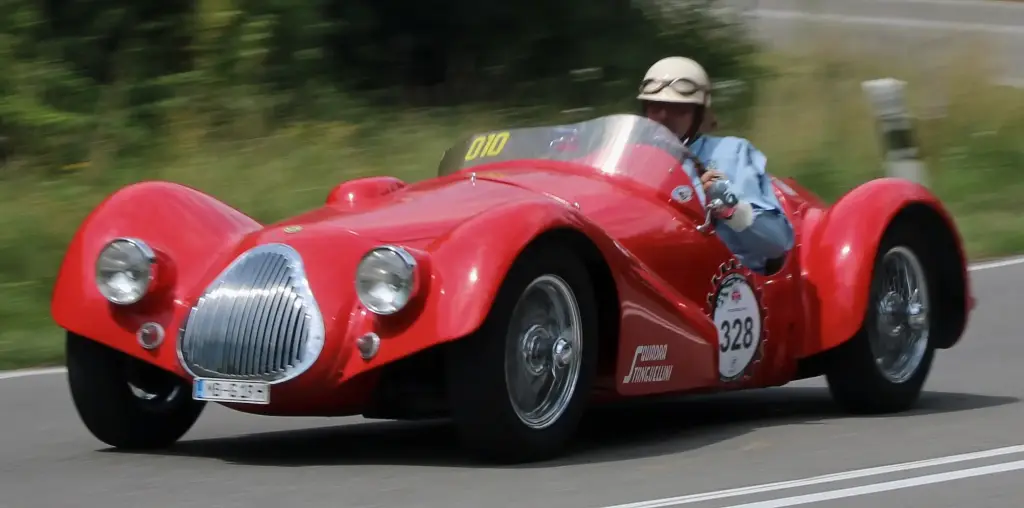
The Stanguellini family had been involved with motor racing since the early years of the century, and by the time Vittorio Stanguellini took over in 1929 the family business included a Fiat dealership. He began tuning and modifying Alfa Romeo, Fiat and Maserati cars for racing, and from 1936 the workshop in Modena produced its own models derived from Fiat and Maserati chassis: the 750, the 1100 and the 2800. Stanguellini had been making special aluminium twin-cam cylinder heads for the Fiat 1100 block since 1947, and the cars were noted for being elegantly engineered, with light-alloy cylinder blocks and dual side-draught Weber carburettors.
The 1100 in competition
The 1100 cc engine produced a claimed 90 bhp at 7000 rpm and gave a top speed of around 190 km/h, while the smaller 741 cc unit was credited with 60 bhp at 7500 rpm and about 180 km/h. Over four decades Stanguellini cars competed in many sports car races, including the 1957 24 Hours of Le Mans, and the team concentrated on the 750 and 1100 cc classes. The 1100 took a class win in the 1940 Mille Miglia, and in 1957 a Stanguellini won its class at the 12 Hours of Sebring with Herman Nehm, Carl Haas and Sandy MacArthur. Stanguellini never won at Le Mans outright because of limited resources; his best result there was a fourth in class in 1959.
Road cars and later use
In 1947 the workshop offered a Bertone-bodied four-seat berlinetta using familiar Fiat 1100 parts in a tubular chassis, also available with a 1,500 cc engine; a Fiat 750-based two-seater followed in 1948. The Fiat 1100 engine remained the backbone of the later single-seaters: it powered the Formula Junior cars from 1958 and was tuned to 95 CV at 7500 rpm for the mid-engined Delfino of 1962. Unlike many of the other small Italian constructors, Stanguellini always refused to use foreign parts, relying on Fiat as much as possible, and the bodywork was usually made by the local Carrozzeria Reggiano.
Design and features
- Stanguellini twin-cam head: an aluminium cylinder head of the workshop’s own design on the Fiat 1100 block.
- About 90 bhp: enough for some 190 km/h in a light sports-racing car.
- Dual Weber carburettors: side-draught carburettors matched to the twin-cam head.
- All-Italian engineering: Fiat components wherever possible, with no foreign parts.
- Local bodywork: coachwork usually by Carrozzeria Reggiano in Modena.
Stanguellini 1100 versions
- 1100 sports-racing car: the works and customer cars of the 750 and 1100 cc classes.
- 1947 Bertone berlinetta: the four-seat road car on a tubular chassis, also with a 1,500 cc engine.
- 1100 S engine: the tuned 1,100 cc unit developed in the workshop in the late 1940s.
- Formula Junior engines: the same Fiat 1100 basis used in the single-seaters from 1958.
The Fiat 1100 engine also powered the Stanguellini Junior Formula Junior car. More models from Modena are in the Stanguellini collection.
Video: stanguellini fiat 1100 sport
Video on YouTube.
Sources
- Automobili Stanguellini, English Wikipedia: engines, power, race results, bodywork
- Stanguellini, Italian Wikipedia: company history and model range