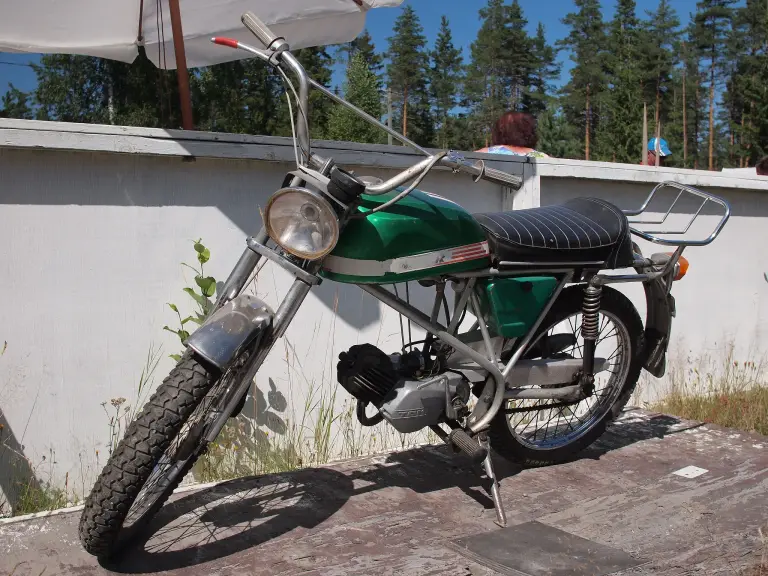
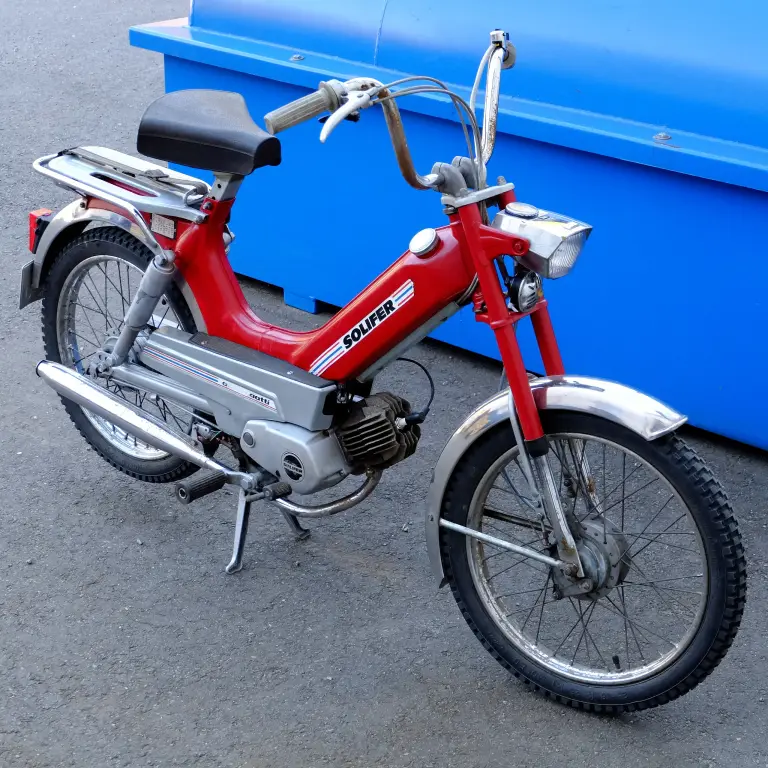
The Solifer Export was a moped of the Finnish Solifer factory, made from 1960 to the early 1970s. It was styled by the designer Richard Lindh and announced with great publicity, but the export success that its name promised never came.
Solifer Export at a glance
| Maker | Solifer, Finland |
|---|---|
| Production | 1960–early 1970s |
| Designer | Richard Lindh |
| Class | moped |
| First engine | Solifer Express by Pluvier, from 1961 |
| Later engines | Tomos under Puch licence, Thermomat |
| Cooling | ram-air, and fan-cooled 1962–64 |
| Gearbox | three-speed in 1964 |
| Export markets | Sweden and England |
| Name reused | for the Export Automat of 1979 |
The Export is described in detail only in the Finnish Wikipedia; the English article covers the company.
History of the Solifer Export
A launch with fanfare
The Solifer Export was presented in Finland on 1 March 1960 after considerable advance publicity. It was designed by Richard Lindh, who worked as a designer at the Arabia ceramics factory, and its name was announced by Aarne Silander, the importer of Suzuki motorcycles and mopeds. During its life the moped won several awards at international exhibitions. It was intended to be an export product and was sold to Sweden and England, but the English export ended after a single batch, apparently because the buyer had payment difficulties, and exports in general stayed far below expectations.
Engines and colours
In 1961 the Export received a new Solifer Express engine built by the Dutch firm Motorenfabriek Pluvier. It had no connection with the earlier Express engine apart from the name, and it soon earned the nickname “hothead” because it tended to overheat and seize. The colour choice was limited at first to blue and red; in 1963 golden brown and a white frame were added, and on white machines the engine covers and front mudguard could be ordered in pastel blue, brick red or dark blue-grey. The last hothead model was a three-speed of 1964, when the Thermomat engine began to replace the Pluvier units.
Tomos and the end of the original Export
From 1962 to 1964 the Export was also built with a fan-cooled engine, a Tomos made in Yugoslavia under licence from the Austrian firm Puch. It looked like a Puch engine but its parts were not interchangeable with it, and although several versions were tried, their quality did not meet Solifer’s requirements; the Tomos was quietly dropped in 1964. The 1962 Tomos-engined Export had painted rims and a luggage rack, and later machines differed only in their engines, the 1964 model already using the Thermomat. In 1971 Tomos returned as the Export engine after Thermomat production ended, now ram-air cooled and of better quality than the earlier M-102 and M-103 fan-cooled types. A brake light was added to the frame in 1973, and there the story of the original Export stopped for several years.
A name reused
In 1979 Solifer presented a completely new model called the Export Automat, which shared little with the original machine apart from the name. In the 2000s the Export name was used again for some moped scooters built in the Far East.
Design and features
- Richard Lindh styling: the Export was designed by a ceramics designer rather than an automotive engineer.
- Export ambitions: the moped was meant for Sweden and England, though sales abroad disappointed.
- The “hothead” engine: the Pluvier-built Solifer Express had a reputation for overheating.
- Several engines: Pluvier, Thermomat and Tomos units were fitted during the model’s life.
- Two cooling systems: ram-air and fan-cooled versions were built side by side in 1962–64.
Solifer Export versions
- Export 1960: the original model with a Pluvier engine from 1961.
- Export 1961–1964: Solifer Express “hothead” engine in blue, red, golden brown or white.
- Fan-cooled Export 1962–1964: Tomos engine made in Yugoslavia under Puch licence.
- Export 1964: three-speed with the Thermomat engine.
- Export 1971–1973: ram-air cooled Tomos, brake light added in 1973.
- Export Automat 1979: a completely different model that reused the name.
The Export was the older stablemate of the Solifer SM, and its automatic successor is covered with the Solifer Automat models. More Finnish mopeds are in the Solifer collection.
Video: Solifer Export vm64 tehari
Video by K-JET DrifT on YouTube.
Sources
- Solifer Export, Finnish Wikipedia: launch, designer, engines, colours, export
- Solifer, Finnish Wikipedia: company history, model list
- Solifer, English Wikipedia: company history, moped production